
By Nicolas Souty, CEO and co-founder at UNRYO INC
Organizations face increasingly complex infrastructure environments. The ability to visualize and understand topology in real-time has become crucial for effective management, troubleshooting, and optimization of IT systems. This article explores the benefits of live topology map visualization and its importance in achieving cross-layer correlation, enabling companies to pinpoint the root cause of issues, quantify their impact on business services and speed-up the incident resolution.
Infrastructure Layers and Topology Discovery
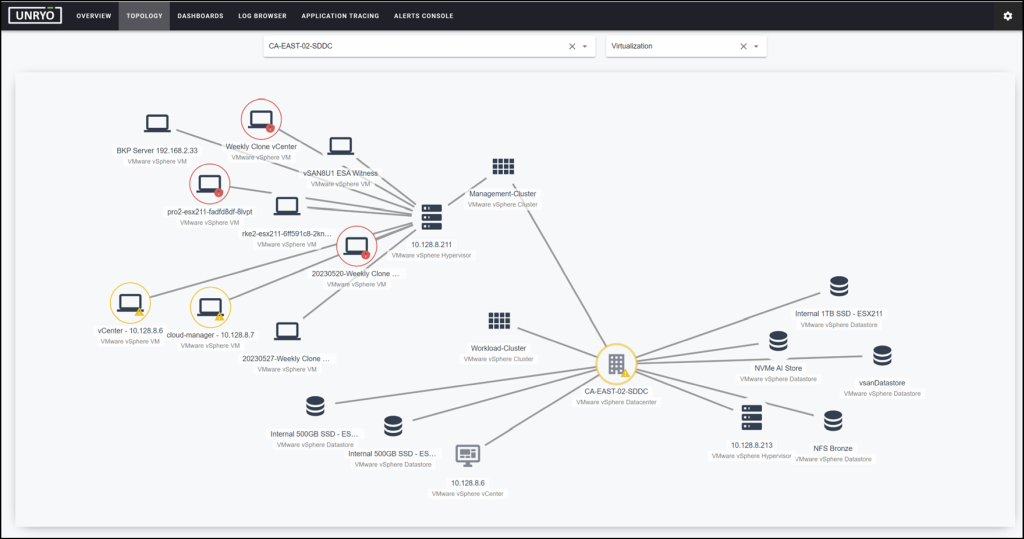
Live topology visualization provides a dynamic, real-time representation of an organization’s IT infrastructure, revealing the intricate connections across all the layers, from physical hardware to virtualization, container orchestration and application, up to the business layer that links infrastructure elements to services and customers. Understanding these layers and their interactions via an integrated interactive topology view offers several key advantages:
- Enhanced visibility: IT teams gain a holistic understanding of the entire infrastructure, allowing them to quickly identify dependencies.
- Improved troubleshooting: Visual representation of the topology enables faster identification of problem areas, reducing issue resolution time.
- Better communication: Topology maps serve as a common reference point for different IT teams, facilitating collaboration and knowledge sharing.
Technical Approaches to Topology Discovery
Topology discovery has undergone a significant shift. Traditionally, monitoring tools relied on active discovery methods to build topology maps. However, these methods have become inadequate in today’s dynamic environments. They rely on periodic network scans, face challenges including latency from set intervals, resource intensity, limited visibility of ephemeral resources, and difficulty adapting to highly dynamic environments like Kubernetes and 5G networks.
In contrast, learning topology from ingested data like metrics and logs offers a superior approach and reflects the true state of the infrastructure in real-time. This method provides real-time accuracy, automatic discovery of new components and reduced overhead. It’s particularly effective for capturing ephemeral resources in dynamic environments like cloud infrastructures or Kubernetes, where containers and services are frequently created, destroyed, or moved. Importantly, it reveals component relationships over time, offering historical context.
A crucial feature is the ability to synchronize and consolidate topology information from existing systems, such as EMS, NMS, Prometheus, Cloud Management platforms and other sources. Those systems expose topology information via APIs, and the topology engine should provide predefined, out-of-the-box support for common data sets. In addition, it must propose an easy way for users to implement a custom logic to interpret the data retrieved from custom sources, allowing for sophisticated relationship mapping.
Cross-Layer Correlation: Bridging the Gap
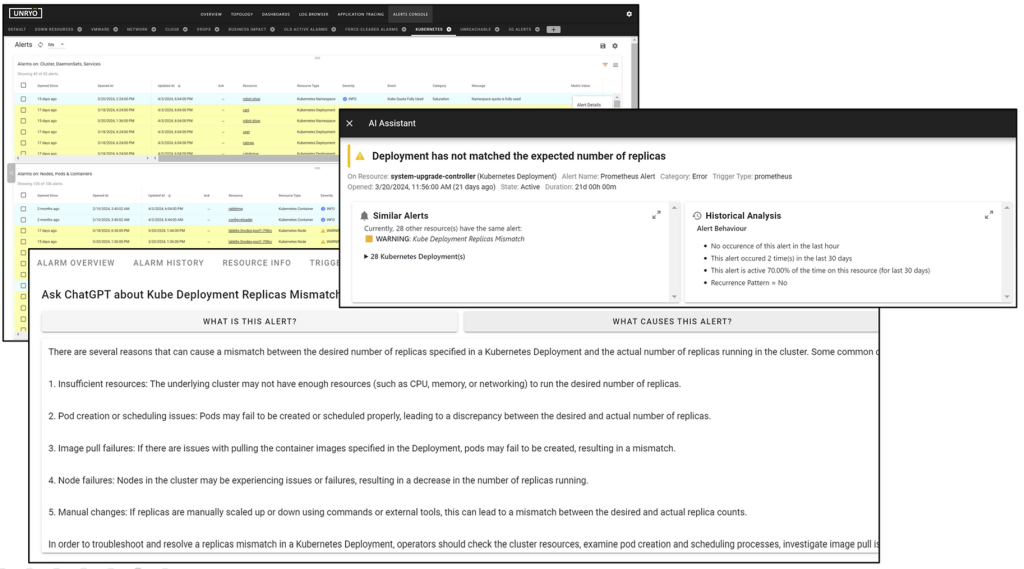
Once a detailed topology map is established, one of the most significant benefits is to enable cross-layer correlation. By correlating data across these layers, companies can:
- Identify root causes: Pinpoint the source of problems by tracing issues across different layers of the infrastructure.
- Reduce mean time to resolution (MTTR): Quickly determine which layer is causing an issue, leading to faster problem resolution.
- Quantify business impact: Assess how infrastructure issues affect business services and prioritize remediation efforts accordingly.
Topology-Based Correlation Techniques
Topology-based correlation techniques utilize the structural relationships to analyze and correlate events effectively. Key advantages include:
- Relationship Mapping: Understanding how components interact allows for intelligent event correlation.
- Root Cause Identification: Dependencies help trace issues back to their source, identifying underlying problems.
- Impact Analysis: Quickly assess how one component’s failure affects dependent systems.
- Noise Reduction: Group related events to minimize alert fatigue for IT teams.
- Context-Aware Correlation: Provides context to distinguish between similar events based on their significance.
- Dynamic Adaptation: Adapts in real-time to changes in the infrastructure.
- Cross-Domain Insights: Correlates events across different layers of the infrastructure.
- Predictive Capabilities: Helps anticipate potential cascading failures or performance issues.
Implementing Topology-Based Correlation
To effectively implement topology-based correlation, organizations should consider these steps:
- Data collection: Implement a robust strategy that gathers information from all relevant sources across the infrastructure.
- Data normalization: Standardize data from diverse sources to ensure consistency for effective correlation.
- Topology modeling: Create a flexible data model that represents complex relationships between infrastructure components.
- Real-time processing: Implement stream processing capabilities for real-time analysis and correlation of data, enabling rapid issue detection.
- Visualization: Develop intuitive visualization tools that allow IT teams to explore the topology interactively.
By embracing live topology visualization and cross-layer correlation techniques, organizations can significantly enhance their ability to manage complex IT infrastructures effectively. This approach enables faster problem resolution, improved performance, and better alignment between IT operations and business objectives. Share your insights with us at [email protected].
Interested in learning more about Unryo and its Observability Platform? Stop by Booth S37 at KubeCon to speak with an expert or see a demo!
To learn more about Kubernetes and the cloud native ecosystem, join us at KubeCon + CloudNativeCon North America, in Salt Lake City, Utah, on November 12-15, 2024.
##
ABOUT THE AUTHOR
Nicolas Souty has over 25 years of experience in monitoring and observability software development. He is the CEO and co-founder of Unryo, a leader in observability solutions. Previously, he co-founded Watch4net, an IT monitoring company acquired in 2012 by EMC.






