Business continuity starts with proactive planning and the right tools. In today’s highly competitive landscape, customer satisfaction goes directly to the revenue and no business can afford such downtimes, especially in contact centers.
Contact centers represent the backbone of customer communication and any downtime can lead to lost opportunities, lowered satisfaction among customers, and ultimately a damaged reputation. Private cloud contact center solutions are fundamental in ensuring your business remains operational and capable of meeting customer needs at all times. Modern businesses require reliability, flexibility, and scalability to maintain continuous operations.
In this article, we’ll see how private cloud contact center solutions help business continuity, why they are a game-changer for businesses, and how you can implement them in your organization.
What is a Private Cloud Contact Center Solution?
Before going into the advantages, let’s define what a private cloud contact center solution is. A private cloud solution refers to a dedicated infrastructure hosted off-site with cloud-like features but enhanced security and control. The resources are not shared like in public cloud solutions, which are used by multiple organizations, and are instead kept exclusively for one organization with a higher level of customization, privacy, and security.
A contact center solution is a software platform that helps businesses manage customer interactions across various channels such as voice, email, chat, and social media. When integrated with the private cloud model, contact center solutions become more powerful, offering businesses greater reliability, data security, and control over their operations.
Importance of Business Continuity in Contact Centers
Keeping lights on isn’t the point of business continuity for a contact center. It’s rather ensuring that your contact center is always there for the customer, whatever the circumstance – whether it is an unplanned crisis, power failure, or technical failure, with strategies and systems in place for minimal disruption.
Unplanned downtime can have a significant impact on companies, with an average cost of $250,000 per hour and $2 million per incident. A contact center outage means customers cannot reach your business, resulting in frustration, lost sales, and possible churn. Even a short disruption can have lasting consequences, particularly in industries where immediate customer support is crucial.
Private Cloud Contact Centers Benefits to Business Continuity
There are a number of advantages private cloud contact centers have in supporting business continuity. Let’s dig into the key benefits:
Increased Uptime and Reliability
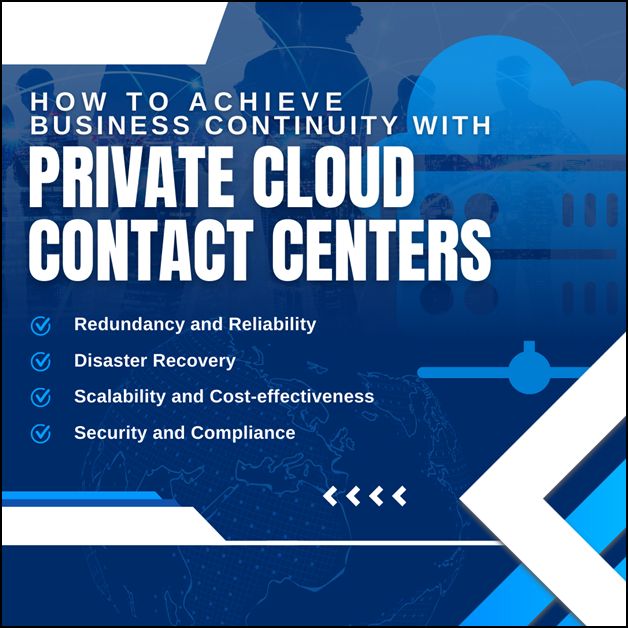
One of the most compelling reasons to adopt a private cloud contact center solution is its ability to offer increased uptime and reliability. Unlike traditional on-premise contact centers, which are prone to hardware failures, private cloud infrastructure has built-in redundancy. In the event of a failure, the system automatically switches to backup resources, thus ensuring minimal service disruption. This reduces downtime risk and allows businesses to continue communication with customers as well as run their operations smoothly.
Scalability and Flexibility
One of the major advantages of private cloud contact center solutions is scalability. Businesses no longer have to worry about overburdening their infrastructure during periods of increased demand, such as during product launches or seasonal peaks. With a private cloud, resources can be scaled up or down quickly, allowing businesses to handle fluctuations in customer interactions without experiencing delays or service outages. This scalability makes it possible for businesses to maintain a level of service during times of normalness and peak periods. It is important for maintaining business continuity.
Data Security and Compliance
Security is always one of the major concerns of cloud-based solutions, but the private cloud contact center solution is more secure and compliant. Since the infrastructure is dedicated to a single organization, businesses have complete control over data storage and access. Besides, private clouds often comply with stricter compliance standards such as HIPAA or GDPR and are, therefore, better suited for industries requiring greater security measures.
How Private Cloud Ensures Disaster Recovery and Redundancy
Business continuity is not only about not being down; it’s also about being ready for whatever the future has in store. Natural disasters, as well as human-induced disasters, can happen overnight. So, having an appropriate DR plan is an important necessity.
Private cloud contact center solutions are equipped with disaster recovery protocols and redundancy to ensure that operations will not be affected by unexpected events. Critical data and systems are duplicated at multiple locations so that a business can immediately shift to a backup site if the primary site goes down. Redundancy guarantees that no customer interaction will be disrupted, regardless of what happens.
An example might be in a crisis situation: say a regional power outage or natural disaster. Such operations could easily shift into an alternate cloud infrastructure, which means agents could still answer calls, manage tickets, and work through customer inquiries with hardly any delays. With the implementation of private cloud contact center solutions, businesses would feel relieved that their contact center will operate in virtually all scenarios.
Seamless Integration with Existing Infrastructure
That is to say, you don’t have to replace the current systems with a private cloud contact center solution. Private clouds are highly flexible, meaning they can easily be implemented in combination with any on-premise or cloud-based tools that you might already use. It could be your customer relationship management (CRM) system, workforce management (WFM) software, or analytics tools. In other words, private cloud contact center solutions can work together with your existing infrastructure.
This allows businesses to optimize the existing investments while bringing in new capabilities for business continuity. For example, integrating contact center solutions with real-time analytics can identify issues before they escalate, allowing proactive intervention and reducing the risk of disruptions further.
Cost-effectiveness and ROI of Private Cloud Contact Centers
While the primary concern for many businesses when adopting new technology is cost, private cloud contact center solutions are often more cost-effective in the long run. Traditional on-premise solutions require significant upfront investments in hardware, software, and IT infrastructure, as well as ongoing maintenance costs.With private cloud solutions, businesses can reduce costs by shifting to a pay-as-you-go model, paying only for the resources they use.
Not only will this help reduce infrastructure costs, but also reduce downtime, improve customer satisfaction, and enhance operational efficiency, all of which will provide a strong return on investment. Private cloud contact center solutions, therefore, have both short-term and long-term cost savings and are an attractive option for businesses focused on maximizing ROI and achieving business continuity.
Steps to Implement a Private Cloud Contact Center Solution
Now that we’ve walked through the benefits, let’s discuss how to implement a private cloud contact center solution in your business. Here are the key steps:
Assess Your Current Infrastructure
Before you make the change, assess your current contact center infrastructure. What are your pain points today? Are there areas in which your current system is not delivering the uptime or flexibility you need? Knowing what you need will help you know what features are most important when choosing a private cloud solution.
Select the Right Partner
Choosing the right private cloud contact center provider is critical to success. A good provider should give guarantees on uptime, robust security, and good customer support. One should also choose a provider that understands the particular requirements of your industry compliance, security, or scalability.
Conclusion
Leverage private cloud contact center solutions to achieve business continuity and provide your business with the leverage to operate smoothly despite challenges that may arise. They provide businesses with increased uptime, scalability, security, and integrative capabilities; thus making businesses agile, and responsive, and reducing downtime and other risks of service disruption. By adopting a private cloud contact center solution, your business will be better positioned to conduct business during disasters and preserve high customer satisfaction levels.
FAQs
How does a private cloud contact center solution improve disaster recovery and business continuity?
Private clouds provide built-in redundancy, and automatic failover allows minimal disruption of service by the crisis. Data can be replicated in multiple sites to ensure smooth transitions should one site fail.
What are the cost implications for switching to a private cloud contact center solution?
Private clouds have higher upfront costs for the initial setup, but they reduce the long-term costs of operation. The pay-as-you-go model brings down the upfront costs while eliminating the ongoing maintenance charges.
How do private cloud contact center solutions scale for fluctuating customer demand?
Private cloud systems provide on-demand resource allocation, allowing businesses to quickly adjust to spikes in customer volume. This flexibility ensures consistent service quality during both peak and off-peak periods.
##