By Ben Bronson, Vice President, Business Operations, Aviz Networks
A new approach to operating multi-vendor networks is at the heart of AI-driven tech projects. Support of any-to-any vendor infrastructures, measurable cost savings, and advanced tools for visibility and control make the case for wider scale disaggregation of switches and software.
Data and cognitive computing projects take greater network horsepower and improved strategies for management. It is forecast that nearly 20% of Ethernet Switch ports sold into data centers will be related to AI/ML and accelerated computing projects, and this will constitute approximately $8B in equipment just for switching and routing, according to market research firm 650 Group.
How did we get here?
After a decade of fits and starts, open networking has been evolving to become the burgeoning norm for enterprises, as surrounding technology has shifted considerably. With new applications and a focus on data, the need has never been greater for a more flexible approach. At a wide scale, servers, data, and applications are now hosted and distributed in differing clouds, rather than being built in on-premises data centers. To run a successful network, enterprises are prioritizing anything-to-anything connectivity with an emphasis on resiliency, security, and predictability, all while reducing management costs and maintaining scalability.
Open networking and the SONiC stack promotes greater visibility and eased support that leads to consistent and predictable network performance and cost reductions. It includes growing integration of data analytics into day-to-day working life, M2M, such as camera and sensors, and data lakes for AI and Machine Learning (AI/ML).
Today’s large and medium enterprises specifically want to use a mix of Layer 2/3 switches and routers from their pick of differing vendors, either brands they are loyal to and familiar with due to quality of experience, or for procuring job-specific gear that is price optimized to save them a hefty bit of their capital and still move data effectively.
The answer is becoming clear. They need more connectivity and horsepower to fuel their AI-driven projects, larger and larger data and language models where machine learning can benefit from repositories of training data.
To make this flavor of open cloud networking mainstream, common software is necessary, which is why community led SONiC OS is pivotal. Originally developed by Microsoft in 2016, SONiC was developed for years and handed over to the Open Compute Project (OCP) and Linux Foundation to further its use.
Aviz Networks is leading the wave towards a much improved strategy by providing the entire network stack for open networks, while getting support from major players and white box vendors.
- Open networking enterprise suite for orchestration
- Offering custom GUI and APIs across the fabric for big customers
- Making Round the Globe Support of Open Networks Easy and Affordable.
- Allow conversion of existing OS (Nexus and AOS) to SONiC based management
- Expand visibility, management, security across varied infrastructure
Instead of a custom SONiC distribution built with a narrow allegiance to a single ASIC vendor, Aviz is using the community version and ensuring openness to all through APIs. The Aviz network suite makes it easier for companies to adopt and manage community SONiC code, and thus, separate the data layer from the network, and host applications as they were intended, across any cloud or virtual instance.
When it comes to cloud network build outs, mixing and matching is the name of the game, however, managing disaggregated networks must be dead simple. Now enterprises are making the most out of the benefits of hardware and software innovations, building in a higher degree of flexibility through APIs, scripts and management, using more ubiquitous tools to fully control their network infrastructures.
To achieve this goal, the network layer is being separated from the data layer, and namely from differing applications.
Why SONiC
- NOS Standardization offers control and flexibility
- Improved operational efficiency
- CAPEX optimization working to free resources for AI and strategic projects
- Multiple choices for supply chain diversification
Getting there from Here
Enterprises and telecom infrastructure companies alike have been welcomed to interoperate and test equipment at the ONE Center.
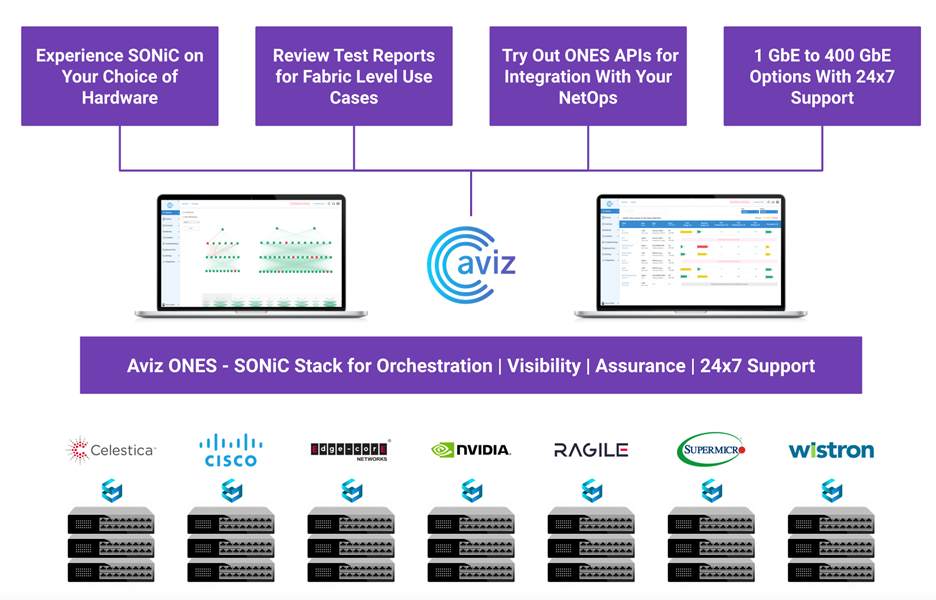
The Aviz ONE Center comprises a state-of-the-art lab, with online and in-person access, designed to showcase the capabilities of SONiC across a wide range of the most commonly used network hardware, such as switches and purpose-built security servers. ONE Center provides an avenue for getting hands-on experience in leveraging SONiC in real-world scenarios.
Organizations can experience SONiC for a range of pertinent use cases on hardware from multiple vendors, without incurring upfront costs. They can review hardware qualification reports (generated via Aviz FTAS) for use cases across multiple versions of SONiC, including vendor distros. And lastly, they can learn how ONES APIs deliver the means to integrate SONiC with existing tools regardless of the underlying platform or ASIC.
To conclude, the network industry has come a long way in the last decade. Priorities for managing and scaling open, multi-vendor networks that once seem unattainable, are now at the ready for enterprises to power through their AI-driven data lakes, and to more effortlessly build and scale multi-cloud, any site computing.
##
ABOUT THE AUTHOR

Ben Bronson serves as Vice President of Operations for Aviz Networks. Ben brings a wealth of skillsets to the company. He is an experienced operations and marketing executive focused on growing great teams and organizations. His diverse experience includes leading product strategy and innovation and managing marketing and business development to put companies on the path towards growing a sustainable bottom line. Bronson is a graduate of the Thunderbird School of Global Management, Phoenix, Arizona, where he achieved his Masters in Global Management. Prior to that, Bronson achieved a BA Communication Arizona State University.