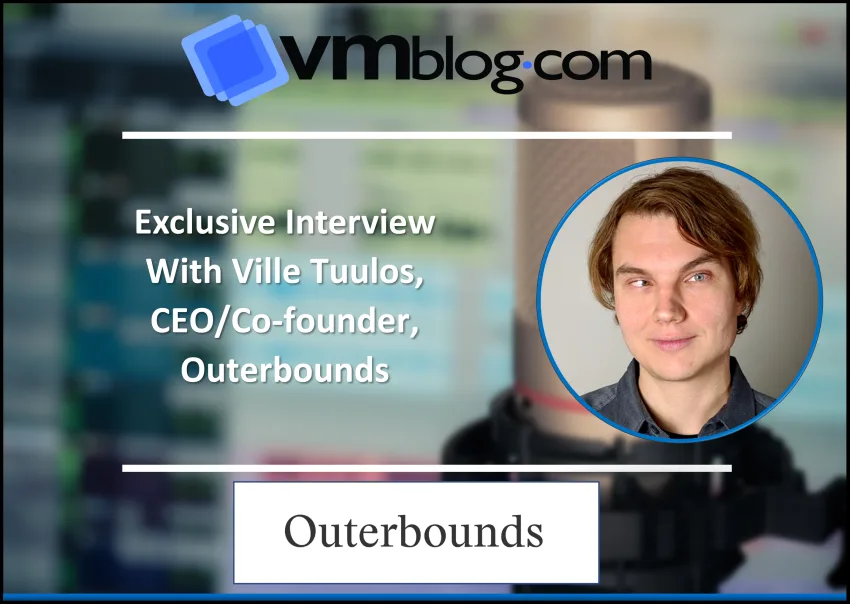
Last week, Outerbounds announced a major drop of new features in its Outerbounds Platform. To find out more, VMblog spoke with Ville Tuulos, CEO/Co-founder, Outerbounds.
VMblog: What is the news Outerbounds announced on 7/19 and how does it help organizations ship data, ML, and AI projects faster?
Ville Tuulos: On July 19, we announced a major drop of new features in the Outerbounds Platform. Since 2019, we have been developing open-source Metaflow with the goal of making it the most user-friendly and productive way to develop data, AI, and ML apps, and deploy them to production quickly.
The four new features we released align with this story:
- New cloud workstations help data scientists and ML engineers develop and test models and code quickly and securely.
- New patterns help companies develop custom large language models and generative AI with their own data securely, without having to leak any data or models outside their premises.
- Companies can now build reactive, event-based ML systems, helping them productionalize models and connect them to surrounding systems.
- We have developed bank-grade security features together with our customers in highly regulated industries, making sure that the new features comply with their security policies and compliance requirements.
VMblog: Why is it important for enterprises related to AI and ML?
Tuulos: We started building foundational infrastructure for ML and AI at Netflix already six years ago, way before the current AI boom. Today, much focus has been on the surface-level cool tooling enabled by chat APIs, which are indeed very immature. It is not clear what approach will turn out to be a sustainable one in the long term.
In contrast, the foundations remain the same: You always need data, compute, orchestration, and versioning in every AI project. Every company should start with a solid foundation, such as the one provided by the Outerbounds Platform.
The tooling and models can evolve on top of it.
VMblog: Can you discuss a few key success stories and how these new features might enhance future projects?
Tuulos: Sure here are a few:
- Trade Republic, a large European fintech, was able to develop and ship a whole new ML-powered feature in six weeks and experience an immediate lift in product metrics.
- Convoy, a US-based logistics company, has been able to unify their data engineering and ML teams on a single platform, significantly increasing efficiency and collaboration.
- Wadhwani AI, an AI research institute in India, has been able to leverage the scalability features of the platform to test more models faster.
VMblog: How will Outerbounds help organizations with the complexities of LLMs and GenAI?
Tuulos: Although AI is new and shiny and exciting today, in the long term AI isn’t an excuse to provide a subpar product experience. The best companies will learn how to adapt and customize AI techniques to support their products in specific ways, not just as an easy chat add-on.
VMblog: How do these new platform features support the process of simplifying workflows?
Tuulos: A key realization is that a data scientist faces tens if not hundreds of small papercut problems every day. Fixing a few of them helps but it’s not sufficient. We have always focused on the end-to-end experience – the workstation feature released today is an example of this, helping data scientists very concretely to develop and test code faster.
Another key question is the tension of freedom vs. responsibility: Data scientists need freedom to experiment but engineers feel the burden of keeping systems running. Today, we are releasing a number of security-related features that allow companies even in regulated industries to allow data scientists to operate freely within well defined boundaries.
VMblog: Can you explain further how Outerbounds is helping organizations retain control over their data and models with your GPU compute for GenAI us cases?
Tuulos: The shortage of GPU resources has been widely publicized over the past months. Our philosophy is to allow customers to use the resources wherever they are available, from public clouds to their on-prem GPU resources. It is pretty clear that we are entering a world where there are more varied needs and there isn’t a one-size-fits-all solution to all compute needs. We provide tooling so that they can customize their solutions to their own needs.
VMblog: How do you see organizations using GenAI and LLMs in the next 1-2 years?
Tuulos: The fact that we can finally use natural language as a robust user interface modality will be a big change. It won’t replace all UIs – today many are overenthusiastic about the chat interface – but it’ll be a significant new capability. Also LLMs and GenAI won’t replace many existing ML techniques but they’ll augment them. It will be possible to enhance all existing models with unstructured text and images, which in some cases can provide a massive lift. Think e.g. recommendation systems or churn prediction that can understand written customer complaints.
VMblog: What makes the Outerbounds approach to MLOps unique and what are your core values?
Tuulos: Ever since the beginning of Outerbounds, we have focused on the user experience. Since the field is so new, many other solutions have focused on technical capabilities, with the UX as an afterthought. We have always believed that the tech will mature, and as always, ultimately it is the best user experience that wins. We see that AI and ML can be applied everywhere. It can be used to enhance all services, products, and business processes.
To achieve our mission, we’re in for the long haul, similar to how adoption of personal computers and the internet took decades to penetrate all parts of life, but it’ll happen.
We love a culture of experimentation: Instead of engaging in a few grandiose projects, it is better to iterate quickly, test many ideas in the market rapidly and adjust.
The autonomy of data scientists is important to us: In order to move quickly, you need to empower individuals to quite a lot by themselves.
Human-centric focus: In contrast to other FANG companies, Netflix is laser-focused on business results, being pragmatic instead of building cool tech for its own sake. This has many implications but an important one is to focus on empowering domain experts to help the business vs. building overly complex technical systems.
Freedom and responsibility are also important: Balance freedom of choice/experiment with the responsibility to do the right thing for the business – life becomes easier if critical responsibilities are codified within the platform – allowing the end user to experiment freely on top.
##