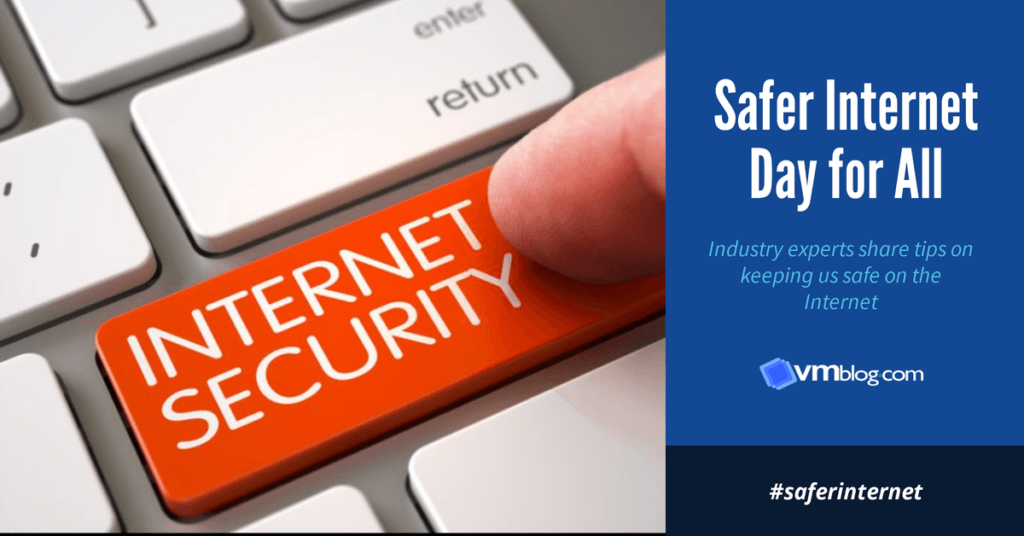
Happy Safer Internet Day! Now in its 19th year, Safer Internet Day is celebrated every second Tuesday of February. It stands to remind those who use the internet for business, personal, and every reason in between to have their guard up anytime you go online. While the internet has revolutionized the way we do everything from communicating to paying bills to shopping, everyone needs to be aware of the dangers on the internet and how to avoid them.
This year’s theme is an important one to keep in mind: “Together for a better internet.” VMblog reached out to a number of industry experts to learn a few tips and tricks to safe out there, and receive expert commentary on how those working remotely can create a safe environment for themselves and others.
—
Peter Tsai, Head of Technology Insights at Spiceworks, an online community used by millions of IT professionals across the world
“A safe internet doesn’t just require protecting data and users by implementing technological solutions or following security best practices. In an online environment plagued by spam, misinformation, trolls, and extremism, online safety requires a human touch. Digital platforms must invest in robust content moderation teams that actively enforce guidelines to keep online discourse focused and civil. Only when internet safe spaces exist can users feel comfortable forming genuine connections with others by taking part the informational and cultural exchange that is so vital to the flourishing of communities that are truly welcoming to all.”
++
Brian Spanswick, Chief Information Security Officer and Head of IT at Cohesity, next-gen data management company
“Safer Internet Day is a reminder that while the internet is an empowering resource, it’s also a hotbed of increasingly sophisticated criminal activity where every entry point should be considered a vulnerability. To minimize the threat of ransomware and data exfiltration, organizations must adopt a security-first, next-gen data management solution designed to safeguard their backup infrastructure and better protect internal and consumer data. Employees must also do their part by adhering to password protocols, stay mindful of email safety, and keep their devices updated with antivirus software.”
++
Daniel Markuson, Digital Privacy Expert at NordVPN, a widely popular virtual private network solution
“As with every new technology, manufacturers want to jump on the Metaverse train as soon as possible and the rush to compete may result in a lack of oversight, allowing hackers to easily take advantage of consumer vulnerabilities using VR technology. Our new study confirms consumer concerns for their privacy and security in the metaverse. Since children tend to not understand the possible risks, they are the perfect targets for cybercriminals. We strongly suggest that parents read the privacy policies at length and instruct children to create anonymous nicknames on VR multiplayer games and to keep their personal information private.”
++
Gabriel Engel, CEO of Rocket.Chat, an omnichannel platform putting data privacy into every conversation and enabling teams to collaborate seamlessly
“When it comes to protecting collaborative data between different universities or universities and businesses, best practices call for intense regulation of data sharing via contracts that specify security policies, data protection responsibilities, technology to be used, and more. Universities are often underfunded and lack resources to acquire and maintain new digital tools. Luckily, more and more governing bodies understand the need for digital transformation in the education sector.”
++
David McKenna, Senior VP Engineering at Axway, a leading API management platform
“Keep systems up to date. The Internet never forgets – be careful with what you post and the content of what you post. You could leak personal information which can be used to exploit you. Or you could post damaging comments that will haunt you in later life. Strong & unique passwords – machines can brute/guess ‘human’ friendly passwords. Never trust a provider to store your credentials safely, so assume they will be hacked and your credentials (user name and password) will be public someday.”
++
Miles Hutchinson, CISO of Jumio, a leading provider of AI-powered end-to-end identity orchestration
“Safer Internet Day promotes the safe and positive use of digital technology for children and young people. The younger generation increasingly relies on technology for everyday activities and positive experiences such as interacting with their friends, virtual learning, gaming, social media and more. However, for all the positives, some dangers can’t be ignored. For instance, younger people can unknowingly overshare and post private information online, access inappropriate content, fall victim to identity theft or be approached by hidden predators. While there has been significant discourse amongst large corporations about implementing stricter age and identity verification measures, not much progress has been made.
Organizations can do their own due diligence to promote a safer internet by strengthening security protocols to prevent young people from accessing inappropriate or age-restricted content. For example, utilizing stronger identity and age verification capabilities like biometric authentication to confirm a user is actually the age they are claiming to be. By properly verifying users and regulating age-restricted content, organizations can contribute to a safer internet community and keep younger people out of harm’s way.”
++
Clara Angotti, co-founder and president, Next Pathway, the automated cloud migration company
“The goal of Safer Internet Day is to promote the responsible and secure use of technology, primarily for youth, but ideally for us all. However, until governments make this topic a real priority and apply the necessary funding to act with speed, we are left to rely on corporations to ‘do the right thing’ – and quite simply, they don’t because the financial incentives don’t exist. So we are left to take responsibility for our own online safety. There are lots of good solutions to this problem; we just need corporations to put our safety ahead of profits.”
++
Terry Storrar, Managing Director, Leaseweb UK, a leading hosting and cloud services company
“The Internet is an integral part of our daily lives and our reliance on it as a society has grown rapidly in recent years. However, this dependence also brings exposure to risk; it is now critical that we enforce robust security protocols to keep connected individuals and organizations safe.
Threat actors are constantly on the lookout for new ways to infiltrate and wreak havoc on an organization’s operations. However, the Internet is now so ubiquitous that its security is not just a corporate responsibility; everyone has a part to play in Internet safety.
Organizations can best contribute by providing company-wide cybersecurity training, promoting Internet safety best practices and working in partnership with the wider community to endorse good Internet habits. Internally, employers should be implementing strong cybersecurity tools to ensure responsible Internet usage. Individuals too must step up to good security practices – even simple tasks like updating passwords can make all the difference.
Particularly in a remote work environment, businesses should do everything they can to create a safe environment. One of the first things is to ensure that employees are making use of robust Internet security software that includes firewalls, pop-up blockers, vulnerability scanning, and email spam filters.
Keeping the Internet safe requires a combination of tactics at an individual, organizational, national and global level. By deploying company-wide tools, promoting employee best practices and working as a global network, businesses can go a long way in combating those that seek to make the Internet dangerous.”
++
Corey Nachreiner, chief security officer at WatchGuard Technologies, a leader in network security and intelligence, advanced endpoint protection, multi-factor authentication (MFA), and secure Wi-Fi
“While every day is a good day to take stock of what you’re doing to protect yourself, your family and your business online, Safer Internet Day is a good opportunity to stop and really think about some of the threats we all face and what to do about them. Here are a couple of tips:
Combat hard-to-detect spear phishing attacks –
Cybercriminals are getting better at creating individually targeted emails or text and message app messages that pretend to be legitimate, often spoofing your friends and co-workers or businesses and organizations (like banks, retailers, government agencies) that you trust. Their goal is often to get you to visit fake websites that will harvest your log-in credentials and other personal information, transfer money, and/or deliver malware. Malicious messages might include attachments with documents that contain malware as well. And stolen data is often sold and used for things like identity theft and fraud. These attacks have gotten better and more personalized with the use of automated phishing tools and programs that cull social media networks and other places on the web where people post personal information. And with more people signing up for services like online shopping and banking during the pandemic, the opportunities for cybercriminals to take advantage of unsuspecting consumers are even greater.
Stopping spear phishing starts with being vigilant. Keep an eye out for warning signs like requests from managers or co-workers that seem out of the ordinary. Check for any details that just don’t add up. Always check the full email address to ensure a message is from a legitimate source, and delete it if it doesn’t look right; but also keep in mind that attackers can spoof email addresses if your domain doesn’t have the right protections (like DNS filtering). Check the domain on anything you click to ensure it really goes to the right place, and simply avoid clicking domains in correspondence. Sometimes it’s just better to type them in manually. Never download files from unfamiliar senders, skip the link in favor of manually typing in your intended destination, and when in doubt, forward the email to your IT or security department for closer inspection.
Adopt a password manager and implement MFA –
Good password management is crucial to a safer internet experience. Simple-to-guess and reused passwords make you more vulnerable to attackers. And it’s easy for cybercriminals to find troves of stolen usernames and passwords on the dark web and underground forums; there are now billions of usernames and passwords from various breaches, widely available, with millions added every day.
Using strong and unique passwords for each of your individual accounts will ensure that attackers can’t use one compromised credential to access multiple accounts. Use a password manager and multi-factor authentication (MFA) wherever possible (even with games). Password managers can help create strong, unique passwords for each and every one of your online accounts. MFA is now available for all kinds of online services, including on many large gaming platforms, with some even offering in-game rewards for players who choose to use it. Combining a good password manager with MFA across all your online accounts is the most effective way to prevent unauthorized access.”
##