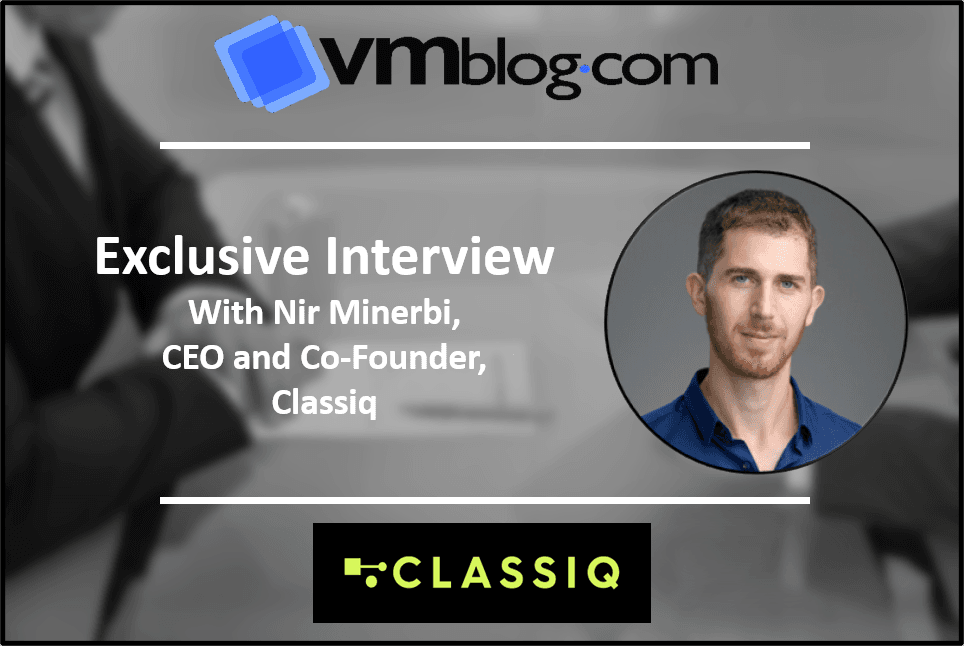
A lot of attention is being paid to the hardware side of quantum computing: the number of qubits, the “quantum volume,” the underlying hardware architecture. But hardware without software would be like a high-end processor without an operating system. To learn more about the unique challenges of quantum computing and the software required to fulfill the promise of quantum, VMblog reached out to industry expert, Nir Minerbi, CEO and co-founder of Classiq.
VMblog: You describe your company as producing a platform for quantum algorithm design. What does quantum algorithm design mean?
Nir Minerbi: Quantum Algorithm Design is the way of creating quantum algorithms for quantum computers of any size. It is a way to create quantum software that is easy to port between different machines, and that is easy to create and maintain by all kinds of engineers and scientists, including those that have not specialized in quantum physics.
Quantum Algorithm Design starts with the methods and knowledge gained in decades of computer-aided design and applies it to the new world of quantum computing. When designing CPUs or other sophisticated electronics circuits, designers use VHDL, Verilog or other high-level modeling languages. Software applications such as those from Cadence and Synopsys ingest these high-level models and the specifications of the target hardware and synthesize electronic circuits. Similarly, Quantum Algorithm Design platforms ingest a high-level model of the quantum circuit as well as the specifications and constraints of the target hardware and use those to synthesize an optimized quantum circuit.
Quantum Algorithm Design is different from the current low-level gate-based method of creating quantum circuits by specifying the connections between quantum bits (qubits) and quantum gates.
VMblog: Several major vendors released software development environments for quantum computers such as Qiskit from IBM, Q# from Microsoft, Cirq from Google. What does your platform provide that those vendors don’t?
Minerbi: Our platform is higher in the software stack and the development process, essentially upstream in the development process. We generate code (such as Qiskit or Q#) that can be directly fed into the compilers and transpilers from these vendors. These compilers do an excellent job in gate-level optimization, but our platform allows specifying the behavior in a higher-level model. We perform system-level optimization which is possible because we understand the desired algorithmic behavior. We allow designers to experiment with different tradeoffs – such as creating a shallower circuit with more qubits – and even to estimate whether their algorithm can run on today’s quantum computers or whether they should wait for the next generation of larger machines.
VMblog: The largest quantum computers today have a couple of dozen qubits. IBM is talking about over 1,000 qubits in 2-3 years. How does software development change when the number of qubits increases?
Minerbi: We believe that the current gate-based methods of creating quantum circuits do not scale when the number of qubits increases. As an analogy, you can manually create an electronic circuit by connecting a couple of dozen AND, OR and XOR gates, but you can’t build a CPU this way. Similarly, if you want to brighten up a small 20×20 pixel image, you can do that pixel-by-pixel, but you’ll want to use Photoshop for megapixel images.
VMblog: What kind of training would one need to write quantum software? Do I have to have a quantum physics Ph.D. from MIT?
Minerbi: Today, most creators of quantum circuits do have a Ph.D. in quantum information science. This is a problem for two reasons. First, there are not enough of these people and this shortage is stifling the development of quantum algorithms. Some say it is the biggest gap in the quantum world right now. Second, to deliver truly useful enterprise solutions, one needs to include domain-specific experts in the process – whether they are experts in option pricing, supply chain or drug discovery. People who ‘speak’ quantum but are also experts in other fields are truly rare.
Our platform changes that. By separating the ‘what’ from the ‘how’, we make quantum computing more accessible and help alleviate this talent shortage.
VMblog: One of the famous quantum algorithms is Shor’s algorithm, which shows how a quantum computer can eventually break the RSA encryption. How worried should security professionals be about quantum computing?
Minerbi: Shor’s algorithm can indeed break the RSA encryption if it ran on a sufficiently large and error-free quantum computer, but these computers are several years away. Many people are already at work on post-quantum encryption, which is the name for algorithms that cannot be broken by quantum machines. What is also important to realize is that quantum computers can also bring significant benefits for cybersecurity. Quantum computers can generate truly random numbers, which is key for many algorithms. The ability of quantum computers to explore many different solutions at once can also be very helpful for penetration testing or automated quality assurance.
VMblog: It seems that quantum computing has potential benefits in chemistry and drug discovery, supply chain and finance. Where do you see the biggest impact from quantum computing in the coming years?
Minerbi: At the risk of sounding a bit philosophical, we don’t yet know where the biggest impact is. Very often, the ‘killer application’ comes after the technology has started to mature. Think about what the creators of the internet expected to do with it, and what it does today. Consider the personal computer or the mobile phone. Yes, we know that quantum computing will deliver substantial competitive advantages in finance, supply chain, and chemistry, but maybe the killer application will be cybersecurity, or natural language processing. With stronger hardware and the right software platforms, we can only start to imagine the possibilities.
VMblog: Finally, if there was one piece of advice you would offer to large enterprises thinking about quantum today, what would it be?
Minerbi: Be realistic in your expectations, but don’t wait. All over the world, we see quantum teams formed. We see enterprise-wide discovery processes to understand what problems are best suited for quantum solutions and proof of concept explorations happening. The availability of cloud-based quantum processing makes it easy to experiment, and with the right software you can create solutions very quickly and port them to other hardware as necessary.
##