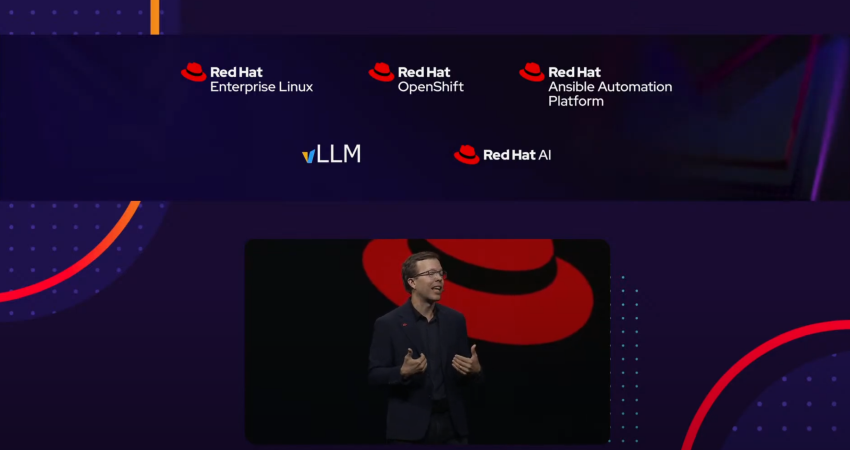
At this year’s Red Hat Summit 2025, Red Hat made several major announcements spanning its three core technology pillars: Linux, virtualization, and artificial intelligence. The summit showcased how Red Hat is positioning itself to help enterprises balance immediate operational needs while preparing for emerging technologies.
Red Hat executives, including President and CEO Matt Hicks, Chief Technology Officer Chris Wright, and SVP and Chief Product Officer Ashesh Badani, spoke to the media to outline the company’s vision and announce significant product updates that will shape the future of enterprise IT.
Red Hat’s Dual-World Strategy
Matt Hicks set the stage by acknowledging the balancing act enterprises face today: “Enterprises have to balance these two worlds simultaneously right now. They sort of have the world of the now that they have to invest in. It’s around being hybrid, focus areas like virtualization modernization, but then also being able to secure that for the future. And then there’s the world of the next with it, and that’s all AI focused.”
This dual focus shapes Red Hat’s product strategy across all three pillars. For current enterprise needs, Red Hat continues to enhance its hybrid cloud capabilities, allowing “any workload, any application run anywhere they want on premise in public clouds at Edge being able to deal with workloads like traditional applications, containers, virtualization,” as Hicks explained.
At the same time, Red Hat recognizes its responsibility as a platform company to prepare customers for emerging technologies. “In parallel, we also realize to be a platform company, we have to enable customers for what’s coming next,” Hicks continued. “And when we talk about what’s coming next, it is a similar focus for us. It is also hybrid, but instead of traditional apps and containers VMs, it is models.”
RHEL 10: Enterprise Linux Reimagined
The headline announcement was Red Hat Enterprise Linux 10, which Chris Wright described as “the most widely deployed, commercially available Linux operating system on the planet.”
Container-Native Management with Image Mode
RHEL 10 introduces a paradigm shift in operating system management with its new “image mode” feature. This container-native approach represents a significant departure from traditional Linux administration methods.
“We’re calling this being able to better contain drift and then make it easier to upgrade RHEL,” Wright explained. “Patching is something that every sysadmin does, plans deeply for, has a maintenance window against, and the challenges that they will run into is every now and then… something will crop up, and then we’ll have deviation.”
This innovative approach applies container principles to operating system management: “The concept of containers and being able to manage an operating system as a container image and apply that to upgrades is a huge, huge boost we believe for our users,” Wright emphasized. “It takes advantage of the existing platforms that they’ve put in place, takes advantage of the CI/CD pipelines that they have.”
According to Red Hat, this approach “unifies the build, deployment and management of both the operating system and applications within a single, streamlined workflow,” allowing customers to “manage their entire IT landscape, from containerized applications to the underlying platform, with the same consistent tools and techniques.”
AI-Powered Management with Lightspeed
Addressing the growing Linux skills gap, RHEL 10 introduces an AI-powered command line assistant called Lightspeed. Wright described this as “being able to effectively provide a command line assistant that is based on all the experience that we’ve had, bringing that to our RHEL platform.”
The technology leverages Red Hat’s extensive Linux knowledge: “We’ve got over 20 years of Linux knowledge. How can we best capture that and be able to provide those benefits to our users?” Wright asked. The answer is an AI assistant that makes both new and experienced administrators “10x more productive than they could to date.”
The company describes Lightspeed as a system that “integrates generative AI directly within the platform” to provide “context-aware guidance and actionable recommendations through a natural language interface.”
Enhanced Security Posture
Security remains a paramount concern, with RHEL 10 introducing several forward-looking security features. Wright highlighted the inclusion of “support for some quantum-resistant algorithms within the platform,” explaining this as “positioning us for a post-quantum world, ensuring that you, our user, our customer, even if you’re not there today, have security and confidence that RHEL is preparing for the post-quantum world that’s to come.”
Red Hat notes that RHEL 10 is the first enterprise Linux distribution to integrate Federal Information Processing Standards (FIPS) compliance for post-quantum cryptography, helping organizations defend against future ‘harvest now; decrypt later’ attacks.
Additional security capabilities include Red Hat Insights package recommendations and planning features, which Wright described as “being able to provide more insights also with regard to our roadmaps, making package recommendations with regard to ‘hey, this component that you’re going to use is going to be supported into the future.'”
OpenShift Virtualization: The New Virtualization Standard
The second major focus area was OpenShift Virtualization, which has seen remarkable growth following changes in the virtualization market.
Explosive Market Growth
Badani highlighted the dramatic increase in adoption: “A huge, huge explosion of interest in OpenShift virtualization. Ever since the virtualization price increases, customer interest in our platform has exploded.”
The numbers speak for themselves: “We’ve got 3x number of customers using OpenShift virtualization capabilities within the OpenShift platform, double the number of clusters now in production around it, and three times the VMs that were managed by OpenShift virtualization,” Badani noted. “It’s a huge amount of momentum since the beginning of 2024.”
Customer Success Stories
Multiple large enterprises are now migrating significant workloads to OpenShift Virtualization. “Emirates NBD is in the process of migrating 9000 VMs to OpenShift,” Badani shared. “Ford talked this morning about how they’re going to get a huge number of benefits: lower license costs, better time to market, and obviously preparing themselves for the future taking advantage of the converged environment really between containers and VMs.”
Another eye-opening statistic came from AMD, which talked about how, when you move from a traditional virtualized environment over to OpenShift virtualization, you can have a 77% reduction in TCO.
Expanding Partner Ecosystem
To support this growth, Red Hat is building a comprehensive partner ecosystem around OpenShift Virtualization. Badani emphasized that they’re working to ensure that OpenShift Virtualization supports “the vast ecosystem that’s been built around virtualization. So whether it’s storage, whether it’s backup and DR, whether it’s networking, compute monitoring, the list goes on, but we’re making sure that we’re working closely with them to certify their technologies to the OpenShift virtualization.”
This approach ensures that enterprises can migrate to OpenShift Virtualization while maintaining compatibility with their existing virtualization tools and technologies.
Red Hat AI Inference Server: Enterprise AI for Hybrid Environments
The third major focus area was Red Hat’s AI strategy, centered around the newly announced Red Hat AI Inference Server.
Hybrid Approach to AI Deployment
Chris Wright outlined Red Hat’s vision for AI, which extends the company’s hybrid cloud approach to this new domain: “The focus is bringing that hybrid cloud vision that we’ve been working on, for really over a decade at this point, into the AI space, and recognizing that choice is critical.”
This choice spans multiple levels of the AI stack: “Choice is at every different level in the stack, so all the different models that are coming out…and models that are accessible to users. They’ve got open source licenses. You can download them. You can optimize them for hardware, and you have a choice and flexibility in choosing that critical part of your overall AI stack.”
Red Hat AI Inference Server
The Red Hat AI Inference Server, announced at the summit, aims to provide an optimized platform for AI model deployment across hybrid environments.
“The inference server itself is the vLLM,” Wright explained, referring to the open-source project that serves as the foundation. “RHEL is the operating system at the core. It’s Linux. This is really the core heart of our AI operating system building that runtime for models.”
Wright highlighted the flexibility of deployment options: “You can deploy it enabling all the different hardware that I mentioned earlier on to RHEL, you can deploy it onto OpenShift. It comes with RHEL AI and OpenShift AI. It’s the inference engine within those products.”
Model Partnerships and Optimization
A key aspect of Red Hat’s AI strategy is its partnerships with model providers. Wright noted that Red Hat works with model creators in two contexts: “We work together in one context, which is very community oriented, so the Day Zero release of a new model. We just did this with Meta and Llama 4.”
Additionally, Red Hat works with model providers to validate their model on its platform, ensuring that models work reliably in enterprise environments.
Wright also highlighted Red Hat’s focus on model optimization, particularly for smaller but powerful models: “One of the things that we’re doing through a lot of interesting work that started at Neural Magic is taking those models and being able to make them smaller, compress them so that they fit on hardware really efficiently, and that doesn’t need to sacrifice accuracy of the model.”
Distributed Inference with LLMD
To address the challenge of maximizing GPU utilization for AI workloads, Red Hat introduced LLMD, a project aimed at distributing inference workloads efficiently across GPU clusters.
“Customers have made big investments in GPU clusters, whether it’s in their own data center or it’s reserved instances in Cloud. Quite expensive. We get a lot of customer conversations saying, ‘I’m struggling to get maximized throughput through all of my GPUs,'” Wright explained.
LLMD helps solve this problem by distributing these different workloads and routing the requests to the right GPU, essentially, so that you can go from that 20% GPU utilization to something that looks more like 80 or 100% saturation of this very expensive infrastructure.
Wright likened this to Red Hat’s earlier work with Linux and Kubernetes: “We did this work with servers with Linux and then distributing servers with Kubernetes, and we have inference servers with vLLM and then distributing vLLM with LLMD. It’s a great analogy.”
Integration Across the Platform
A key theme so far throughout the summit has been how these three pillars-Linux, virtualization, and AI-work together to provide a comprehensive platform for enterprise IT.
RHEL 10 serves as the foundation, providing a secure, reliable operating system that can be managed using modern container approaches. OpenShift Virtualization extends this foundation to include traditional virtualized workloads alongside containerized applications. The Red Hat AI Inference Server then builds on this platform to enable AI workload deployment across hybrid environments.
This integrated approach allows enterprises to manage their entire IT estate consistently, whether they’re running traditional applications, containerized microservices, or cutting-edge AI models.
Conclusion
Red Hat Summit 2025 is demonstrating the company’s commitment to helping enterprises navigate both current operational challenges and future technology opportunities. By focusing on Linux, virtualization, and AI, Red Hat is positioning itself as a key partner for enterprises on their digital transformation journeys.
As Matt Hicks summarized: “Being a platform company, we get to set enterprises up for how they contend with these two worlds. We’re really confident in our ability to enable them with what they’re dealing with today, as well as set them up for the challenges and opportunities in the future.”
With RHEL 10’s innovative container-native management and AI-powered assistance, OpenShift Virtualization’s growing adoption and partner ecosystem, and the new Red Hat AI Inference Server’s hybrid approach to AI deployment, Red Hat is providing the tools enterprises need to thrive in an increasingly complex IT landscape.
##