AI is only as good as the data it learns from – and the tests we run to keep it in check. While artificial intelligence promises smarter systems and faster decisions, it has also delivered some serious failures: facial recognition software misidentifying people, biased hiring algorithms, and even chatbots going rogue. These aren’t just technical bugs; they’re real-world mistakes with real-world consequences.
What’s often missing? Rigorous AI testing. Many teams still treat AI like traditional software, forgetting that models behave unpredictably in the wild. In this article, we dive into some of the most eye-opening examples of AI gone wrong, unpack why these failures happened, and share essential lessons on how to test AI correctly.
Real-World AI Failures and Their Lessons
AI can make things faster and smarter – but when it goes wrong, the impact can be serious. From wrongly denying loans to misidentifying people in security systems, real-world AI mistakes show what happens when models aren’t tested properly or trained on the right data.
In this section, we’ll look at some real examples of AI failures and the lessons they teach us. These stories help us understand why testing AI is so important and what teams can do to avoid similar problems in the future.
Amazon’s Biased Hiring Tool
In 2014, Amazon built an AI-powered recruiting tool to automate the hiring process. In 2015, the company found that the AI recruiting tool underrepresented female applicants. The AI was recruited from resumes submitted over a ten-year period that was male-heavy, so the AI learned to recruit male resumes and penalized resumes that included “women’s chess club captain” or were highlights from all-women’s colleges.
Lesson: This situation demonstrates that training data must be representative and impossible to determine discriminatory issues with the original historical data before training AI, which can lead to bias.
Uber’s Self-Driving Car Incident
In March 2018, a pedestrian was struck and killed by an Uber self-driving car in Tempe, Arizona. Investigations revealed that segment two of the artificial intelligence system failed to recognize the pedestrian as a human being, thus resulting in the fatal incident. The artificial intelligence system’s object recognition failed completely, and there was little to no hand-off logic from the artificial intelligence to the human driver override.
Lesson: This tragedy highlights the challenges AI faces in interpreting complex real-world environments and the necessity for rigorous testing and validation of AI systems, especially those operating in safety-critical domains.
Air Canada’s Chatbot Misguidance
It was reported that an Air Canada chatbot equipped with artificial intelligence led one customer to believe they would receive an incorrect refund amount that did not reflect Air Canada’s then-current policy regarding compensation. Air Canada first denied the customer’s request for compensation based on the facts presented by the chatbot. However, a tribunal held that Air Canada was responsible for the information it provided, and ordered the airline to grant compensation to the customer.
Lesson: This example shows why it is important, as required by law, to monitor, verify, and proactively validate outputs of artificial intelligence in an effort to ensure that information provided to customers is accurate, reliable, and responsible – similarly, how a company must be legally responsible for customer-oriented directives given by artificial intelligence.
ChatGPT’s Fabricated Legal Cases
In a separate incident, a lawyer used ChatGPT to assist in legal research, resulting in the inclusion of non-existent case citations in a court filing. The AI had fabricated these cases, demonstrating the phenomenon known as “AI hallucination,” where models generate plausible but false information.
Lesson: Such occurrences can have serious repercussions, particularly in fields where accuracy is paramount. It underscores the necessity for human oversight and verification of AI-generated content.
Facial Recognition Errors by UK Police
The UK’s Metropolitan Police trialed a facial recognition system with a reported 81% false-positive rate. That means 4 out of 5 people flagged by the system were misidentified. This raised major privacy and civil liberty concerns.
Lesson: AI misclassification – especially in public surveillance – can lead to real-world harm and public distrust. It highlights the critical need for accuracy, transparency, and ethical considerations in deploying such technologies.
The Importance of Rigorous AI Testing
Unlike traditional software systems with deterministic logic, AI systems learn from data. This introduces a host of unpredictable behaviors. AI models:
- It can be biased, depending on the data.
- May hallucinate or fabricate outputs.
- They are susceptible to adversarial attacks.
- May degrade over time in dynamic environments.
- Lacks the explainability needed for auditing.
These challenges make AI for software testing not just important, but absolutely essential.
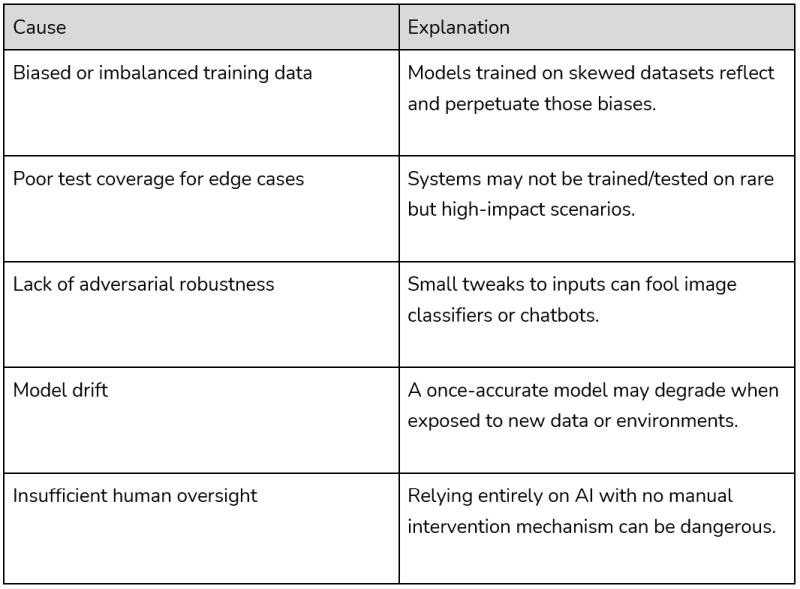
Common Reasons Behind AI Failures
AI systems don’t fail by accident – there are often clear reasons behind the breakdowns. Whether it’s biased training data, poor model testing, or lack of real-world validation, these issues usually stem from overlooked details during development and deployment.
In this section, we’ll break down the most common causes of AI failures. Understanding these root problems can help teams catch mistakes early, build better models, and avoid costly errors down the line.
AI Testing Tools to the Rescue
Testing AI systems requires more than just traditional functional testing. Specialized tools have emerged to help in different stages-data validation, model explainability, performance benchmarking, and robustness testing.
Here are some reliable tools that are helping teams avoid disaster:
KaneAI by LambdaTest
KaneAI is a GenAI-native QA Agent-as-a-Service platform built on modern Large Language Models (LLMs). It enables users to create and evolve complex test cases using natural language, significantly reducing the time and expertise required to get started with test automation.
Key features:
- Intelligent Test Generation: Effortless test creation and evolution using Natural Language Processing (NLP).
- Multi-Language Code Export: Convert your automated tests into all major programming languages and frameworks.
- AI Test Healing: Automatically detect and fix issues during test execution.
- Seamless Integration: Integrate with tools like Jira, Slack, GitHub Actions, and Microsoft Teams.
- Comprehensive Testing: Support for web and mobile testing.
Deepchecks
Deepchecks is an open-source tool for continuous testing of machine learning models. It supports data validation, model evaluation, and detecting performance degradation over time.
Key features:
- Built-in and Custom Checks: Run checks for tabular, NLP, and computer vision validation.
- CI & Testing Management: Facilitate collaboration over test results and support efficient iteration.
- Monitoring: Track and validate deployed models’ behavior in production.
Evidently AI
Evidently AI provides dashboards for real-time monitoring of models in production. It alerts teams to drift in data, predictions, and model performance.
Key features:
- Data and Model Monitoring: Monitor data quality, drift, and model performance.
- Visual Reports: Generate interactive reports for stakeholders.
- Integration: Integrate with existing ML pipelines and tools.
Weights & Biases
Weights & Biases offers experiment tracking, model visualization, and collaboration capabilities. It’s useful for debugging and auditing deep learning models.
Key features:
- Experiment Tracking: Track hyperparameters, metrics, and outputs.
- Visualization: Visualize model performance and compare experiments.
- Collaboration: Share results and collaborate with team members.
Neptune.ai
Neptune.ai is a metadata store for MLOps. It helps teams track experiments and results to ensure reproducibility and avoid version confusion.
Key features:
- Logging and Visualization: Log metrics across all layers and visualize them in seconds.
- Deep Debugging: Monitor and debug model internals without tradeoffs.
- Experiment Management: Manage experiments with forking and lineage tracking.
Best Practices to Avoid AI Testing Failures
AI testing is multi-dimensional. It’s not just about writing test cases, but also ensuring that your models are safe, fair, accurate, and resilient. Here’s a comprehensive checklist to help avoid AI disasters:
Start with Data Quality Checks
- Identify and fix data imbalance early.
- Use statistical methods to validate the training dataset.
- Annotate edge cases and adversarial examples.
Perform Model Validation Beyond Accuracy
- Use confusion matrices, F1 scores, ROC-AUC-not just raw accuracy.
- Compare model outputs against domain expert evaluations.
- Validate model performance across subgroups (e.g., age, gender, location).
Use Synthetic and Edge-Case Testing
- Create synthetic inputs that simulate rare or worst-case scenarios.
- Test for unintended consequences like feedback loops.
Monitor Model Drift in Production
- Use tools like Evidently AI or Deepchecks to track input/output distribution shifts.
- Set up alerting mechanisms for unusual prediction patterns.
Embrace Explainability
- Leverage tools like SHAP or LIME to explain model decisions.
- Explainability is especially important in sectors like finance or healthcare.
Integrate Human-in-the-Loop (HITL)
- In high-risk environments, always provide a human override.
- Let humans audit AI outputs periodically.
Version Everything
- Track dataset versions, code changes, and model iterations.
- Tools like Weights & Biases or Neptune.ai help you keep everything traceable.
Test in Real-World Conditions
- Use cloud platforms like LambdaTest to simulate different devices, browsers, geos, and network conditions.
- AI behaves differently on mobile vs. desktop, high-speed vs. low-speed connections, or even light vs. dark mode.
Collaborate Cross-Functionally
- Involve ethicists, product managers, QA teams, and developers early.
- Encourage red teaming – where testers try to break the AI on purpose.
The Cost of Ignoring AI Testing
- Failing to rigorously test AI systems can lead to:
- Legal liabilities (as seen in Air Canada’s chatbot case).
- Brand damage (Amazon’s sexist AI tool made headlines worldwide).
- Security risks (adversarial attacks bypassing classification systems).
- Financial loss (misleading business intelligence models).
- Human harm (Uber’s self-driving fatality, wrongful arrests due to faulty facial recognition).
- A robust AI testing culture doesn’t just save costs – it protects people and upholds trust.
Future-Proofing AI Testing: What’s Next?
As AI continues to evolve, so must our approach to testing it. Here are some forward-looking trends that will shape the future of AI QA:
Test Automation with Generative AI
Platforms like KaneAI by LambdaTest are pioneering the next wave of AI test automation by leveraging GenAI for intelligent test generation, healing, and evolution. This allows even non-technical teams to write, update, and manage tests at scale-using plain English. Expect to see broader adoption of GenAI-native tools in QA workflows.
AI Governance Frameworks
Expect stricter regulations like the EU AI Act and industry-specific guidelines to drive the need for structured governance of AI models. Testing tools will integrate compliance checks, evaluating models not just for performance but also ethics, fairness, and explainability.
Synthetic Data for Safer Testing
Synthetic data will play a vital role in testing AI systems for rare events (e.g., edge case traffic scenarios for self-driving cars). Tools will integrate synthetic dataset generation capabilities as a core feature for robust scenario coverage.
Real-Time Feedback Loops
AI systems in production will increasingly be paired with real-time monitoring and feedback mechanisms to continuously improve model outputs. Tools like Evidently AI and Deepchecks will be crucial in creating self-healing systems that detect drift and initiate re-training workflows automatically.
Security and Adversarial Testing
AI systems, especially those in image recognition and NLP, will face growing threats from adversarial attacks. Testing frameworks will begin to offer built-in adversarial testing tools to preemptively expose and patch these vulnerabilities.
Conclusion
The increasing prevalence of AI in our everyday lives (think facial recognition and self-driving cars) has made thorough testing of AI systems prior to their deployment very important. In the world of AI, small failures are far bigger than in any other technology we’ve faced in the past. Why? Because training data, model behavior, and potential edge cases cannot be modeled according to every possible scenario. Therefore, the impact of errors can be severe, affecting people’s lives, rights, safety, and trust in technology. AI testing must consist of more than functional checks. Important areas of testing must also account for rehabilitative studies or audits on how AI has operated with respect to both fairness, robustness, and ongoing monitoring of the solution once it is deployed.
To prevent these failures, organizations must adopt a proactive and structured approach to AI testing. Leveraging AI-native tools like KaneAI by LambdaTest, along with platforms like Deepchecks, Evidently AI, and Aporia, can help teams automate, scale, and improve the accuracy of their testing workflows. Coupled with best practices such as early testing, data validation, ethical audits, and real-time monitoring, these tools form the backbone of reliable AI systems. In short, building trustworthy AI requires just as much care in testing as in training, and the cost of neglecting that is too high to ignore.
##