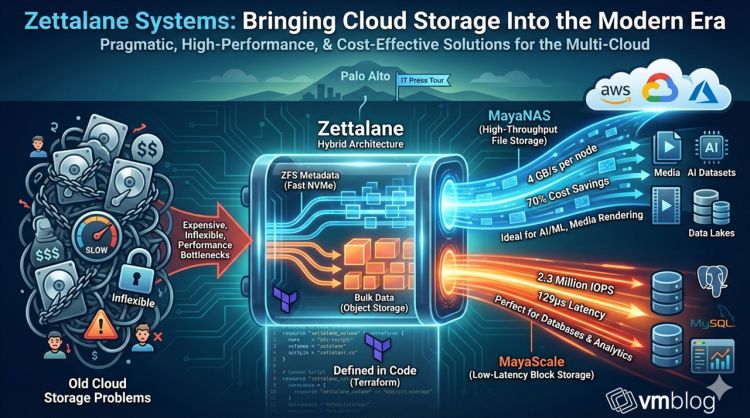
At the 66th IT Press Tour in Palo Alto last week, we sat down with Supramani Sammandam, founder and CEO of Zettalane Systems, to learn about a company that’s taking a refreshingly pragmatic approach to one of cloud computing’s thorniest problems: expensive, inflexible storage.
The conversation centered on two products that represent a genuine departure from how the major cloud providers think about storage. And after 25 years in systems software, including work on the original software-defined storage platforms in the 2000s, Sammandam knows what he’s talking about.
The Storage Tax Nobody Wants to Pay
Here’s the frustration that Zettalane is trying to solve. If you need network-attached storage (NAS) in the cloud today, you’re looking at a brutal choice: pay premium prices for convenience, or deal with severe limitations.
Take AWS EFS, for example. Block storage on AWS costs roughly $0.08 per gigabyte per month. But if you want managed file storage, you’re suddenly looking at $0.30 per GB per month. Do the math: 100 terabytes comes to $360,000 per year. That’s not a minor line item, that’s a budget killer for teams that need real storage capacity.
Even worse, performance doesn’t just come included. With AWS EFS and Google Cloud Filestore, you hit per-client throughput bottlenecks. Want more performance? You’re paying extra for IOPS on top of capacity. And most enterprise solutions have a hard floor: you need to commit to 100 terabytes minimum just to make the economics work. If you only need a terabyte, you’re out of luck.
“The small players are left out,” Sammandam said during the briefing. That’s the market gap Zettalane is targeting.
Two Products, One Philosophy
Zettalane has two distinct offerings, each addressing different workload needs:
MayaNAS is a high-throughput file storage system that combines ZFS with cloud object storage. The idea is elegant: metadata and small configuration files go on fast NVMe drives, while bulk data lives in object storage like AWS S3 or Google Cloud Storage. The result is 4 gigabytes per second of throughput per node with roughly 70% cost savings compared to traditional cloud storage options.
MayaScale targets the opposite end of the spectrum, low-latency block storage for databases and analytics workloads. It delivers 2.3 million IOPS with latencies around 129 microseconds, and it’s available in multiple performance tiers depending on your cloud provider and budget.
Both products deploy in minutes using Terraform scripts. There’s no complex configuration, no vendor-specific consoles. You define what you want in code, and it’s ready to go.
The Architecture Thing
The technical differentiation here is worth understanding because it reveals why Zettalane thinks differently about cloud storage.
MayaNAS uses what’s called a “hybrid ZFS special VDEV” architecture. ZFS is an advanced filesystem that Sammandam’s team has extended with a custom component called objbacker.io. Instead of FUSE-based approaches that split large I/O requests into tiny chunks, objbacker.io talks directly to the kernel’s ZFS layer and sends full-sized I/O requests directly to object storage. The result: 1MB writes stay intact, not fragmented.
This matters because object storage on major clouds can deliver massive bandwidth, 200 gigabits per second in some configurations, but only if you’re sending it large, concurrent requests. Traditional storage approaches can’t exploit that. Zettalane’s can.
For MayaScale, the differentiator is a server-side architecture for data mirroring. Most competitors do client-side replication, which means clients have to send writes twice and wait for acknowledgment from both storage nodes. Zettalane’s approach keeps that logic on the server side. The client writes once, the server handles replication internally. It’s faster, uses less network bandwidth, and doesn’t burden client applications with the complexity of managing redundancy.
Multi-Cloud Done Right
One thing that stood out: Zettalane treats AWS, Google Cloud, and Azure as genuinely different environments – because they are.
Google Cloud gets most of the company’s focus right now, and there’s a practical reason. GCP provides generous allocations of local NVMe storage on ephemeral instances and doesn’t cap network bandwidth the way AWS does. That hardware configuration aligns perfectly with Zettalane’s architecture. Azure, Sammandam noted, still lags in network performance for storage workloads, though Microsoft is working on that.
But here’s the key: Zettalane uses unified Terraform modules that adapt to each cloud’s quirks. It handles the networking configuration (jumbo frames on AWS, accelerated networking on Azure, Premium Tier 1 networking on GCP), the storage APIs, the failover mechanisms, all transparently. You don’t need to know those details. The scripts do.
Who’s This For?
Zettalane is starting with small businesses and developer-oriented companies. AI and ML teams that need to stream large datasets. Media companies doing video editing and rendering. Data engineers building lakes and ETL pipelines. Database teams running self-managed PostgreSQL or MySQL. CI/CD systems that need fast local storage for builds.
The company isn’t pretending to compete with enterprise monoliths today. They’re building the foundation for it. The current customer base is small (Sammandam mentioned “roughly about 10 people in the team”), but the focus is deliberate: get the product right, prove the value, then expand.
The Business Model
Zettalane uses straightforward per-vCPU pricing with no surprises. No per-gigabyte charges. No hidden IOPS costs. The products are available on all three major cloud marketplaces, so you can spin them up self-service. The company also plans direct sales for enterprise accounts and partnerships with systems integrators.
This matters. Too many storage vendors hide pricing complexity in their models. Zettalane’s approach – transparent, consumption-based, no surprise bills – aligns with how cloud-native companies think.
Why This Matters for Your Infrastructure
The storage problem Zettalane is solving is real and widespread. Cloud providers have never quite cracked affordable, performant NAS storage. They’ve optimized for their own ecosystem (EBS, EFS, managed services), but those solutions are expensive and inflexible.
What Zettalane is doing is interesting because it’s not trying to replace cloud provider storage wholesale. It’s using the cloud’s own tools, object storage, local NVMe, Terraform, to build something better. It’s cloud-native, not cloud-hostile.
The benchmarks are legitimate too. Zettalane provides reproducible scripts on GitHub that anyone can run. No marketing-speak. No cherry-picked numbers. Run the validation yourself.
Whether Zettalane becomes a major player in enterprise storage remains to be seen. The team is small, and going from 10 people to a sustainable business is never trivial. But they’re solving a problem that matters, their technical approach is sound, and they’re starting in the right place: with developers and small teams who have immediate pain points.
That’s how the best infrastructure companies get built.
##