At the 66th IT Press Tour in Palo Alto, we sat down with Robbie Litchfield, Co-Founder of Novodisq, a New Zealand-based startup tackling one of the most pressing problems facing modern data centers: the collision between exploding data growth and finite physical resources. What we heard wasn’t about raw performance metrics or another me-too storage solution. It was about the hard reality that power budgets, rack space, and data sovereignty are the new constraints holding back AI infrastructure.
The Problem Nobody’s Really Solving
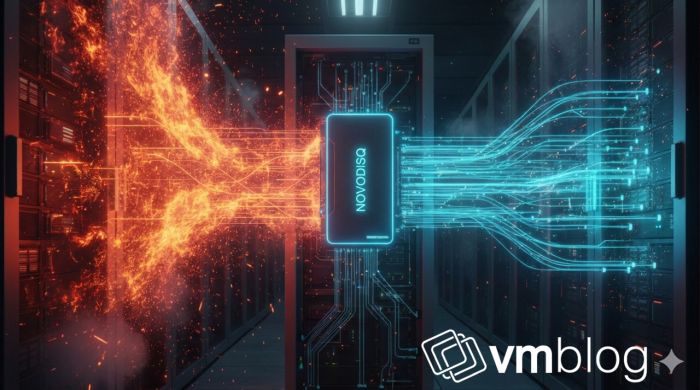
Let’s start with the uncomfortable truth. Global data is growing 20-30% annually. Meanwhile, power supply and data center capacity? Not so much. You can build faster GPUs all day long, but if you can’t reliably deliver training data at scale without melting your power budget, you’ve got a problem.
Novodisq calls this “hitting a wall.” Data centers are already capacity-constrained in key regions, with rack space booked out months in advance. But here’s the twist: the real bottleneck isn’t compute anymore. It’s the warm storage and caching layer-the stuff that sits between active data and cold storage. This layer is notoriously power-hungry and inefficient, yet it’s essential for modern AI pipelines that require constant data ingestion and access.
Add in the geopolitical dimension, and you’ve got another layer of complexity. Nations are increasingly demanding sovereign control over training data and inference pipelines, making on-premises and regional deployments not just preferable but necessary for many organizations.
A Hardware Company That Gets It
What makes Novodisq interesting is that they didn’t try to paper over these problems with software. They went the harder route: building custom hardware designed from the ground up for efficiency and sovereignty.
The company’s flagship product, the Novoblade, is a 2U blade server that stores up to 11.5PB of data while consuming roughly 1,200 watts at full capacity. To put that in perspective, traditional approaches would require significantly more power, more rack space, and higher operating costs. Their economics claim 10x density and 90% less power consumption compared to conventional HDD or Flash setups – which translates to 1/10th the power cost per gigabyte and 1/10th the rack space.
That’s not incremental improvement. That’s structural.
Three Products, One Architecture
Novodisq’s product roadmap shows some strategic thinking. Rather than chasing every market opportunity, they’re focusing on three variants of the same underlying platform:
- Novoblade DC: The flagship hyperconverged node for data centers, scaling up to 11.5PB in 2U
- Novoblade SME: A compact version for R&D, small and medium businesses, and power users
- Novoblade Edge: Still in development, aimed at telco, 5G, and edge AI ingestion
The unified architecture means they can reuse hardware, firmware, and software investments across markets. That’s smart from both an engineering and financial perspective.
The Real Differentiator: Custom Silicon
Here’s where it gets technically interesting. Novodisq isn’t just packaging off-the-shelf components. They designed their own SSDs and firmware to control the exact trade-offs they needed. Each blade includes an ARM-based Versal FPGA SoC (system-on-chip) that provides both storage management and compute capability.
Why build custom SSDs? Because commercial SSDs are optimized for either high-performance use cases or consumer-grade applications. What Novodisq needed was something optimized for the specific access patterns of warm storage-write once, read sometimes, maintained for years. That’s a different optimization problem entirely, and it required custom silicon.
The Novoforge development kit is their way of getting this technology into customers’ hands early. It’s a lower-power version that functions as both a testbed and a development platform, with 8 hot-swap drive bays, integrated FPGA I/O, and 16 networked Ethernet ports. It’s the kind of thing that lets customers validate their own custom deployments before committing to full production systems.
Use Cases That Actually Matter
During the briefing, several specific use cases came up that reveal where the real demand is:
Genomics and Medical Data: Genomic sequencing produces roughly 1TB per human genome sample, and these datasets are never discarded. Customers accumulate tens of thousands of samples annually, all requiring long-term storage and increasingly needing real-time processing. The Novoblade’s embedded FPGA can run genomics algorithms in parallel with data ingestion-processing, analyzing, and storing in the same system. It’s a compelling value proposition for research institutions and healthcare providers dealing with strict data privacy requirements.
Video and Surveillance Systems: Cities and business associations are increasingly building CCTV networks with local storage requirements for both cost and privacy reasons. The Versal SoC includes video codecs and AI cores, so you can inline re-compress video, run AI models on it, and store the results-all in one system. That’s powerful for building decentralized surveillance infrastructure.
Backup and Restore: A production case study showed Novodisq replacing backup staging infrastructure for an IT service provider. They needed fast tape backup operations without expensive SSD deployments. By placing a Novodisq system between their primary systems and tape library, they could hold 3-4 weeks of backups online with restore times measured in minutes rather than hours. The hardware-accelerated RAID, checksumming, and encryption handled everything without hitting the CPU.
Kubernetes and Microservices: Private sector and public sector customers are already asking about migrating containerized workloads from hyperscalers to Novodisq infrastructure. Since it runs standard Linux with no proprietary OS, existing deployment stacks work as-is. They’re planning partnerships with vendors like Red Hat to provide long-term support.
Sovereign Infrastructure: This is the one that keeps coming up in customer conversations. Organizations want to own and operate their own infrastructure, particularly in regulated sectors like healthcare, legal services, and government. A fully self-contained 2U system with redundant power, networking, and storage makes that practical.
Competitive Positioning
The competitive landscape breaks into three categories, and Novodisq has thought through where they fit.
Hyperscalers (AWS, Google, Microsoft) dominate through sheer scale but are expensive, power-hungry, and come with sovereignty concerns. Legacy storage vendors (Pure, WD, Huawei) offer low-density, high-opex solutions that don’t solve the power problem. Regional integrators patch together custom solutions but lack a cohesive vision for AI pipelines.
Novodisq is positioning as the alternative for organizations that need density, efficiency, sovereignty, and purpose-built AI ingestion – not just point solutions.
Go-to-Market Strategy: Measured and Methodical
The company isn’t trying to boil the ocean. Year one focuses on 60-250TB trials with early adopters, largely MSPs and engineering-heavy organizations willing to do some customization work. Year two is land-and-expand, establishing partnerships and growing manufacturing capacity. Year three is where they expect to see 50%+ year-over-year ARR growth with major alliances.
Pricing starts simple: MVP hardware sales, value-added support contracts in year two, bundled software contracts in year three. During the briefing, they mentioned they’re in discussions with potential customers whose deployments could reach $100 million annually, which gives some sense of the scale they’re targeting.
The Supply Chain Question
One journalist asked about memory price volatility – a fair concern given current market conditions. Novodisq has pre-booked inventory with Micron and has secured relationships with key component suppliers (AMD for SoCs, Microchip for SSD controllers). They’re also designing flexibility into their stack so they can source memory from multiple vendors as they scale.
They’ve also made an interesting commitment: while designed and assembled in New Zealand today, they’re open to manufacturing in Europe or North America if regional partners want to handle design-to-manufacture themselves. That’s a pragmatic acknowledgment that supply chain security matters to their customers.
What This Means for Infrastructure Operators
If you’re an infrastructure operator or IT service provider wrestling with the reality of power constraints, Novodisq represents a genuinely different approach. Not just faster, not just cheaper, but fundamentally rethinking the trade-offs between density, efficiency, compute capability, and sovereignty.
They’re not trying to replace hyperscalers. They’re trying to give organizations an alternative to hyperscalers for workloads where efficiency, data residency, and cost of ownership matter more than raw compute power.
The company is still in early stages. They’re signing proof-of-concept deals now across multiple verticals (genomics, surveillance, backup, Kubernetes deployments). They’re looking for pilot customers and additional funding. But the technical foundation is solid, the market problem is real, and the team has relevant experience.
Whether Novodisq becomes a major player depends partly on execution, partly on market timing. But they’re addressing a constraint that’s only going to get tighter: the question of how you build data infrastructure when power is the limiting factor, not compute.
##