By Tom Butler, VP of WW Commercial Portfolio and Product Management, Lenovo
The conversation around AI has shifted from promise to practical application. As organizations begin executing 2026 business strategies, a key challenge is bridging the AI fluency gap among everyday professionals. According to Boston Consulting Group, only one-third of employees have been trained to use AI, even as 42% of enterprises are exploring its potential.
As businesses have long measured value through operational efficiency, they will increasingly assess AI by how effectively it helps teams stay focused, perform at a high level and adapt in a world where speed and resilience matter more than ever. This shift in expectations is redefining what organizations require from the solutions that power their workforce. In a work environment defined by constant change, AI PCs offer a huge opportunity to be the infrastructure that unlocks both productivity and human potential at scale.
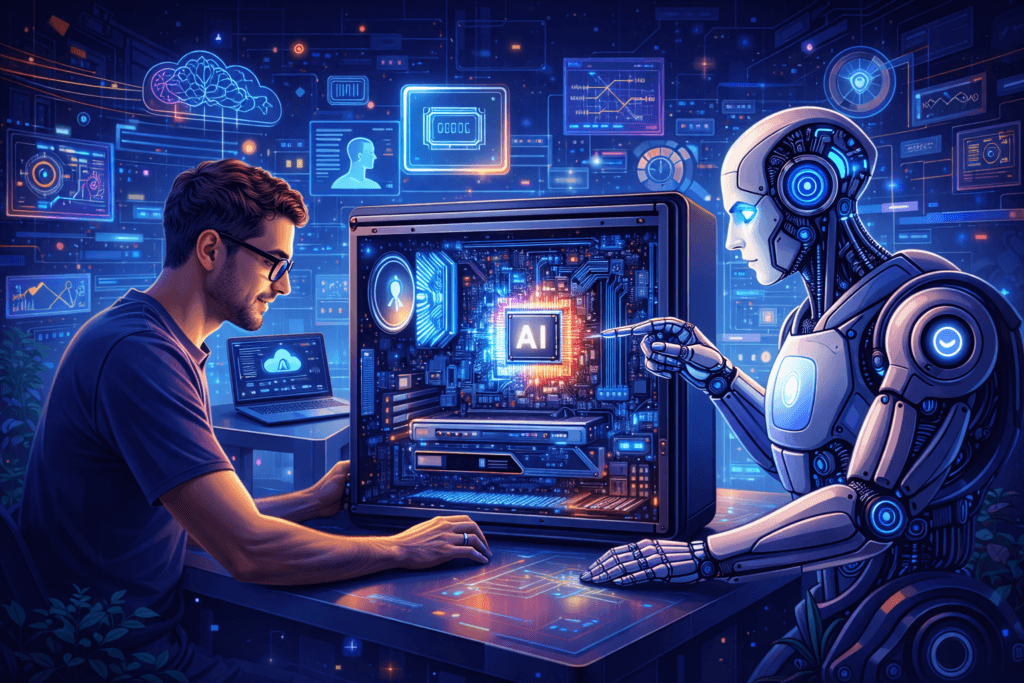
As AI moves from experimentation to everyday execution, the true measure of AI’s value will no longer be raw computational power. It will be its ability to help humans elevate their everyday tasks. Next-generation AI PCs will close the AI fluency gap by enabling secure, intuitive and truly personal AI experiences, delivered through a hybrid AI architecture that intelligently spans device, edge and cloud.
The New Performance Divide: AI-Ready Employees vs. Everyone Else
The biggest barrier to AI-driven performance is not access to tools, it’s human readiness. Without the right devices and experiences, AI adoption stalls at the employee level. With adoption outpacing workforce preparedness, the absence of intuitive, secure devices prevents AI from translating into meaningful productivity gains for employees.
The goal is not a worker-free enterprise, but a work-redefined enterprise: adaptive, creative, and profoundly human at its core. Being “AI-first” only succeeds when it is, above all, people-first.
Gartner predicts that by 2028, 40% of employees will be trained and coached by AI when entering new roles, up from less than 5% today. Further, research shows that 60% of workers feel they lack the skills needed to effectively use AI at work, reinforcing the need for more intuitive, built-in AI experiences. To close the fluency gap, workers will need to rethink how they interact with the device itself.
Physical design innovations help ensure devices fit the many ways people actually work. Rather than requiring people to conform to rigid input models, devices are evolving to adapt to how work naturally happens, incorporating voice, touch, gesture, and situation-aware experiences. This evolution is central to the rise of personal AI, where intelligence adapts to the individual, understands context, and evolves alongside how each employee works.
AI PCs Redefine Performance by Embedding Intelligence at the Edge
Next-generation AI PCs extend AI beyond the cloud to the device, enabling faster, more reliable, and more personalized human-AI collaboration. Research from Lenovo’s 2026 CIO Playbook found that 84% of organizations prefer on-premises or edge deployments as part of a hybrid AI environment.
Additionally, a study from Research and Markets, the global edge AI market is projected to grow from an estimated $24.05 billion in 2025 to approximately $356.84 billion by 2035. As the global edge AI market continues to grow, AI PCs will not just become productivity tools; they’ll become operational endpoints in modern business ecosystems.
On-device AI reduces latency and dependency on connectivity. Solutions with built-in advanced AI acceleration can also enable improved cooling, contributing to higher sustained performance and energy efficiency. Devices built with sustainability improvements in mind can handle demanding workloads from analytics to content creation with ease. Dedicated NPUs enable real-time assistance for tasks like content creation, analysis, and collaboration which supports improved collaboration for businesses of all sizes.
Secure, Smarter Devices Enable Trust and Resilience at Scale
Legacy systems are not only expensive to maintain, but they may create security vulnerabilities that are difficult to address. Modernizing applications can significantly improve their performance and efficiency. According to a tech report, only 5% of organizations feel highly confident in their AI security preparedness, and one in five organizations has already experienced a cyberattack due to “shadow AI” security issues. In a hybrid AI model, where workloads move intelligently between device and cloud, security must be embedded at every layer.
AI PCs support a more secure-by-design architecture, keeping sensitive data local. By processing data locally rather than in the cloud, AI PCs can better protect sensitive data and potentially offer faster, more private AI interactions. As the workforce adapts with new solutions and new generations of workers, devices will need to be purposefully designed for AI to meet the evolving needs of modern professionals.
Powering the Next Era of Workforce Performance
Looking ahead, the organizations that lead will be those that design work around human potential rather than technological capability alone. AI PCs signal the next evolution of the workplace, where intelligence is seamlessly embedded into the tools employees use every day, enabling them to think faster, collaborate more deeply, and respond with confidence to constant change. As AI becomes a permanent collaborator in how work gets done, investing in secure, adaptive, and AI-ready devices will be essential to building workforces that are not only more productive, but more resilient, creative, and prepared for what comes next.
As organizations plan for 2026 and beyond, success will depend less on how much AI they deploy and more on how effectively it helps people do their best work. AI PCs represent a fundamental shift in how technology supports employees by turning everyday devices into intelligent partners that accelerate learning, sharpen focus, and enable continuous adaptation. As hybrid AI architectures mature, the PC becomes more than a productivity tool, it becomes the personal AI engine for each employee.
##
ABOUT THE AUTHOR

Tom Butler joined Lenovo in 2005 and is currently the VP of WW Commercial Portfolio and Product Management. His responsibilities include global portfolio strategy, innovation planning, and customer engagement across the Large Business, Education and Government segments for the next generation notebook, detachable, and new category devices. Prior to joining the Worldwide team, Tom worked in the North America region leading the Product teams with ownership of the full commercial portfolio (devices, services, software, and partners). Tom has also held various leadership positions in the Americas and in Worldwide during his career at Lenovo.
Before joining Lenovo, Tom was Director of User Support Services at Meredith College overseeing the IT Support team and the ThinkPad University Program. As a 20+ year veteran of the IT industry, Tom has worked across leading IT and Telco companies including Cisco, Ericsson, and several smaller start-ups.
Tom holds an MBA from the Jenkins Graduate School of Management, North Carolina State University and a Bachelor�s Degree from Western Carolina University. Tom is based in Raleigh, NC.