By Julie Davila, VP of Product Security at GitLab
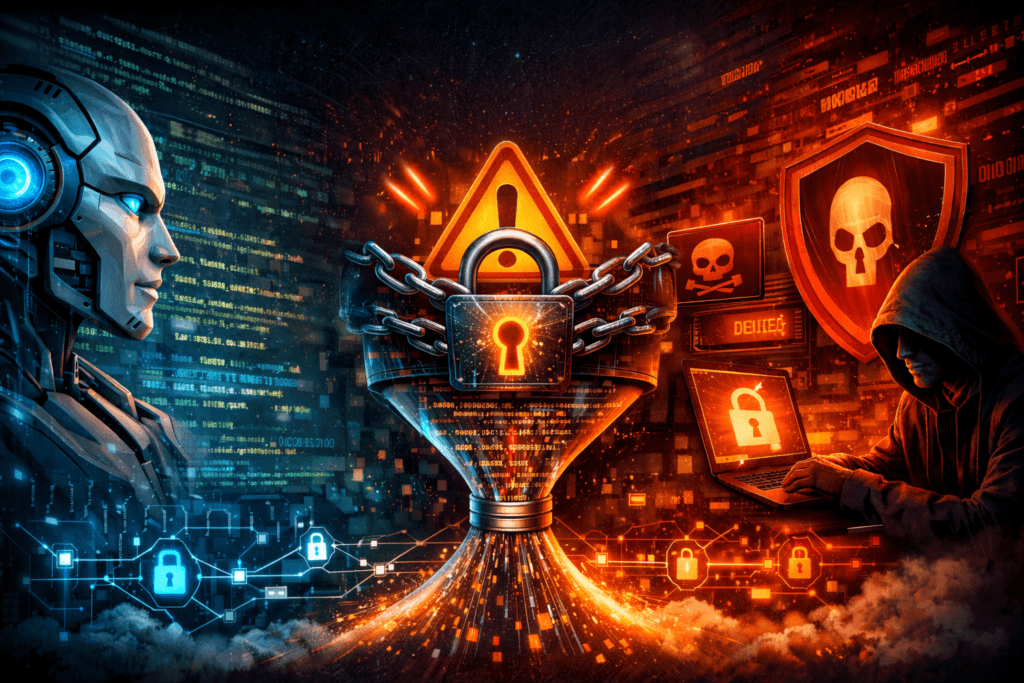
AI code assistants are not yet delivering the 10x productivity boost the industry expected. A recent GitLab survey of DevOps practitioners found that while more than one-third of code is now written by AI, practitioners ranked quality control and security vulnerabilities introduced by AI as the top adoption challenges. As organizations deploy AI coding tools at scale, these problems are overwhelming their security teams. AI set out to accelerate development, yet organizations now face security review bottlenecks that outpace the efficiency gains it delivers.
Security engineers who previously reviewed 100 lines of code per hour can now face 100,000 lines of code because AI contributed to that code. Meanwhile, attackers are already using autonomous agents to rapidly detect flaws in existing systems. As risks escalate and security backlog growth accelerates, our capacity to defend remains constrained.
We’ve already seen this challenge before, but security processes that depend on human toil could be easily overlooked when code volumes were manageable. Now, AI’s complexity is making product security work exponentially harder. If we don’t address these scaling challenges quickly, the window to secure AI-scale development will become trickier to close.
Two compounding failures fuel these bottlenecks. Understanding them is the first step toward avoiding them.
You can’t adopt AI without scaling security reviews
The “shift left” movement aimed to address security bottlenecks by shifting security responsibility to developers earlier in the software development lifecycle (SDLC). Adding security testing to development workflows sounds good in theory, but forcing developers to address security checks that often flag false positives is suboptimal. We can unintentionally add hours to their workday without considering incentives. Developers find workarounds because they need to ship features on a deadline.
The shift left approach overlooked the full SDLC, and teams absorbed the downstream consequences. We’re making the same mistake with AI code assistants.
These assistants optimize for code generation while leaving the review process unchanged. The solution isn’t adding more people or more tools in isolation. A holistic view of the entire pipeline is essential.
The organizations that avoid this trap map their value streams before adding more AI tools. This is in addition to documenting processes that rely on tacit, institutional knowledge, which complicates how teams define and measure the value AI delivers. Without documented processes, teams cannot measure the efficiency AI brings or demonstrate its value.
Leaders should also implement scalable review methodologies that combine AI with practical human oversight, establishing prioritization frameworks based on measurable risk. For instance, code that touches sensitive customer data or production databases requires a much more intensive review than a feature to customize an application’s theme.
The friction between traditional security frameworks and AI agents
Traditional security frameworks assume predictable human behavior. AI agents don’t follow those rules, and the result is an entirely new class of risk.
The complexity multiplies when agents interact with other agents across organizational boundaries. When instructions pass through multiple agents before reaching an internal system, malicious requests can become much more difficult to detect; security models need to account for this layered complexity.
Avoiding these issues requires developing security controls to limit permissions and monitor agent behavior. Emerging approaches, like establishing composite identities for AI systems, can help tie AI activity to human accountability by tracking which agents performed specific actions and who authorized them.
Building system design fluency within security teams also strengthens the team’s ability to assess how a new AI implementation may affect existing security boundaries. Many security engineers today struggle to articulate how the backend of an LLM actually works, but understanding how an AI system is designed is fundamental to understanding AI security risks. This doesn’t require deep engineering expertise for every component, but rather a basic understanding of how the pieces fit together to achieve outcomes, much like security professionals understand how web applications work.
Here’s what lies ahead
Most organizations will build AI capabilities on imperfect systems over the next two years, because halting development is not realistic. It’s the right choice. No single solution will work for every organization to secure AI-driven development. Success requires acknowledging risk, managing it with intention, and steadily working toward doing things the right way.
Security teams also can’t solve these failures alone. Recent research from DX shows that while 91% of developers now use AI tools and report saving 3-4 hours per week, organizational dysfunction, including meetings, interruptions, slow code reviews, and CI wait times, is costing teams more time than AI saves. Quality outcomes also vary among organizations, with some seeing improved change failure rates and faster delivery, while others are drowning in technical debt.
The gap between organizations that succeed and those that struggle comes down to engineering practices and culture, not the AI tools themselves. As continuous delivery expert Bryan Finster observes, “AI is an amplifier. If your delivery system is healthy, AI makes it better. If it’s broken, AI makes it worse.”
The failures are rooted in upstream problems that AI now exposes at scale. Security reviews sit at the end of this chain, inheriting every weakness that came before.
Security teams must become active advocates for the engineering practices that enable secure AI-driven development, including documented processes, a strong testing culture, and continuous delivery principles that embed security throughout software delivery. Ultimately, the quality of what enters the security review process determines what security teams can accomplish.
The organizations positioned to succeed are those that address these challenges today, before the scale of AI-generated code places them permanently out of reach.
##
ABOUT THE AUTHOR

Julie Davila is VP of Product Security at GitLab, where she enables critical infrastructure software factories to develop secure software faster. Her career has spanned from US Army service to NASA, where she helped implement the first federal AWS migration. Julie built early AWS integrations at Ansible, grew a multi-million dollar consulting practice at RedHat, co-founded the email security startup ZibaSec (achieving FedRAMP authorization in under two years), and led global field CTO teams at Sophos. She is passionate about finding diverse engineering talent, prioritizing employee well-being, and mentoring women and veterans in technology. Julie’s approach balances technical innovation with practical security-always believing the hardest problems are best tackled with a team you can trust.