By Jim LaRoe, Symphion
A Legacy of Obscurity
I don’t care about printers. It’s a common thought. For years, most leaders have not spent any time thinking about printers. They printed. They scanned. They sat quietly on the network and generally worked. Security teams focused on servers, endpoints, identities, and users. Infrastructure teams focused on availability. Printers and similar connected IoT endpoints rarely crossed anyone’s mind, let alone landed on a priority list. They’ve been treated more like appliances or supplies to be procured, not as infrastructure to be governed. They’re ordered through procurement catalogs, outside of IT, information security, governance, regulatory and compliance functions, out of sight out of mind.
Identity is the New Edge: Why Printers Suddenly Matter
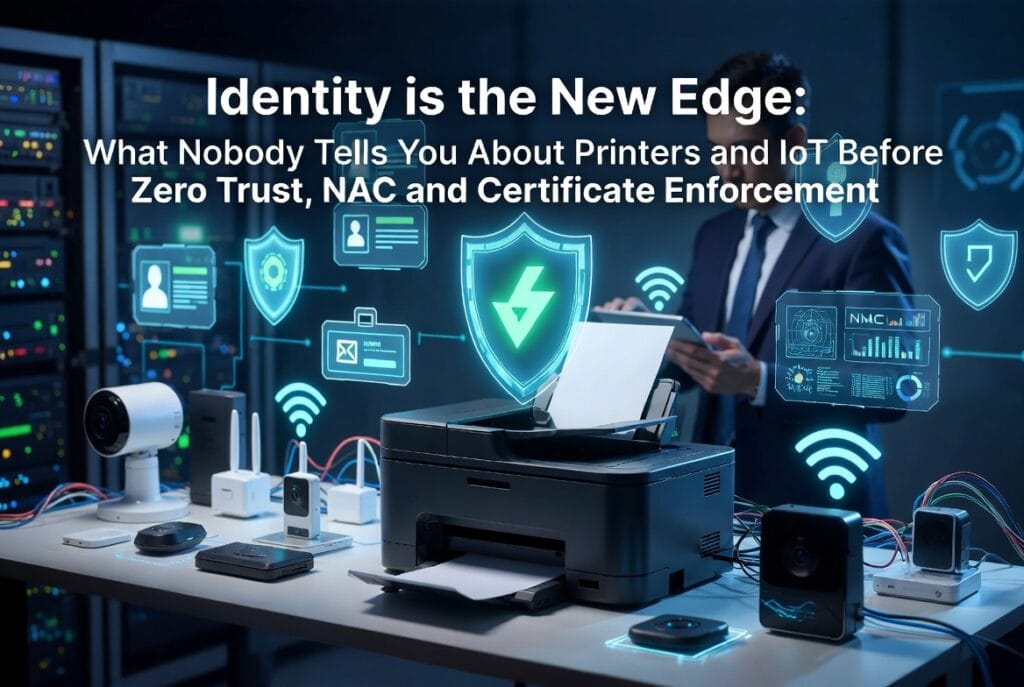
That thinking changes quickly as organizations respond to rising cybersecurity threats by modernizing networks, moving beyond perimeter defenses and strengthening trust at the endpoint. In cybersecurity, the edge is shifting from the network itself to identity including protection of data in flight. Zero trust initiatives, NAC and segmentation efforts, certificate-based identity, audit expectations and network modernization introduce a new reality: printers and connected IoT endpoints increasingly must authenticate and prove trust in ways they never had to before.
The reason is pretty simple. In a zero-trust world, devices are no longer trusted simply because they sit on the network and data in flight to and from them must be protected. Increasingly, they have to continuously prove identity to gain and keep access.
What surprises many organizations is not that printers suddenly matter, but that printer and IoT identity turn out to be very different from what they already know about PCs, servers, and traditional endpoint management. That is often the moment organizations realize that they’re no longer dealing with familiar endpoint tooling and management models, but with the operational realities of the Internet of Things.
Why Printer and IoT Identity Is Different
What surprises many organizations is that identity becomes operational quickly. The challenge is understanding device capability, firmware dependencies, authentication readiness, operational workflow disruption and sustaining trusted identity afterward.
Most security and infrastructure teams initially assume that printer and IoT identity will work like everything else: install an agent, push policy, deploy certificates and monitor centrally.
Printers and connected IoT endpoints do not work that way. The environment is highly disparate. Device capabilities vary widely by manufacturer, model, age, firmware level, and type. Some devices support modern certificate methods. Others support only subsets. Some require remediation before certificate-based authentication can function at all. Certificate locations, authentication methods, supported formats, and management interfaces vary widely even in a small fleet and can change with firmware updates. Most importantly, unlike PCs and servers, there is no common native cross-vendor management layer across all printers or other IoT. The operational implication is that identity quickly becomes less of a PKI project and more of a sustained endpoint operations challenge.
Why Identity Becomes Operational
Very quickly, identity becomes an operational problem—and, most often, a highly manual one. Before identity can even function reliably, organizations must first establish and continuously maintain accurate inventory in an environment that changes constantly. They need to know what devices actually exist, whether they are capable of participating in certificate-based authentication, what firmware state they are in, what credentials are required to access them, where certificates must be installed, what certificate signing request formats they support, and whether operational workflows can tolerate change during deployment, for all devices and at all times.
Then comes the part organizations usually underestimate: execution. Each device in the fleet must be logged into at the device console or using that manufacturer’s brand- (and often model-) limited software to access the device’s features. Credentials are located. Capabilities are verified. Firmware dependencies addressed. Certificate requests are normalized. Certificates applied to the correct locations. Authentication validated afterward. In most environments, changes must occur carefully to avoid disrupting workflows already dependent on the devices, i.e., during identified maintenance windows or off hours. At small scale, this feels tedious. At enterprise scale, it becomes operationally overwhelming if not impossible.
What Organizations Often Assume
Organizations often begin printer and IoT identity initiatives assuming existing security and IT tools will solve the problem. Certificate lifecycle tools help govern certificates. NAC and Zero Trust platforms enforce trust decisions. Vulnerability scanners identify exposure. Managed print focuses on uptime. Traditional IT operations manage general infrastructure.
What surprises them is that none of these functions, by themselves, continuously sustain trusted identity across highly mixed printer and IoT fleets. The challenge is not deploying identity. The challenge is operationalizing and sustaining it.
Why Traditional Teams Struggle
Organizations often discover that no existing role naturally owns printer and IoT identity operations. Security teams identify risk but do not operate fleets. IT operations teams often lack device-specific cycles. Managed print providers optimize uptime and service delivery. Procurement manages contracts. Network teams increasingly own enforcement. Identity becomes operational, but nobody steps in to own it.
What Happens When Identity Breaks
Identity for printers and connected IoT endpoints is not static. Factory resets—common in printer environments by technicians after servicing the device—can remove certificates entirely. Firmware remediation or device replacement may require identity to be reapplied. Certificates expire. Device state changes.
If identity is not required for network access, these failures may go unnoticed. Devices quietly drift outside intended policy and trust assumptions, exposing the business and the edge. This is one reason organizations incorrectly assume identity is functioning until enforcement begins.
If identity is required for network access, the consequences become operational. Devices fail authentication, fall into network exceptions, lose connectivity, or stop participating in workflows. What begins as a certificate problem can quickly become a business problem. Labeling slows. Scanning breaks. Clinical, manufacturing, distribution and revenue workflows get disrupted.
This is especially important because many of these endpoints sit inside revenue-critical workflows. When authentication fails, the effect is larger than the device itself. When authentication fails broadly across a location, operations can come to a halt.
Why This Gets Harder Faster
The problem becomes even harder as certificate lifecycles are shortening. What was once an occasional maintenance event increasingly becomes recurring operational work. Certificates must be maintained, revalidated, and sometimes reapplied across highly disparate fleets whose identity posture can change through resets, remediation, firmware incompatibility, or replacement. The challenge is not simply deploying identity once. The challenge is sustaining it.
Questions to Ask Before Enforcement
- Do we know what devices exist?
- Which devices support certificate-based authentication?
- What firmware dependencies exist?
- What happens after resets, replacement or firmware changes?
- Who continuously owns identity operations?
The surprise isn’t that certificate-based identity matters. It is how quickly printer and IoT identity becomes an operational challenge once enforcement begins—and how few organizations are prepared to sustain it over time.
ABOUT THE AUTHOR

Jim LaRoe is Symphion’s (https://symphion.com) dynamic leader with a special combination of skills, experience and insight that has driven Symphion’s success since inception to the world’s leader in print fleet cyber security. Symphion’s focus has been on continual innovation, seamless delivery, affordability of its solutions and a dedication to excellence in customer service. Follow Jim on LinkedIn: https://www.linkedin.com/company/symphion