A VMblog field report from the 68th IT Press Tour, Boston
Most storage briefings I have sat through over the past two decades begin the same way: an architecture diagram, a throughput chart, and a roadmap slide promising the customer everything by next quarter. The Wave Domain session at the 68th edition of the IT Press Tour in Boston did none of that. It began with a 95-year-old physicist, a parrot photographed in 1891, and a deliberate pair of puns about “exposing” the room to a technology and a method “developed” 140 years ago.
For a data center audience, that framing matters more than it might first appear. And I must apologize in advance, as this truly was one of the first briefings I’ve ever joined where I felt amazed at the possibilities, while also feeling like I know very little. This technology was truly forward looking, as I’ll explain.
The two words Wave Domain co-founder Bob Miller played with — exposure and development — are the literal chemical steps this storage medium runs on. This is not a metaphor. It is silver-halide photographic chemistry, repurposed to store digital data in light, and it is one of the more genuinely different ideas to cross an IT Press Tour stage in years.
So I’ll do my best to lay out, for the administrators, architects, CTOs, and infrastructure planners who read VMblog, what this technology actually is, why it could matter, and the very real reasons it is still a long way from your data center.
What Wave Domain is building towards
The technology is called Standing Wave Storage (SWS), and the archival concept wrapped around it has carried the working name WORF — write once, read forever.
Here is the short version. Take the silver-halide chemistry behind the world’s first color photographs, divide a glass plate into a grid of pixels, and store digital data inside the colors captured at each location rather than rendering a picture. The science traces directly back to French physicist Gabriel Lippmann, who won the 1908 Nobel Prize in Physics — the only Nobel ever awarded for a photographic method — for full-color photography based on the interference of light.
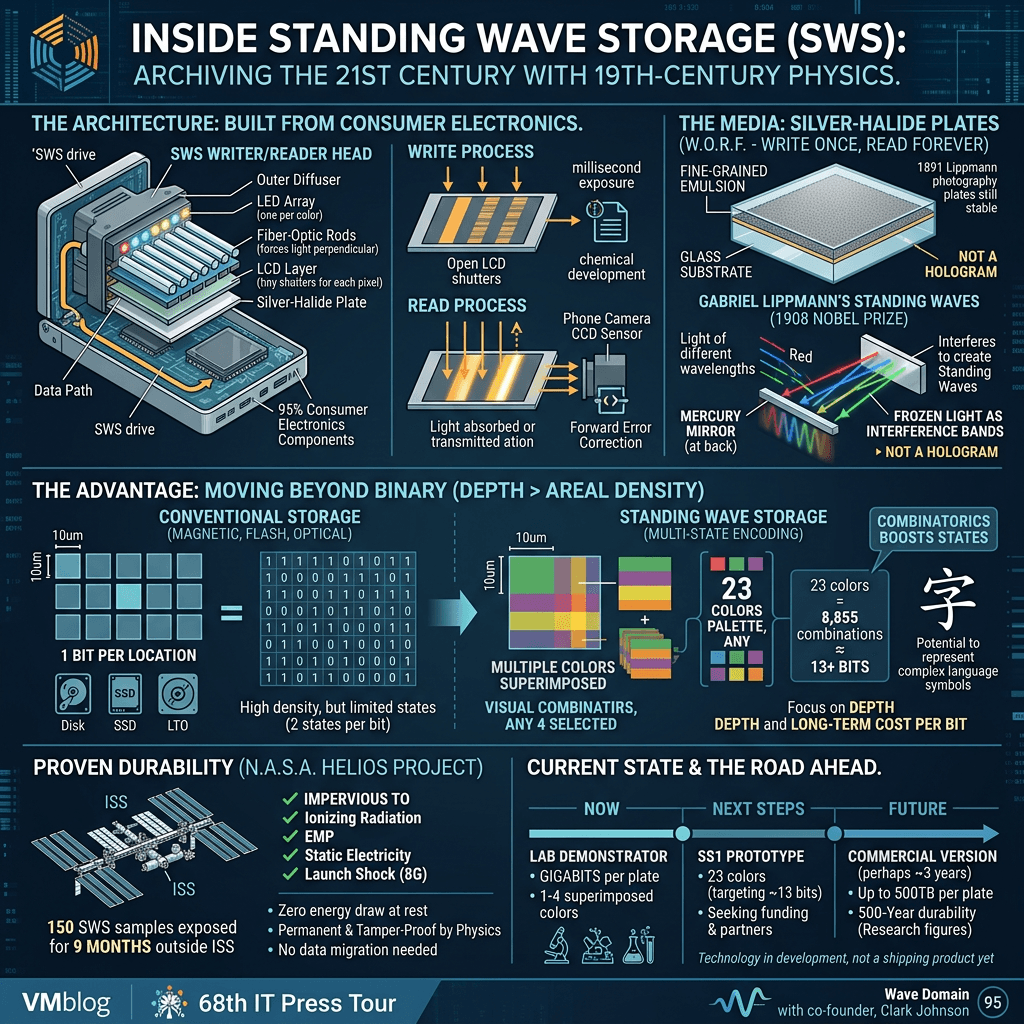
Lippmann’s plates used no dyes. Light entered a fine-grained emulsion, bounced off a mercury mirror at the back, and interfered with itself to create standing waves. Every wavelength that struck the plate reinforced itself and froze in place as bands of exposed silver. Co-inventor Clark Johnson, an IEEE Life Fellow who at 95 remained the sharpest explainer of his own physics in the room, was emphatic on one point: this captures standing waves, and it is not a hologram.
The results in Lippmann’s day were beautiful and commercially useless. Each plate was a one-off that could not be copied, and exposures ran into minutes. The art form survived only as a fringe pursuit. But that same property — extreme physical permanence — is exactly what makes it interesting as a long-term storage medium today.
The big takeaway: storage that isn’t binary
This is the single most important concept for a technical audience to absorb, and it is what separates SWS from every other storage technology on the market.
Conventional storage — magnetic, flash, optical — can pack bits densely, but each physical location still holds one binary choice: a 0 or a 1. Standing Wave Storage records up to four superimposed colors in a single location, selected from a palette of distinct narrow-band colors. A single pixel, roughly 10 micrometers across, can hold several colors at once, and they can overlap rather than sit side by side.
The power is in the combinatorics. Wave Domain’s first real prototype targets 23 colors with any 4 selected, which yields 8,855 distinct combinations per location — a little over 13 bits where today’s media manages one. The roadmap extends to 32 colors, and every additional color multiplies the number of possible states dramatically. As Johnson put it, a single location could in principle represent the entire Chinese alphabet.
When I and other journalists pressed on areal density — the number every storage person reaches for first — Miller deliberately redirected. His thesis is that the metrics for the future of long-term archiving are different:
- Depth — the number of states per storage location.
- Cost per bit over long time horizons.
Areal density, he argued, is the wrong first question for forever-storage. Whether the market agrees is one of the open questions, but the framing is a serious one worth debating.
The drive is mostly a cell phone
For anyone who has watched competing archival technologies struggle with exotic, expensive hardware, the SWS device architecture is refreshingly mundane — and that is the point. Johnson walked through it part by part, noting that roughly 95% of the componentry comes from consumer electronics:
- An outer diffuser, like the layer spreading light behind a phone screen.
- An array of monochromatic LEDs, one per color.
- A bundle of fiber-optic rods to force the light perpendicular and uniform.
- An LCD layer acting as banks of tiny shutters, opened and closed under firmware control.
- The silver-halide plate itself.
To write, the system flashes each color in turn while the shutters over each pixel open only for the colors that location is meant to keep. The full plate is exposed at once, in milliseconds, then chemically developed so the exposed silver darkens and the pattern locks in permanently.
Reading runs the process in reverse with a CCD sensor of the kind in any phone camera, flashing the colors again and detecting which ones each pixel absorbs. Because the entire plate reads in well under a second, the potential for massively parallel readout is significant. Error handling, importantly, is forward error correction at the channel level rather than bit-level remapping — you cannot patch a written plate the way a disk drive remaps bad sectors, so correction has to be built in up front.
The cost implication is the headline: no femtosecond lasers, no vibration-isolated optical benches. Miller suggested a reader could eventually cost in the hundreds of dollars because it is assembled from parts already rolling off consumer electronics lines.
Why it survived nine months bolted to the space station
The durability story is where SWS stops sounding like a museum curiosity. Properly processed silver-halide images stay chemically stable for well over a century — the reason Lippmann’s 1891 plates still glow.
To prove the data case, the team sent roughly 150 SWS samples to NASA, which exposed them outside the International Space Station for nine months under a project nicknamed HELIOS (Hardened Extremely Long Life Information and Optical Storage). NASA paid for the test. The plates returned with no measurable degradation, deemed in the final report effectively impervious to:
- Ionizing radiation
- Static electricity
- Electromagnetic pulse (EMP) and power surges
- The 8G shock of launch
Stack up the inherent properties and the enterprise appeal becomes clear:
- Permanent and unchangeable once written — tamper-proof by physics, not policy.
- Zero energy draw at rest — a developed plate simply sits there.
- No migration, ever — eliminating the recurring tax that consumes archival budgets.
- Data, human-readable images, and metadata on the same substrate — a plate can carry its own visible label.
The honesty section: nowhere near a product yet
To Wave Domain’s credit, no one had to drag the caveats out of them — Miller volunteered them, and VMblog readers deserve the same candor.
The headline figures you will eventually hear — up to 500TB per plate and 500-year durability — come from research into Lippmann photography, not from a shipping product. “We are nowhere near there,” Miller said plainly. Today’s reality is on the order of a couple of gigabits on a four-by-five-inch plate.
What the team has done is methodically knock down the original objections:
- Exposure time, once measured in Lippmann’s minutes, is now under half a second and dropping.
- Pixel size is down to 2 micrometers.
- They have gone from one color to four superimposed and recoverable in a single location — work largely validated years ago with the U.S. research body MITRE.
- Seven patents have been granted.
The current state of play is a credible lab demonstrator chasing its first proper prototype, called SS1, with 23 colors. Earlier work drew about $1.5 million and involved NASA, the National Security Agency, and the Naval Research Laboratory. The next step needs roughly $5 million more, with an early commercial version perhaps three years out — if the funding materializes.
Where it sits against the other forever-storage bets
For data center planners, the useful question is how SWS compares to the growing field of cold, permanent, low-energy archival contenders:
- Tape (LTO) — the incumbent and the real target. Cheapest medium, air-gappable, but requires generational migration and hides cost in libraries, drives, and second copies.
- Microsoft Project Silica — data written into quartz glass with femtosecond lasers, claiming readability for thousands of years.
- Cerabyte — ceramic-on-glass tablets etched with femtosecond lasers, backed by notable strategic investors and aggressive public visibility.
- DNA storage — the other long-horizon molecular play.
- Nanoparticle optical disks — academic work demonstrating multi-terabyte capacity with multi-century lifespans.
Wave Domain’s differentiators are the multi-state encoding that none of the binary approaches share, and the off-the-shelf optics that spare it the laser and microscopy costs the glass and ceramic players carry. The catch is that it is the least commercially mature of the group.
The business model and the visibility problem
Ask who builds the readers, writers, and plates, and the answer is: not Wave Domain. The plan is to license designs the way Arm licenses chip cores, leaving manufacturing to partners. Two outside optics-and-systems firms are already competing to build the SS1 prototype, and the specialist emulsion supply chain has more than one source.
The company grew out of a technology-licensing background — co-founder Bob Miller ran a monetization practice before meeting the inventors — and the team consulted operators of genuinely large archives to shape requirements.
Then there is the elephant in the room that the assembled journalists could not let go: Wave Domain is nearly invisible by choice. No website. Unrelated “Wave Domains” clutter search results. A single, dated press release. As Miller candidly admitted, that one release did not bring partners knocking. The equation is simple and the team knows it — no website plus no search presence equals no fundraising.
The clock the whole thing is racing
What gives this story unusual weight is the age of the people carrying it. Of the three original inventors, one passed away in 2025. Johnson is 95. His surviving co-inventor is in his 80s and runs the lab where much of the work still happens. “We didn’t want to start a company, because that’s a 24/7 type of job, and we don’t have 24/7 in us anymore,” Johnson said. A younger chief technology officer is now driving the engineering, and the team is openly seeking a partner — or a buyer — with the energy to take what Johnson cheerfully calls “a laboratory curiosity” and run with it.
He also hinted at ambitions beyond archiving: edge and embedded systems where data is encoded to stay inside your own hardware, never touching the internet, and even applications in tokenization. That is the next white paper, not the current demo — but it signals the team views SWS as more than cold storage.
The bottom line for VMblog readers
Here is my honest read after 20-plus years covering data center technology. The underlying science is real, the durability is genuinely tested in one of the harshest environments available, and the physics of multi-state storage is meaningfully different from everything else touring the circuit. The “drive built from phone parts” is a clever answer to the cost problem that dogs glass and ceramic approaches.
But the gap between a gigabit-scale lab plate and a terabyte-scale product is enormous, the company is invisible by choice, and the people who understand it best are openly racing the clock. Wave Domain is, today, a science experiment in search of funding and partners — not a product you can evaluate, pilot, or buy.
For infrastructure leaders, the actionable takeaway is not “deploy this.” It is “watch this.” If a well-funded partner steps in, the notion of archiving the 21st century with a Nobel-winning trick from the 19th century stops being a curiosity and becomes a roadmap worth tracking. For now, it is a beautiful plate of frozen light, looking for someone with the runway to finish it — and a name worth keeping handy… assuming they don’t change the name.
##