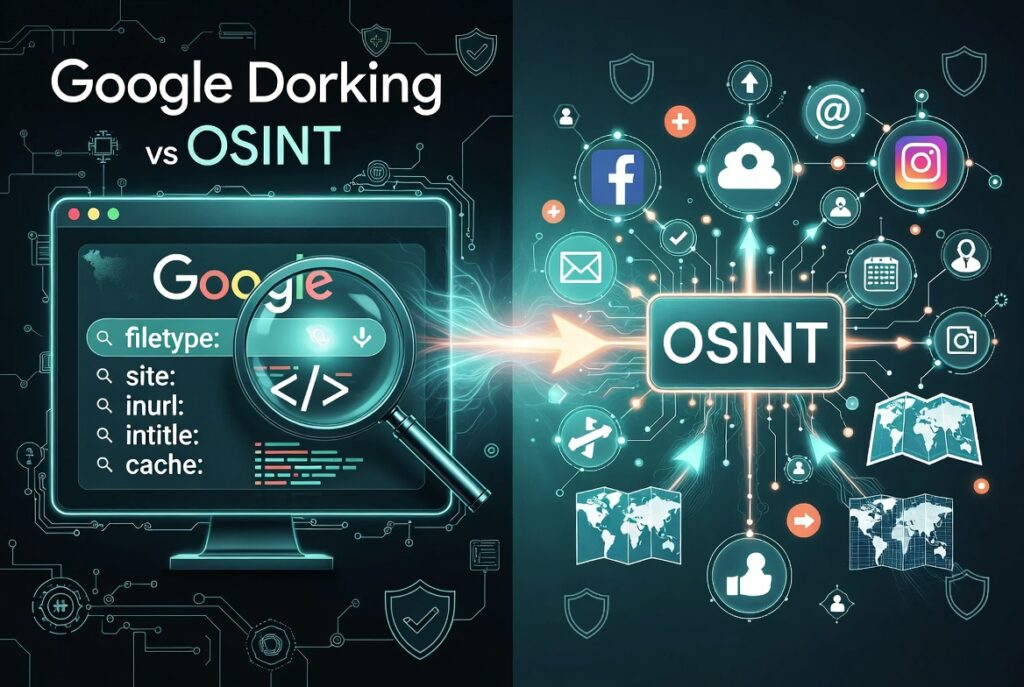
Security professionals rely on various reconnaissance techniques to identify risks before attackers do. Among the most widely used approaches are google dorks and the OSINT framework. Although these terms are often used interchangeably, they are not the same.
Google Dorking is a technique for finding publicly indexed information using advanced search operators, while OSINT (Open-Source Intelligence) is a broader discipline that gathers intelligence from multiple publicly available sources. Understanding how they differ helps organizations choose the right approach for security assessments, threat intelligence, and attack surface monitoring.
This article explores the key differences between Google Dorking and OSINT, explains where each method is most effective, and highlights how they complement one another in modern cybersecurity.
What Are Google Dorks?
Google dorks are advanced search queries that use Google’s search operators to locate specific types of publicly indexed content. Instead of performing a standard keyword search, security professionals use search operators to narrow results and identify exposed resources more efficiently.
Examples of information that Google Dorking may reveal include:
- Publicly indexed PDF documents
- Login portals
- Configuration files
- Backup files
- Directory listings
- Development or staging environments
- Publicly accessible web applications
Google Dorking only searches information that Google’s search engine has already indexed. It does not access private systems or bypass authentication mechanisms. Instead, it helps organizations understand what information is already visible to the public.
For this reason, many security teams include Google Dorking as part of routine external security assessments.
What Is OSINT?
Open-Source Intelligence (OSINT) is the process of collecting, analyzing, and validating information from publicly available sources.
Unlike Google Dorking, which primarily relies on Google Search, OSINT draws information from many different locations, including:
- Search engines
- Social media platforms
- Public records
- Government databases
- Domain registration records
- DNS information
- Certificate transparency logs
- Git repositories
- News websites
- Technical forums
Because OSINT gathers data from numerous sources, it provides a much broader understanding of an organization’s digital footprint than Google Dorking alone.
Security analysts, threat intelligence teams, incident responders, and penetration testers frequently use OSINT throughout investigations.
What Is an OSINT Framework?
An OSINT framework is a structured collection of tools, websites, and resources that helps investigators gather intelligence from publicly available information.
Rather than being a single application, an OSINT framework organizes hundreds of intelligence-gathering resources into categories such as:
- Domain intelligence
- Network information
- Email investigation
- Metadata analysis
- Social media research
- Image analysis
- Geolocation
- Threat intelligence
- Website analysis
- Document investigation
Using an OSINT framework allows security professionals to efficiently select the right tools for a particular investigation without manually searching for reliable resources.
Google Dorks vs OSINT Framework
Although Google Dorking is often considered part of OSINT, there are several important differences.
| Google Dorks | OSINT Framework |
| Uses Google Search operators | Uses multiple public intelligence sources |
| Focuses on indexed web content | Covers websites, databases, DNS, social media, repositories, and more |
| Simple to perform | Supports comprehensive investigations |
| Primarily identifies public exposure | Builds complete intelligence profiles |
| Limited to Google’s indexed results | Expands beyond search engines |
In short, Google Dorking is one technique, while the OSINT framework supports an entire intelligence-gathering process.
When Should You Use Google Dorks?
Google Dorking is particularly useful when organizations need to quickly evaluate publicly indexed information.
Common use cases include:
External Security Audits
Security teams can identify documents, login pages, or directories that should not be publicly accessible.
Attack Surface Reviews
Google Dorking helps discover forgotten web assets that remain indexed after projects or migrations.
Website Exposure Assessments
Organizations can verify whether sensitive resources have accidentally appeared in search engine results.
Compliance Reviews
Regular searches help identify publicly available information that may create compliance or privacy concerns.
Because Google Dorking is fast and easy to perform, many organizations schedule these reviews regularly as part of continuous security monitoring.
When Should You Use an OSINT Framework?
The OSINT framework is better suited for broader investigations that require information from multiple sources.
Examples include:
Threat Intelligence
Security teams can investigate threat actors, infrastructure, and indicators of compromise using numerous intelligence sources.
Third-Party Risk Assessments
Organizations may evaluate vendors by collecting publicly available information about exposed assets, domains, and security posture.
Incident Response
Investigators can gather intelligence surrounding suspicious domains, IP addresses, email addresses, or leaked credentials.
Digital Footprint Analysis
The OSINT framework enables organizations to understand how much information about their business is publicly available across the internet.
Because investigations often extend beyond search engines, the OSINT framework offers significantly greater visibility than Google Dorking alone.
Why Security Teams Use Both
Rather than choosing one approach over the other, mature cybersecurity programs often combine both techniques.
For example, a security audit may begin with google dorks to identify publicly indexed assets. Analysts can then expand the investigation using the OSINT framework to gather additional intelligence from DNS records, certificate logs, public repositories, domain registration data, and other sources.
This layered approach provides:
- Better visibility into external assets
- Faster identification of exposed resources
- More comprehensive risk assessments
- Improved attack surface awareness
- Stronger threat intelligence capabilities
Using both techniques together enables organizations to make more informed security decisions.
Best Practices for Ethical Use
Google Dorking and OSINT should always be conducted responsibly and within authorized environments.
Organizations should follow these best practices:
- Only assess systems you own or are authorized to test.
- Verify findings before taking action.
- Document publicly exposed information for remediation.
- Integrate findings into regular security audits.
- Review search engine exposure after infrastructure changes.
- Combine OSINT findings with vulnerability management and attack surface monitoring.
- Maintain records of remediation to support continuous improvement.
Responsible use ensures these techniques strengthen security without creating unnecessary risk.
Conclusion
While google dorks and the OSINT framework are closely related, they serve different purposes. Google Dorking focuses on identifying publicly indexed information through advanced search queries, making it an effective method for discovering exposed web resources and validating external visibility.
The OSINT framework, on the other hand, provides a structured approach to gathering intelligence from a wide variety of public sources, enabling deeper investigations into an organization’s digital footprint, infrastructure, and potential security risks.
Together, these approaches give security teams a more complete view of externally available information. By incorporating both Google Dorking and OSINT into routine security assessments, organizations can proactively identify exposure, reduce risk, and strengthen their overall cybersecurity posture before adversaries have the opportunity to exploit publicly available data.