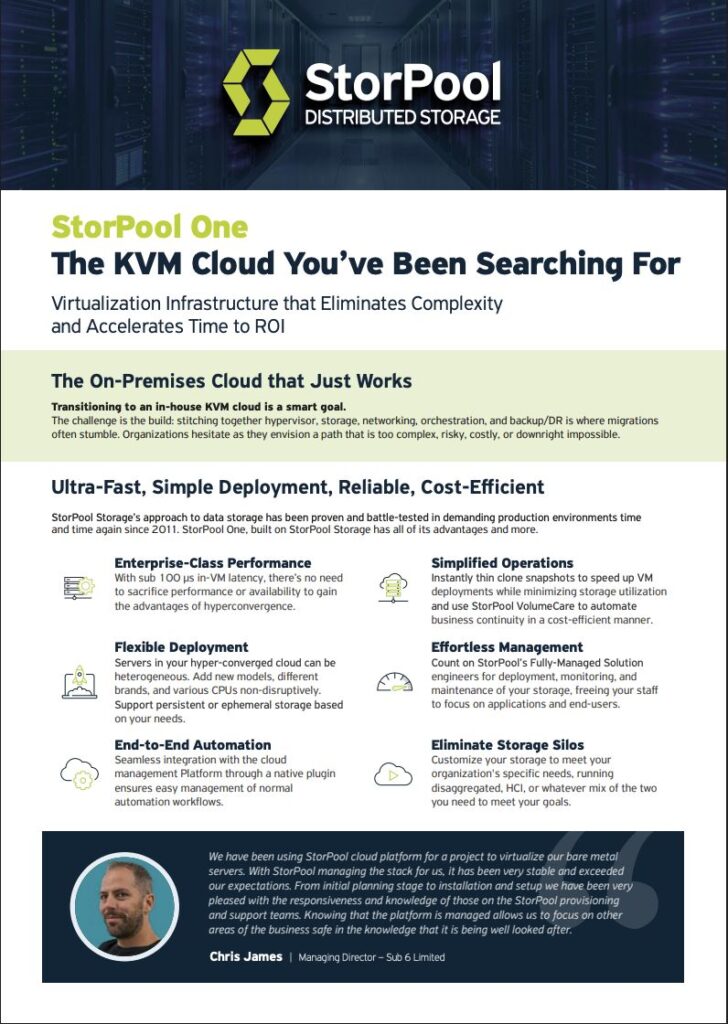
StorPool One: The Fully-Managed KVM Cloud Solution
Topics: Block data storage, Distributed storage, Hyperconverged, Software-defined storage, Virtualization, VMware Alternative, KVM Cloud, Primary Data Storage
Pages: 2
Company: StorPool
This document outlines the benefits of using StorPool One to build and manage an on-premises KVM cloud environment. The solution allows organizations to easily transition to an in-house cloud without the typical risks, costs, and complexities of stitching together hypervisors, storage, networking, orchestration, and backup. The integrated platform supports a variety of flexible deployments, accommodating heterogeneous servers, various CPUs, and both persistent or ephemeral storage.
Key advantages of the StorPool One solution include:
- Enterprise-Class Performance: Achieves sub 100 µs in-VM latency, eliminating the need to sacrifice performance or availability for hyperconvergence.
- Move Beyond Linear Scaling: Allows the addition of compute-only or storage-only nodes alongside standard HCI nodes, making scaling highly cost-effective by ensuring you only pay for resources you actually use.
- Flexible Deployment: Supports heterogeneous hardware so organizations can add new server models and different brands non-disruptively.
- Simplified Operations: Utilizes instant thin clone snapshots to speed up VM deployments and StorPool VolumeCare to automate business continuity.
- Effortless Management: Relies on StorPool’s Fully-Managed Solution engineers to handle design, deployment, 24/7 monitoring, and maintenance.
- Eliminate Storage Silos: Customizes storage to run disaggregated, HCI, or a mix of the two to meet specific organizational goals.
- End-to-End Automation: Integrates seamlessly with cloud management platforms through a native plugin to easily manage automation workflows.
With StorPool managing all phases of cloud adoption—from day-one design and deployment to ongoing operations, continuous improvement, and updates—organizations can ensure their cloud stack is always tuned for maximum performance and stability.