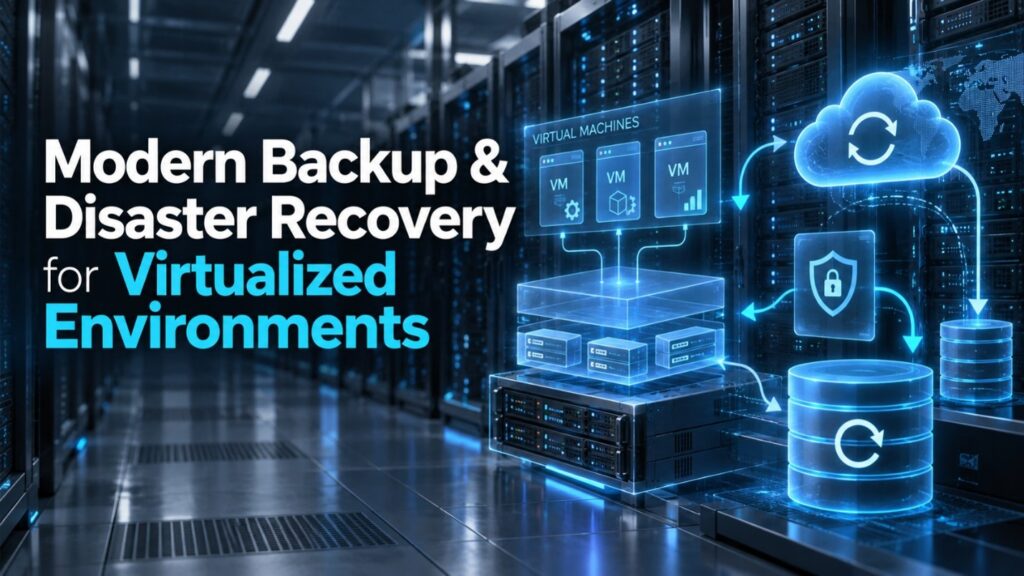
Virtualization has transformed enterprise IT by enabling organizations to run more workloads with greater flexibility, scalability, and efficiency. Platforms such as VMware, Hyper-V, and other virtualization technologies allow businesses to consolidate servers, optimize resources, and quickly deploy applications.
However, as organizations become more dependent on virtual infrastructure, protecting these environments has become increasingly important. A single virtualization host failure, ransomware attack, or configuration issue can impact dozens or hundreds of virtual machines simultaneously.
This is why modern organizations need a comprehensive backup and disaster recovery strategy designed specifically for virtualized workloads.
The Changing Requirements of Virtual Machine Protection
Traditional backup approaches were created when physical servers were the primary source of enterprise workloads. Modern environments are different.
Today, businesses need protection for:
- Virtual machines
- Databases
- Applications
- Cloud workloads
- Containers
- Hybrid infrastructure
Virtual environments introduce unique challenges, including VM sprawl, rapid data growth, dependency mapping, and the need for fast recovery.
A backup solution that only stores copies of virtual machines is no longer enough. Organizations need intelligent recovery capabilities that minimize downtime and protect critical applications.
Why Backup Alone Is Not Enough
Many organizations still view backup as simply creating copies of data. While backups remain essential, modern data protection requires a broader approach.
A complete strategy must address:
- How quickly systems can be restored
- Whether backups are protected from ransomware
- How recovery processes are tested
- Where backup copies are stored
- How business operations continue during disruptions
This is where backup and disaster recovery become interconnected.
Backup provides recovery points, while disaster recovery ensures that applications and services can be restored within required timeframes.
The Importance of a 3-2-1 Backup Strategy
One of the most widely adopted approaches for protecting business data is the 3-2-1 backup strategy.
The principle recommends maintaining:
- Three copies of important data
- Two different storage types
- One copy stored offsite
This approach helps organizations protect against multiple failure scenarios, including hardware failures, accidental deletion, natural disasters, and cyberattacks.
Modern enterprises often enhance this strategy by adding additional security layers such as:
- Immutable backups
- Air-gapped copies
- Encryption
- Automated recovery testing
Protecting Virtual Machines Against Ransomware
Ransomware has changed how organizations think about backup security.
Attackers increasingly target backup repositories because they know that eliminating recovery options increases their leverage.
To reduce this risk, organizations are adopting security-focused backup architectures that include:
Immutable Backup Copies
Immutable backups prevent backup data from being modified or deleted during a defined retention period.
For organizations using Veeam environments, a Veeam immutable backup appliance can provide protected backup storage designed to support secure recovery after ransomware incidents.
Network Isolation
Keeping backup infrastructure separated from production systems reduces the risk of attackers accessing recovery data.
Access Control
Strong authentication, least-privilege access, and monitoring help prevent unauthorized changes to backup systems.
The Role of Purpose-Built Backup Infrastructure
Many organizations rely on general-purpose storage for backup repositories. While this approach can work for smaller environments, enterprises often require dedicated infrastructure designed for data protection workloads.
A Veeam backup appliance combines optimized storage hardware with backup software integration to simplify deployment and improve reliability.
Purpose-built backup infrastructure helps organizations achieve:
- Faster backup operations
- More predictable recovery performance
- Simplified management
- Better scalability
This is especially valuable for environments with hundreds or thousands of virtual machines.
Disaster Recovery Planning for Virtual Environments
A disaster recovery plan should go beyond restoring individual files or virtual machines.
Organizations should define:
Recovery Time Objectives (RTO)
How quickly systems need to be restored after an outage.
Recovery Point Objectives (RPO)
How much data loss is acceptable between backup intervals.
Application Dependencies
Which systems need to be recovered first to restore business operations.
A well-designed Disaster recovery appliance can help organizations automate recovery workflows and reduce downtime during infrastructure failures.
Hybrid Cloud and Disaster Recovery
Many enterprises now operate hybrid environments that combine on-premises infrastructure with public cloud services.
This creates new opportunities for disaster recovery but also introduces additional complexity.
A hybrid recovery strategy should consider:
- Data movement between environments
- Cloud recovery costs
- Compliance requirements
- Security controls
- Recovery speed
Cloud-based recovery can provide additional resilience, but it should complement a carefully designed backup architecture rather than replace proper planning.
Common Backup Mistakes in Virtualized Environments
Even organizations with backup solutions can face recovery problems due to poor planning.
Common mistakes include:
Not Testing Recovery
A backup is only useful if it can be restored successfully.
Regular recovery testing helps identify configuration issues before a real incident occurs.
Keeping Only One Backup Location
A single backup copy creates unnecessary risk.
Organizations should maintain multiple recovery options based on business requirements.
Ignoring Backup Security
Backup infrastructure should be protected with the same attention given to production systems.
Failing to Monitor Backup Jobs
Failed backups can remain unnoticed until recovery is needed.
Continuous monitoring ensures backup operations remain reliable.
The Future of Virtualization Backup and Recovery
As virtualization continues to evolve, backup and disaster recovery will become increasingly automated and security-focused.
Future-ready data protection platforms will focus on:
- AI-driven threat detection
- Automated recovery workflows
- Cyber resilience
- Hybrid cloud support
- Faster application recovery
Organizations will increasingly view backup infrastructure as a critical component of their overall security strategy rather than simply a storage function.
Conclusion
Virtualized environments provide businesses with flexibility and efficiency, but they also require stronger protection strategies.
A modern backup and disaster recovery approach combines proven methods like the 3-2-1 backup strategy, immutable storage, secure backup infrastructure, and tested recovery processes.
By investing in reliable backup and recovery solutions, organizations can protect virtual workloads, reduce downtime, and maintain business continuity even during unexpected disruptions.
##
ABOUT THE AUTHOR
George Williams, Senior Technical & Product Marketing Specialist, StoneFly Inc.

George Williams has over 13 years of experience in the data storage, backup and disaster recovery, air-gapping, immutability and archiving markets. A true geek with love for ease and simplicity in data storage, George has been working for StoneFly Inc. for over a decade. Ever since StoneFly started shipping products since 2006, George has been working to ensure that technical information is relayed in a simple and effective way to customers and targeted audience. George helps curate content and works with numerous publishers and technology blogs to spread awareness and knowledge of data storage technology.