By George Crump, CMO, VergeIO
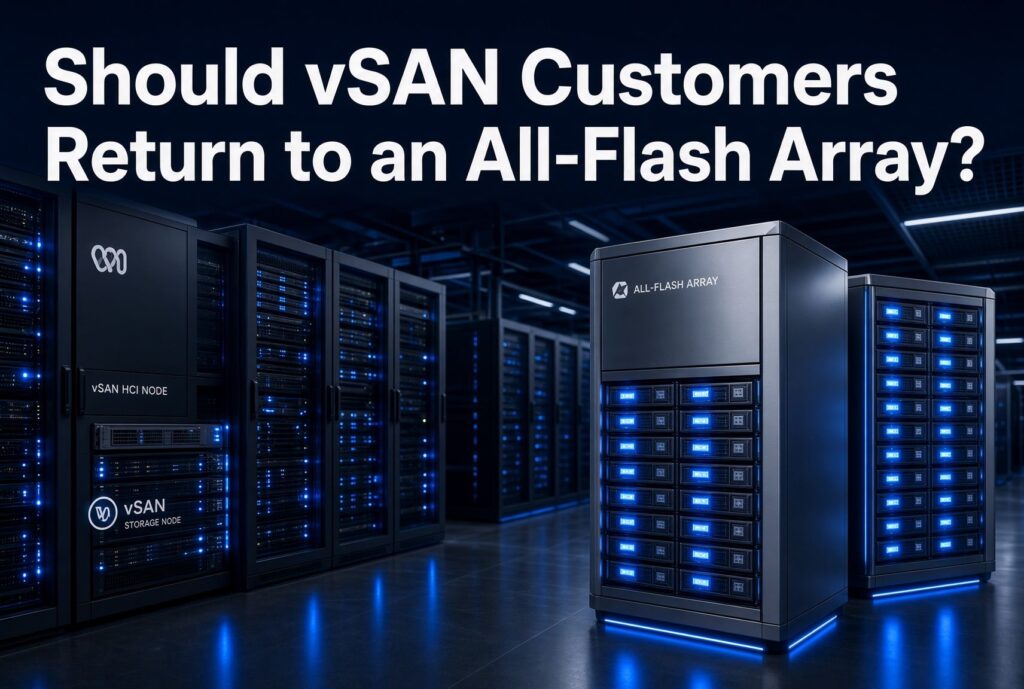
vSAN customers evaluating a VMware alternative eventually ask whether they should return to a traditional three-tier architecture with an all-flash array (AFA) as the storage tier. The appeal is easy to see. An external array opens up more hypervisor options, and most of the hypervisors offered as VMware alternatives lack a suitable replacement for vSAN.
Some vendors include Ceph in their product stack, but Ceph runs as its own distributed system beside the hypervisor, with separate management, tuning, and failure domains. It is a heavy lift with a steep learning curve for most IT teams. Next to Ceph, the AFA can look like the safe path. The question is whether returning to an AFA and a three-tier architecture makes sense once you factor in the cost.
Investment Loss
The first challenge in returning to a dedicated AFA is lost investment. Running vSAN meant buying additional memory and CPU for every host, so the hosts can deliver storage I/O and storage services without a significant performance impact on the application VMs they also support (more on the CPU and memory economics of vSAN). vSAN customers also invested in storage capacity in the form of SSDs and, in many clusters, hard disk drives.
That investment is significant. Some of it finds a second life after a move to an AFA, but much of it goes to waste. The drives sit in hosts that no longer use them, and the cores and DIMMs sized for vSAN overhead become idle capacity.
CapEx Spend
The lost investment also, maybe obviously, results in new CapEx spend. The organization has to buy the AFA and repurchase the storage capacity it already owns, often with room for growth added on top. Array pricing makes the repurchase worse. On a price-per-capacity basis, server-side SSDs cost about one-third of what the same SSDs cost inside an array. The array also includes its storage controllers, which are the equivalent of two high-end physical servers loaded with memory.
These additional costs were significant before data center inflation. Since early 2026, AI demand has pushed flash prices up by as much as 5X and nearly doubled the price of server DRAM, and both array controllers and the media behind them have followed those increases. The timing is especially painful. The hardware already in the vSAN cluster is more than adequate for hosting a VMware alternative that includes an efficient vSAN replacement.
Complexity Increase
The goal of vSAN in particular, and of VSANs in general, was to simplify infrastructure management and operations and to lower costs with commodity, off-the-shelf hardware. The goal was right, but the results fell short of expectations. Three-tier architectures move in the other direction. They often require specialists in each of the three domains of networking, storage, and virtualization.
They also demand sophistication in storage network design, as Fibre Channel and iSCSI each have unique nuances in zoning, multipathing, and performance tuning. A Fibre Channel SAN adds its own switches and HBAs, one more set of hardware to buy at today’s prices. Outside of all of this sits data protection and disaster recovery, which often requires its own level of specialization. For a midsize enterprise with an IT team of three to five people, returning to three tiers means rebuilding expertise the team no longer needed when it moved to vSAN.
The HCI Letdown
One reason organizations are considering a three-tier architecture again is that HCI solutions fell short of expectations. HCI turned the three tiers into separate software components running on the same servers. That eliminated the dependency on specific storage hardware, but it raised per-server requirements and did little to simplify operations. The storage software still runs as its own product, often inside a controller VM, with its own updates, compatibility lists, and resource reservations. The tiers moved into software, and the team still manages three of them.
The vSAN ESA Option
One option is to stick it out with VMware and upgrade to VCF and vSAN ESA. That path leaves the problem that started the whole process in place: the high cost of VMware licensing. In fact, it makes the problem worse. Capacity-based licensing charges per TiB for vSAN storage beyond the bundled entitlement, so the license bill grows with every terabyte the cluster stores. ESA also has strict hardware requirements, including NVMe-only storage on certified hardware, that often force premature upgrades of servers that run fine today. Those upgrades arrive at the peak of NVMe pricing.
A Third Path That Keeps the Hardware
vSAN customers have another choice. An infrastructure operating system like VergeOS runs the hypervisor, storage, and networking in one code base, and it installs on the servers the vSAN cluster runs on today. VergeFS pools the SSDs and hard drives already in those hosts into shared storage, so the organization keeps the capacity it paid for in production. The CPU and memory once reserved for vSAN go back to applications, and global inline deduplication stretches the existing flash further.
The organization skips the array purchase, keeps its Ethernet network, and avoids repurchasing capacity at inflated prices. The team manages one platform through one interface and one update cycle, which is the simplicity HCI promised. The three-tier path solves the hypervisor problem by paying for storage twice. Reusing the hardware solves both problems at once.
So should vSAN customers return to an AFA? For most, the math says no. The servers they already own are the better foundation for the exit.
I’ll walk through all of the vSAN exit paths, including the return to an AFA, in the TruthInIT webinar Leaving VMware Means Leaving vSAN: Your VMware Exit Is Really a Storage Decision. It airs Thursday, November 12, at 1:00 PM ET. Register here