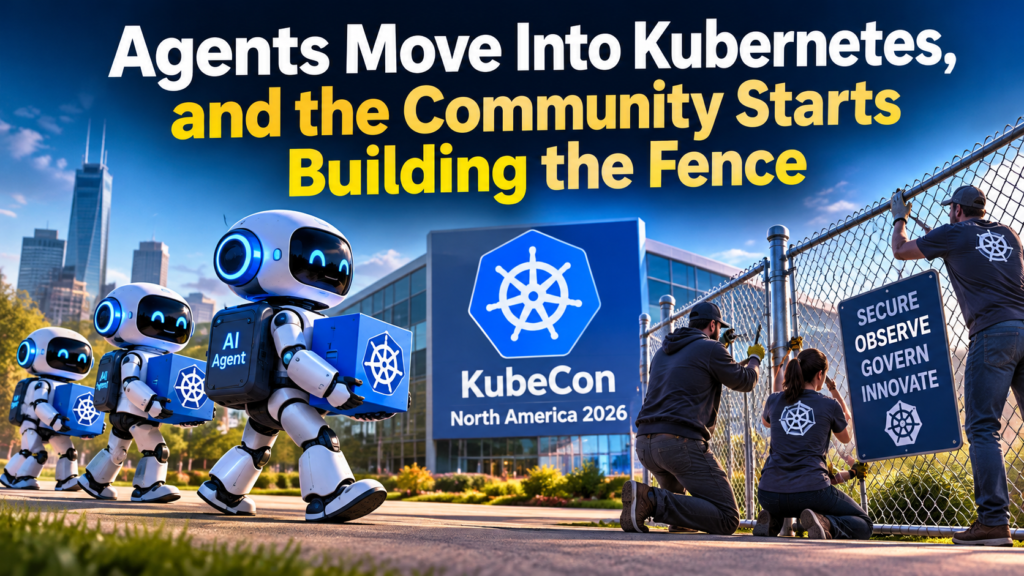
Chris Aniszczyk, CTO at the Linux Foundation, opened Tuesday’s KubeCon + CloudNativeCon NA 2026 keynotes with a show of hands. Who in the room already uses a coding agent? Nearly everyone. Who has a personal assistant agent doing real work in their life? Fewer than a quarter.
CNCF executive director Jonathan Bryce brought that gap up again when he met with press a few hours later, and honestly, it’s the best lens for the whole day. Developers hand agents their code without much fuss. Handing over a bank login is another matter. Most of what CNCF announced in Salt Lake City, under this year’s “cloud native without limits” banner, is an attempt to close that trust gap.
Bryce framed it as two problems: constrained resources, and security and control. Pretty much every project, demo and partner announcement on the main stage fell into one of those buckets.
The numbers behind the mood
CNCF opened with growth figures, and they’re hard to wave away. The foundation now hosts 231 projects, 32 of them new in the past year. It counts 21.2 million cloud native developers worldwide, with more than 5.5 million added in the last 12 months. Cloud native events drew 82,000 attendees across more than 50 countries, and KubeCon + CloudNativeCon Europe set a CNCF attendance record at nearly 13,500.
Membership is shifting too. Eight new Platinum members joined: Adyen, Broadcom, CoreWeave, CVS, HAProxy, NVIDIA, OVHcloud and Vultr. Two of those, Adyen (payments) and CVS (healthcare), are end users rather than vendors. Bryce said that matters because they help set strategic direction, and both spoke on the main stage this week.
On the project side, Cloud Native Buildpacks, Karmada, Kubeflow, KubeVirt, NATS and OpenTelemetry reached graduation. CloudNativePG, K8gb, Meshery and Open Cluster Management moved to incubation, and HAMi, the project for sharing and scheduling GPUs, reached incubation as well. The Kubernetes AI Conformance Program now lists 40 certified platforms, according to CNCF’s release.
Getting more out of the same hardware
Nobody on stage pretended GPUs are easy to find. The first half of the keynote was about stretching what you already have.
Inference gets a 1.0
llm-d joined CNCF as a Sandbox project in March and has already reached 1.0. In a clip from PyTorchCon, a cluster running a thousand agents showed a clear jump in throughput once llm-d was switched on. In the briefing, Bryce cited up to 14x more throughput on the same accelerators, though he didn’t spell out the workload, so read that as a best case. He also said some companies already run it in production, which is fast for something that arrived eight months ago.
Ray comes to Kubernetes
Robert Nishihara, co-founder of Anyscale and a creator of Ray, announced that KubeRay is joining CNCF. Ray sits underneath models from GLM, Cursor and NVIDIA’s Nemotron family, and reinforcement learning is one of its main uses. Nishihara’s point was that an RL job isn’t one workload. It’s training, inference servers, sandboxes and rollout agents, all tightly coupled, all moving weights and data back and forth. Kubernetes manages the cluster, Ray manages the workload, and each needs to know what the other is doing. Bryce added that Ray is now part of the llm-d inference stack too.
OpenRL and a fleet-wide control plane
Ravin Kumar of Google DeepMind introduced OpenRL, a Kubernetes-native service for reinforcement learning post-training. Install it with a single manifest and it schedules trainer and sampler jobs across GPUs, using Dynamic Resource Allocation to partition the accelerators. There’s even an OpenRL skill, so a coding agent can point at your cluster and write the training run for you.
Then the live demo hit the wall. After a stall, Kumar switched to a recording, to sympathetic applause. (Anyone who has run a live demo at a conference knows that feeling.) Earlier, he had shown Dolphin Gemma, an open model fine-tuned on 40 years of dolphin vocalization research. Yes, really.
A separate session from a longtime CNCF contributor took on a related question: what happens when no single cluster has the GPUs you need? His demo, called Model Plane, put Blackwell GPUs on AWS and AMD GPUs on Vultr behind one regional gateway, served a model through a single OpenAI-compatible endpoint, then drained the AWS capacity and watched the replicas reappear on CoreWeave. His line was that the infrastructure changed, but the intent didn’t. The team said it is applying to bring Model Plane into CNCF.
Fixing Kubernetes upstream
My favorite segment was the least flashy. AWS engineers walked through problems they hit running very large AI clusters and described the fixes they sent upstream instead of forking. A lazy snapshot in the API server cut a list operation from over half a second to two milliseconds at a million pods. Changes to the horizontal pod autoscaler allow roughly four times the workers. A scheduler cache that tracks only deltas now sustains over 300 pods per second. An etcd compression proposal is accepted as alpha for Kubernetes 1.38. For container images, parallel unpacking took a 10 GB image from about two minutes to under 45 seconds. They even reproduced a Go garbage collector stall of up to 20 seconds and handed it to the Go team.
Building the fence around agents
If resources were the first half of the day, control was the second. The word “sandbox” came up so often that it was close to a running joke.
Agent Substrate hits 1.0, live
Agent Substrate was the demo everybody could join. Google, working with Anthropic, Solo.io and Microsoft, built lightweight, tightly packed sandboxes that run on standard Kubernetes. The system snapshots memory and disk, suspends idle agents and wakes them almost instantly. That matters because agents are stateful, bursty and idle a lot. The team says it went from one agent per node to 65.
The audience scanned a QR code and got their own managed agent, which went off to complete tasks on a live map that matched the convention center layout. Roughly 2,000 people signed up while the team begged for more. The whole thing ran on one GKE cluster, front end and storage included. Bryce told us in the briefing that it spun up 2,500 agents in a couple of minutes.
The team also announced Agent Substrate 1.0 is generally available. Anthropic announced a bridge for its Claude Managed Agents. In a separate segment, Solo.io said Swissquote and OutSystems already run it in production, and that kagent 1.0 is rebased on it.
OpenShell and the escape room
OpenShell, started by NVIDIA, is now a CNCF Sandbox project. Justin Boitano of NVIDIA said in a video message that controls have to operate outside the agent, independent of it. You can’t just ask agents to follow rules.
Red Hat’s Jessica Forrester made that concrete with the best analogy of the week. Agents, she said, are the best escape-room players you’ve ever met: they’ll try every drawer and picture frame until something opens. Prompts are signs that say “please don’t move the picture frames.” Policies are bolts. In her demo, an agent could read from GitHub but was blocked when it tried to reach anywhere else, and every attempt was logged and turned into a proposal for a human to approve. Her team runs sandboxes inside Kata Containers so each agent gets its own kernel, and OpenShell hands the agent fake credentials, swapping in the real ones only on the way out the door. “Assume the agent is already compromised” was her closing advice.
Identity, gateways and, yes, VMs
A talk from one of this year’s co-chairs picked up the identity problem. Replicas of a pod share a service account, so when an agent misbehaves at 3 a.m., you can’t tell which one did it. The answer is short-lived, per-session identities through SPIFFE and Spire, plus a proxy to decide what each agent may do. Also, containers don’t contain: without something like gVisor, Kata or Firecracker, you’re sharing a kernel with the host.
Broadcom’s Dilpreet Bindra argued the other side of the isolation coin. VMs are back in the conversation because they’re a natural boundary for a non-deterministic agent, and Broadcom says 34% of organizations are expanding VMs for AI and agentic workloads. He announced a new Kubernetes workload conformance working group, and a VM API effort to make virtual machines a first-class Kubernetes resource.
Aniszczyk summed it up in the briefing: VMs are “kind of cool again.”
New neighbors on the block
You can’t miss the neoclouds anymore. CoreWeave said nine of the top ten frontier model providers use it, and it described upstream work on fair scheduling, API correctness and production hardening. It also noted that NVIDIA committed $4 million over three years for CNCF projects to run CI/CD on CoreWeave GPUs, and Kubernetes already does.
Vultr expanded its open source credit program to projects across CNCF, the Agentic AI Foundation, PyTorch and OpenInfra. NVIDIA said it has donated its DRA driver, KAI Scheduler and, last month, the Run:ai platform. It also shared a stat worth sitting with: on OpenRouter, agent-generated tokens now outnumber human ones, around 80% of traffic, and AI factory builders now plan for several CPUs per GPU instead of one, because of agents. CNCF will also host NeoCloudCon, a co-located event, at KubeCon Europe next year.
And then there was Quack
Physical AI got its moment too. An NVIDIA presenter brought out Quack, a small robot built with Hugging Face, that learned to walk on a Kubernetes cluster. Quack did not walk on cue. It tried a second time. The presenter’s explanation was that it had a long flight. His serious point was that physical AI needs three computers: one to simulate, one to train and one on the robot itself. Kubernetes is the shared layer.
What to do with all this
If you run production clusters, this week points to a few concrete next steps:
- Try OpenShell or Agent Substrate with a low-risk agent. Both plug into the policies, telemetry and network controls you already have.
- Check whether your accelerators are shared well. DRA, HAMi and llm-d are the places to start.
- Look at the AWS upstream fixes if you run large clusters, because they landed in the newest release of Kubernetes.
- Plan for VMs and agents to share a platform instead of competing for one.
Bryce put the mood well in the CNCF announcement: bring your hardest problems. Based on Day 1, plenty of people have.
##