The IoT is likely to bring with it the most important and impactful technology developments of the 21st century. Through the IoT, communication and data sharing will become effortless and accessible, even to the point where human intervention is no longer needed.
There is a world of potential waiting in the IoT, from improving processes and systems to entirely new devices.
Many of the machines and devices we interact with on a day-to-day basis are already connected to the Internet of Things. For example, many systems come with smart speakers and the like. As the technology continues to advance, it is likely that our lives will integrate ever more closely with this intricate and responsive network.
Computer chips and wireless technology have advanced to the point where it is now relatively easy to connect a device to the internet. Right now, hundreds of companies are working on embedding systems into everything from appliances to decor, which will allow these things to connect to digital networks.

Image sourced from mesh-net.co.uk
You can already see the potential of this in things like smart homes, in which heating, entertainment systems, and so on can be controlled from a phone, or even respond automatically to things like temperature fluctuations.
Over the next few years, we can expect the IoT to expand and develop rapidly. It’s likely to encompass pretty much anything you can think of, from sci-fi concepts like robotic assistants to business-based things.
Here, to prepare you, we’ll take a deep dive into the IoT. We’ll explore everything from what it is to its current applications and future potential. Read on, for the ultimate IoT guide for beginners!
What is IoT Technology?

Image sourced from techtarget.com
Though its applications may be futuristic, IoT technology can be surprisingly simple. IoT tech essentially connects a ‘Thing’ (i.e. device, appliance, system etc) to:
- A sensor and/or interface. This is where the ‘Thing’ will receive data from its user and/or environment.
- A ‘gateway’. This will connect the ‘Thing’ to the internet.
- A data storage and/or analysis facility. Data will typically be sent to the Cloud for secure storage. If the data is needed to help the Thing operate, it will be analyzed via the internet, and then returned to the Thing with operating instructions. A data warehouse data pipeline is a crucial step in transforming messy data into something useful.
By enabling the Thing to access the internet, we can give it tremendous potential for action.
Think of the internet as like a gigantic brain, and the ‘Things’ of the IoT as like limbs. Up until recently, we’ve only really been interacting with the ‘brain’ of the internet – it hasn’t been able to do more than give us information and facilitate communication.
The IoT enables the ‘brain’ of the internet to have more of a physical presence in our lives. Through the IoT, the internet can do physical things for us – like speak to us, warm and light our houses, cook our food, maybe even (one day!) drive our cars.

Image sourced from iot4beginners.com
Of course, all of these things require a power source. However, wireless charging technology means that we don’t need to cover our houses, offices, and cities in a tangle of charging cords to get them the power they need.
What are IoT Devices?
Put simply, IoT devices are devices which are connected to the Internet. Almost anything can become an IoT device, from drawing pads to beds.
If this sounds dangerous, don’t worry. Every new IoT device goes through rigorous test case execution and quality assurance (QA) testing to make sure that every device is safe and secure for human use.
Of course, a digital tablet differs a lot from a digital fridge – so it’s worth digging a little deeper into the types of devices which could be connected to the IoT.
What are the 5 Types of IoT Devices?
Broadly speaking, IoT devices fall into five categories: Consumer/domestic, Military, Commercial, Industrial, and Infrastructural.

A. Consumer IoT
Consumer IoT devices are those which will be used for everyday purposes. Examples of Consumer IoT devices include:
a. Home Appliances. You can already get fridges and even toilets connected to the IoT. If connecting something to the internet will make it easier and/or more useful, you can bet on an IoT version hitting the market soon.
b. Voice Assistant. Siri, Alexa, and so on are a crucial element of the consumer IoT. They are often our chief point of contact with the IoT, and they help us to navigate this brave new interconnected world.
c. Fixtures. Lighting, heating, entertainment systems – all of these can be wired up to the internet. By adding domestic systems to the IoT you can gain a degree of control and complexity that analogue systems cannot provide.
B. Military Things (IoMT)
The military is taking a huge interest in the IoT. The enhanced communications, connectivity, and capabilities the IoT offers could give a significant strategic advantage.
a. Human – Wearable biometrics. Wearable tech already allows for the tracking of health, fitness, location, blood pressure, oxygenation, and more. All of this is very useful from a military standpoint – and the field of wearable tech is progressing fast.
b. Surveillance Robots. Surveillance is a very dangerous part of any military operation. With IoT advances, militaries can avoid sending human soldiers into life-threatening situations, and gain vital surveillance intel from IoT robots.
c. Drone Cameras. Similarly to surveillance robots, drone cameras could provide crucial intel without a risk to human life. Drones can also reach places that humans can’t.
C. Commercial IoT
We’re not just talking about improving customer service with cloud based PBX solutions. There is huge IoT potential for businesses. For example, wearable tech could help companies care for their employees, preventing burnout and encouraging a culture of empathy. Self-service machines in stores could become far more advanced (and therefore far more useful) than they already are.
There are currently two main commercial areas where the IoT is taking off, but expect to see it everywhere soon:
a. Healthcare. Wearable, wireless-charging tech is a huge boon to healthcare. Pacemakers connected to the IoT, for example, can be adjusted and monitored remotely – minimizing the need for invasive procedures.
b. Transport Industries. Logistics, monitoring systems, self-driving vehicles, and so on. All of these are revolutionizing the transport industry as we know it.
D. Industrial Internet of Things (IIoT)
The industrial sector has always led the way when it comes to innovation, and it continues this trend with the IoT:
a. Industrial Applications. Smart data of the kind that can be gained from IoT systems is hugely important for primary industries like agriculture, mining, and so on. IoT devices could also save on labor costs and protect human lives in dangerous industries.
b. Manufacturing and energy sectors. Digital control systems are incredibly useful in manufacturing and energy production. Combined with the ability to control remote device, they allow people to monitor processes and facilities any time and from anywhere. This allows for significant improvements to systems and processes of all kinds.
E. Infrastructure IoT

Image sourced from axiomtek.com
‘Smart Cities’ are an exciting concept. Advances in wireless tech make it possible to connect entire infrastructures to the IoT. In the near future, we will see this used to make the very infrastructure of our towns and cities safer, smarter, more connected, and more useful.
a. Connectivity in Smart Cities would involve things like ‘smart roads’, which could warn or even halt cars when a pedestrian or other object is in their way. The IoT is already used in things like sensor-operated traffic lights, so we’re well on our way there!
What are the IoT Device Communication, Connectivity and Networking Protocols?
The protocols you use to connect, communicate, and network your IoT system will make a big difference to their capabilities. A larger and more complex system like an enterprise VoIP provider will require more robust protocols.
However, if you just want your speaker to connect to google, Bluetooth will do the job.
Prominent IoT communication protocols include:
● ZigBee
● LoRa
● NB-IOT
● WiFi
● Thread
● Bluetooth
Prominent IoT connectivity protocols include:
● HTTP
● MQTT
● CoAP
● WebSocket
● XMPP
● AMQP
Prominent IoT networking protocols include:
● Bluetooth and BLE
● Cellular (3G, 4G, 5G etc)
● LPWANS
● Mesh protocols
● WiFi/ HaLow
● RFID
What are the 2 Major Security Concerns of IoT?
All in all, the IoT has the potential to transform our lives in many positive ways. But what about the negative? After all, nothing good comes without a price.
There are many concerns about the potential negative impacts of the IoT. For example, some people worry that it will lead to an overly cyber-driven workplace, in which vital human skills like empathetic communication and emotional intelligence will fall by the wayside.
This kind of concern is definitely something that IoT-innovators and those who take up IoT devices need to consider. However, as things stand, one of the most pressing issues presented by the IoT is cybersecurity.
Any opening to the internet is a potential weak point for a network. And traditional cybersecurity measures may not fit the unique architecture of the IoT. So, what can people and companies do to protect themselves, their networks, and their devices?
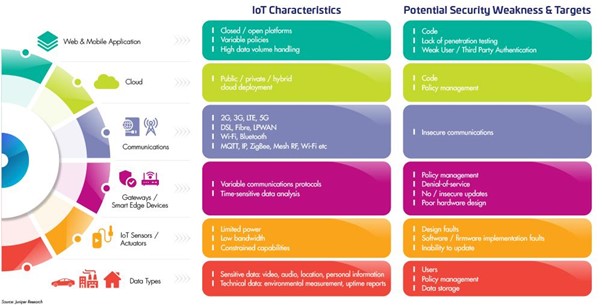
Image sourced thalesgroup.com
1. IoT Device Security
Just like Dialpad meetings software IoT devices usually come with inbuilt security measures. However, as we all know, cybercrime is a constantly-evolving industry. It takes more than the firewalls, etc, your device comes with to keep them safe.
On a legal level, many businesses are protecting themselves from IoT-based threats with BYOD policies. BYOD (Bring Your Own Device) policies are designed to manage the risks and responsibilities inherent in workers bringing IoT devices to work, or using them for work.
A good BYOD policy will set out things like:
- Who owns data generated by/stored on a given device.
- The security measures the device owner must put in place.
- If, when, and/or how the device will be monitored.
- The technical support the employee may expect for their device.
- Liability in the case of device-based data breaches.
- How devices may/may not be used off work premises – this is particularly important with the rise in remote working.
In addition to BYOD, it’s important to make sure that your device security is constantly updated. This is an area that’s developing fast, so it’s worth keeping up to date with all the latest developments.
2. IoT Network Security
Devices themselves are a lot less vulnerable if they’re within a secure network. So, it’s vital to ensure that your network security measures aren’t just effective for your computers. You must also prime them for your devices.
This may mean digging deeper into specifics than you’re used to, as devices and systems made by different companies may respond in different ways to your security measures.
For this reason, if you’re running a business, it’s a good idea to standardize the devices and systems you and your employees use. You can specify your standards and protocols in your BYOD policy.
You also want to make sure that all devices and systems are updated regularly with the latest software updates and think about conducting regressive testing to ensure your system is secure.
Are there unlimited possibilities with IoT?
There is always going to be a place for human creativity and ingenuity in the world and the workplace. When it comes to things like forging relationships, fostering empathetic team culture, and even creating new, innovative IoT devices, humanity has the edge over the Things!
However, the IoT can help us to do all of that, and more.
Predicting the future is never a good idea. So we can’t say for sure that the IoT has unlimited possibilities. But it certainly has an awful lot of potential.
Right now, we’re seeing a glimpse of the world that the IoT could provide. A world in which previously static ‘things’ can help us in unthought of ways, and all without wires!
The IoT is developing fast. So, if you’re considering investing in the IoT – don’t be afraid to think big!
Conclusion
The Internet of Things is already here and it’s already a part of our lives. How many people reading this have a smart speaker? Or a Fitbit? Or a digital doorbell? All of these and more are part of the Internet of Things.
The Internet of Things is set to improve and revolutionize every aspect of our lives, from the most domestic of details (beds that monitor your sleep health, for example) to global infrastructure.
However, the IoT is not without challenges. Security is one area that presents unique problems. The IoT security field is developing fast, and is definitely one to keep an eye on. Other concerns center around the social impact of the IoT – are we ready for such a radical change to our way of life?
Whatever the answer to these questions, one thing is certain: the IoT is here, and it’s growing fast. How we use it is up to us.
##