Big news from Pleasanton, California today as CloudFabrix
announces its corporate rebranding to Fabrix.ai. The company, which made its
name as the inventor of the Robotic Data Automation Fabric Platform, is marking
more than just a name change – it’s showcasing the next phase in its evolution
from data automation pioneer to AI-driven operations innovator.
The transformation from CloudFabrix to Fabrix.ai reflects
the company’s expanded vision of providing a Modern Operational Intelligence
platform for businesses. While they’ve spent years mastering data automation
and AIOps, helping organizations deal with complex IT operations, this move
signals their push into what they see as the next frontier: AI agents that can
autonomously manage IT operations.
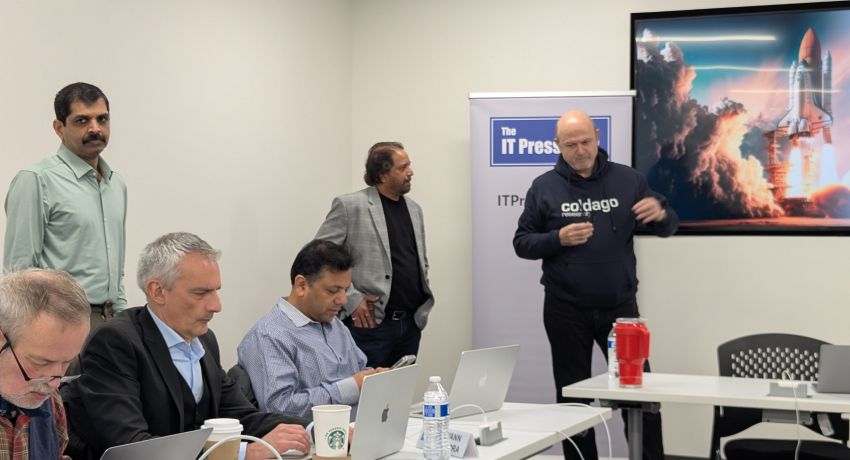
During the 60th Edition of the IT Press Tour, I got a
first-hand look at how this evolution is taking shape. The company isn’t just
adding AI capabilities to their existing platform – they’re fundamentally
rethinking how AI can transform IT operations through what they call
“agentic AI.” This approach moves beyond simple automation to create
AI agents that can reason, plan, and take action autonomously while maintaining
proper controls and visibility.
Why Now? Understanding Today’s IT Operations Challenge
The pace of change in IT operations isn’t just fast – it’s
accelerating. During the briefing, Fabrix.ai shared some eye-opening data about
this acceleration: each wave of technological transformation is happening twice
as fast as the previous one. What took 100 years during the industrialization
era shortened to 50 years for the service economy, then 25 years for the first
digital transformation. Now? We’re looking at major shifts every 10-15 years.
But speed isn’t the only challenge. Modern IT environments
have become almost impossibly complex. Consider this reality many organizations
face today:
- Data
centers packed with thousands of containers and VMs, generating terabytes
of logs and metrics daily - Multiple
clouds and edge locations to manage - 20+
monitoring tools creating disconnected data silos - Legacy
systems running alongside modern applications - Constant
pressure to maintain high availability while implementing new technologies
The existing solutions aren’t keeping pace. Current AIOps
and observability tools often add to the problem instead of solving it.
Organizations typically employ over 20 different tools, lacking a unified
source of truth. Each tool brings its own query language – whether it’s PromQL
for Prometheus, Lucene for Elasticsearch, or various proprietary languages.
It’s like having 20 different languages to learn just to understand what’s
happening in your environment.
The market for these solutions is highly fragmented. As
Shailesh Manjrekar, CMO at Fabrix.ai, explained during the briefing, “You
look at Datadog, you look at Dynatrace, you look at ServiceNow – everyone has
bits and pieces of the solution. This is a very hard problem to solve.”
Some vendors focus on data collection, others on analytics, and still others on
process automation, but few attempt to address the entire operational
lifecycle.
The results of this fragmentation are costly:
- 40% of
IT organizations receive over 1 million daily alerts - 11%
face more than 10 million alerts - The
average cost of dealing with these alerts? $1.27 million annually - Supervised
learning approaches require extensive data labeling and constant model
retraining - Most
tools can’t handle the high cardinality and velocity of modern operational
data
Making matters worse, organizations can’t simply hire their
way out of this complexity. “Organizations can’t just add engineers – they
can’t find them and can’t afford them,” Manjrekar noted. The traditional
human-based, tool-centric approach to operations, with its manual approvals and
hard-coded rules, simply can’t scale to meet today’s challenges.
This perfect storm of accelerating change, growing
complexity, and fragmented solutions has created an urgent need for a new
approach – one that can unify data, automation, and AI to enable truly
autonomous operations. This is the gap Fabrix.ai aims to fill with their
agentic AI platform.
Enter Fabrix.ai – A New Approach to IT Operations
What makes Fabrix.ai different is its approach to automation
through what they call “agentic AI.” Instead of just responding to
queries or following preset rules, these AI agents can actually reason, plan,
and take action autonomously.
“Agents are fundamentally different from
co-pilots,” Manjrekar pointed out. “While co-pilots are primarily
based on conversational queries leveraging RAG (Retrieval Augmented
Generation), agents have foundational models at the center of decision making
which make automation contextual. They can sense, reason, plan, and act
autonomously.”
The platform consists of three main components:

Data Fabric
Think of this as the foundation – it unifies all your data
sources, whether structured or unstructured, real-time or historical. With over
1,000 pre-built data bots, it can connect to practically any data source you
throw at it. The platform handles data automation, enrichment, and routing,
creating a unified data model that feeds into both analytics and automation
processes.
Automation Fabric
This isn’t your standard automation engine. It orchestrates
workflows that can be fully autonomous or include human oversight, depending on
your comfort level. The system can integrate with existing automation tools
like Cisco BPA, Red Hat Ansible, or Terraform, making it flexible enough to fit
into any environment.
AI Fabric
Here’s where things get interesting. The AI Fabric serves as
a distributed orchestrator that enables customers to securely build, deploy,
and manage agents’ lifecycles. It includes built-in guardrails and quality
controls, and can integrate with various large language models (LLMs) and
automation frameworks.
Inside Fabrix.ai: Key Platform Capabilities
The heart of Fabrix.ai’s platform lies in its approach to
agent management and control. Let’s break down the key capabilities that make
this possible.
Agent Orchestration and Lifecycle Management
Creating and managing AI agents isn’t a “set it and
forget it” process. Fabrix.ai has built a comprehensive lifecycle
management system that handles everything from agent creation to retirement.
Users can create new agents either through predefined templates or by
describing tasks in plain language. The platform’s AI then translates these
descriptions into task graphs, outlining the sequence of actions, dependencies,
and conditions for the agent.
The lifecycle management process includes several critical
stages:
- Review:
Users can examine and refine the task graph to ensure it aligns with their
objectives - Dry
Run: Agents can be tested in simulation mode without actual execution - Test:
Limited duration or iteration testing on specified data sets - Deploy:
Agents can be scheduled or triggered by events - Decommission:
Graceful retirement of agents when needed
AI Guardrails: Keeping Agents in Check
“AI-based agents need guardrails to prevent unintended
or harmful actions,” Manjrekar emphasized during the briefing. Fabrix.ai’s
platform implements three levels of guardrails:
- Standard
Guardrails: Basic controls preventing inappropriate language or harmful
activities - Industry-Specific
Guardrails: Enforcing compliance with industry regulations and best
practices - Enterprise-Specific
Guardrails: Customizable controls aligned with organization policies and
standards
The platform monitors every interaction between agents and
LLMs to ensure ongoing compliance with these guardrails, providing a safety net
for autonomous operations.
Agent Visibility and Observability
One of the most innovative features is the platform’s
Storyboard capability, which provides deep visibility into agent operations.
These Storyboards offer:
- Real-time
visualization of agent workflows - Detailed
tracking of agent progress and decision points - Identification
of bottlenecks or areas for optimization - Capture
of LLM reasoning processes for better understanding of agent decisions
“We’re not just showing you bits and pieces of the
problem statement,” explained Manjrekar. “We’re telling you a story –
from data sources to correlation to outcomes.”
Flexible LLM Integration
Fabrix.ai takes a pragmatic approach to large language
models, offering flexibility in model selection and deployment. The platform:
- Includes
their own optimized implementation of Llama 2 - Supports
integration with major LLM providers like OpenAI and Azure - Works
with NVIDIA’s inference microservices (NIM) for efficient model deployment - Allows
for both cloud-based and on-premises model hosting
Notably, their Llama 2 implementation achieves comparable
performance to larger models while using significantly less computational
resources – as little as 1GB of GPU memory. This efficiency makes advanced AI
capabilities accessible to organizations without massive GPU infrastructure.
The platform’s Agent Quality Control module leverages these
LLMs to monitor agent performance, ensure successful outcomes, and incorporate
user feedback for continuous improvement. This creates a learning loop where
agents become more effective over time while staying within their defined
operational boundaries.
New Features That Matter
Composable Storyboards
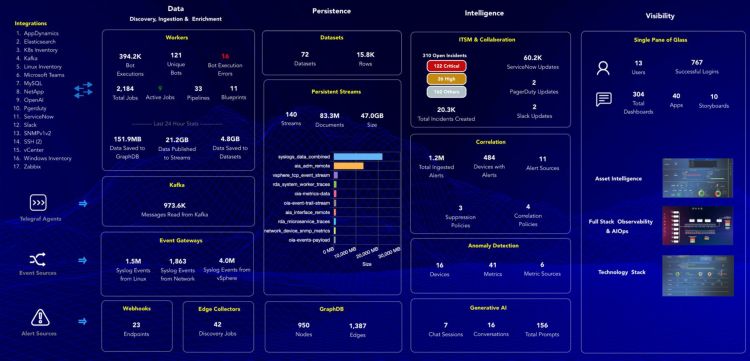
Instead of throwing endless dashboards at you, Storyboards
tell the complete story of your IT operations. They’re customizable based on
different personas – what a CXO needs to see versus what a Level 1 engineer
requires. The storyboards provide end-to-end visibility, from data sources
through correlation to outcomes, making it easier to understand complex systems
and troubleshoot issues.
Intelligent Copilot
The platform includes an AI-powered copilot that’s embedded
throughout the user interface. Users can ask natural language questions about
their environment, create new dashboards, or trigger automated workflows.
Unlike traditional chatbots, this copilot understands the context of your IT
environment and can provide specific, actionable insights.
Digital Twin for Network Operations
This feature creates a near real-time replica of your
network infrastructure, letting you run what-if scenarios and predict potential
issues before they happen. It covers everything from Layer 1 to Layer 7,
providing complete visibility into your network operations.
Real Results with Real Customers
One of their managed service provider customers used to
struggle with alert fatigue from 25 different tools and frequent war rooms with
20-30 people on each call. After implementing Fabrix.ai, they achieved:
- 90%+
reduction in alert noise - Real-time
visibility for executives and end customers - Automated
synchronization of their CMDB - Streamlined
operations across their entire stack
Partnership Ecosystem
Fabrix.ai has built a robust partnership ecosystem to
enhance their platform’s capabilities:
- Cisco
CX&T: The professional services arm of Cisco uses Fabrix.ai’s
platform to deliver enhanced managed services to their customers. - IBM
Consulting: As Meenakshi Srinivasan, Senior Partner at IBM Consulting,
explained: “We’re bringing together IBM Consulting’s deep expertise
in observability and AIOps solutions for global and deeply complex clients
with CloudFabrix’s Composable Analytics powered by Robotic Data Automation
Fabric.” - NVIDIA:
As part of the NVIDIA Inception program, Fabrix.ai optimizes their AI
operations using NVIDIA’s inference microservices. - HPE:
Integration with HPE’s infrastructure solutions enhances deployment
options for enterprises.
Looking Ahead
The company’s vision extends beyond just IT operations.
They’re positioning themselves as pioneers in the emerging field of agentic AI,
with several new capabilities in development:
- SLO/KPI
Management agents for automated performance monitoring - Predictive
Maintenance agents for proactive issue resolution - Closed
Loop Remediation agents for automated problem fixing - Network
Digital Twin agents for service assurance
“We’re excited to introduce a platform where AI agents
become the backbone of productivity, driving efficiency and intelligent
decision-making across organizations,” said Raju Datla, CEO of Fabrix.ai.
For IT teams struggling with complexity and alert fatigue,
Fabrix.ai’s approach offers a way to automate operations without losing
control. The platform lets you start small with specific use cases and
gradually expand as you build confidence in the system.
What’s particularly interesting is their focus on making
this technology accessible. You don’t need a team of data scientists or AI
experts to create new agents – the platform can generate them from simple
conversational descriptions while maintaining proper controls and visibility.
As we move into what many are calling “the year of AI
agents,” Fabrix.ai seems well-positioned to help shape how enterprises
adopt and implement this technology. They’re not just adding AI to existing
tools – they’re rethinking how IT operations can work in an AI-first world.