
At this week’s 66th IT Press Tour in Palo Alto, InfoScale pulled back the curtain on something that’s been quietly reshaping how enterprises think about keeping their systems alive. And honestly? It’s a conversation that’s overdue.
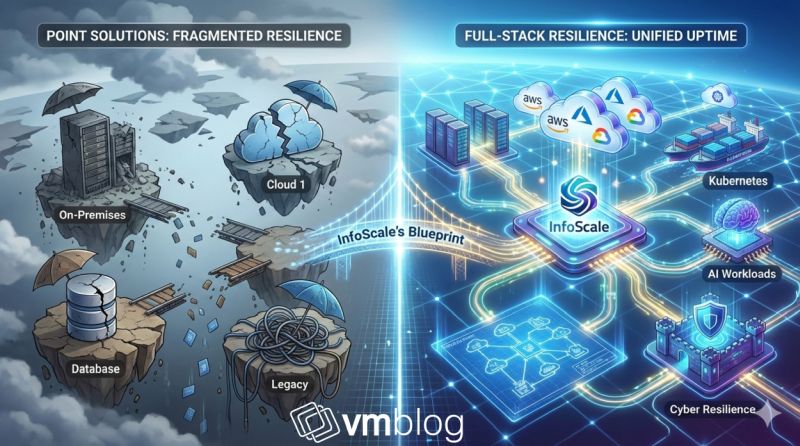
For decades, the approach to operational resilience was straightforward: protect your data, recover your systems, hope nothing goes wrong. But that playbook is broken. Today’s enterprises are drowning in complexity – cloud providers, containers, Kubernetes, on-premises infrastructure, AI workloads that can’t tolerate a restart, and cyber threats that seem to get smarter by the week. The old way of bolstering individual components doesn’t cut it anymore.
InfoScale’s pitch is simple but profound: stop protecting infrastructure in isolation. Start thinking about resilience as a unified, intelligent system that understands how everything connects.
The Problem Nobody’s Really Solved
Here’s the thing about modern IT environments: they’re messy. Beautifully, frustratingly messy. An enterprise might run VMware in one data center, Kubernetes in another, have workloads split across AWS and Azure, maintain some legacy Unix systems for good measure, and throw in a few on-premises servers for compliance reasons. Each technology has its own backup solution, its own failover mechanism, its own recovery procedure.
The result? A fragmented operational strategy that looks good on paper but crumbles when something actually breaks.
During the briefing, Joe D’Angelo, Director of Product Management at InfoScale, made a point that resonated: most organizations protect individual applications or individual infrastructure pieces without understanding the context. You’ve got your database protected, your storage arrays replicated, your virtual machines backed up, but nobody’s thinking about what happens when the database fails and five downstream services go silent because they’re waiting for data that isn’t coming. That’s the operational blind spot that costs companies real money.
The numbers are worth considering. According to the briefing materials, financial services companies face $163 million in costs for every 24 hours of mission-critical application downtime. That’s $6.48 million per hour. And that’s before fines kick in. Sixty percent of Fortune 500 companies reported experiencing unexpected downtime averaging 1.6 hours per week. At scale, that’s 83 hours a year of unplanned outages.
Meanwhile, 96% of cyber incidents achieve at least partial success, meaning it’s not a question of if your organization will face a breach, but when. And when it does, the average recovery time from a ransomware attack? Twenty-four days.
Why Traditional Approaches Keep Falling Short
The enterprise currently faces four major headwinds that existing point solutions just can’t address all at once.
Operational blind spots are the first problem. Thousands of interconnected systems, hundreds of data sources, and nobody has a clear view of how they all depend on each other. Most organizations lack the visibility to understand what happens when one component fails, which services go down, how quickly, and what the actual business impact is.
Constant change is the second. You might think outages come from hardware failures or infrastructure disasters. They don’t. Most downtime happens during routine operational stuff: patching, scaling, upgrades, configuration changes. Existing tools are reactive, they respond after something breaks. By then, the damage is done.
Infrastructure-only resilience is the third. Companies protect storage, they protect compute, they protect networks, separately. Then they’re surprised when a data corruption issue crashes an application even though the backups worked fine. Or when a failover succeeds technically but the application won’t reconnect to its dependencies. You can’t protect infrastructure and data in silos and expect resilience.
AI and cyber complexity is the final piece of the puzzle. AI workloads can’t be restarted when something goes wrong, they’ll lose their computational state. Cyber attacks now target not just data but operational uptime itself. Ransomware doesn’t just encrypt files; it’s designed to take business services offline and hold them hostage.
What InfoScale Is Actually Doing Differently
InfoScale isn’t a new company, though it might feel that way. It has roots going back to Veritas in the 1990s, survived the Symantec acquisition, got spun back out, and was recently acquired by Cloud Software Group and rebranded. That history actually matters because it means the product has evolved through every major infrastructure transition: physical to virtual, on-premises to cloud, monolithic to containerized. The company has been there for each inflection point.
The core innovation isn’t about doing more. It’s about understanding relationships. InfoScale operates as a software layer that sits within the operating system (Linux, Windows, Unix, Solaris, you name it) and builds a unified view of your entire operational stack. Application layer, data layer, infrastructure layer, cloud layer. All of it.
The product does something most resilience solutions don’t: it tracks dependencies. It knows which applications depend on which databases, which storage systems, which network paths. When something fails, it doesn’t just trigger a failover – it orchestrates recovery across all the interconnected pieces in the right order, at the right time, understanding the business context of what’s being recovered.
Real-time application health monitoring is table stakes here. The system watches your applications in real time, understanding not just whether they’re up or down but how they’re behaving-CPU usage, memory consumption, I/O patterns, performance characteristics. If something goes wrong, you know about it in seconds, not minutes or hours.
Recovery times matter enormously. During the briefing, Bruce Scheibe, Global Sales Leader, mentioned a customer case where they got recovery time objective (RTO) down to around five minutes. What used to take four hours now takes five minutes. For mission-critical systems, that difference between a brief blip and a business-stopping outage.
The Cyber Resilience Angle: Thinking Beyond Backups
This is where InfoScale gets interesting from a security perspective. Most organizations think of cyber resilience as “do we have backups?” The answer, more often than not, is “sort of.” They’ve got copies of data scattered around, but they haven’t tested whether those copies are actually good, whether they’re clean, whether they can be recovered without spreading the infection.
InfoScale incorporates AI-driven anomaly detection into the primary data layer itself. The system learns the normal behavior of your file system over a period (30, 45, 60 days) and then watches in real time for deviations. When it spots something unusual, an abnormal spike in read operations, write operations, or access patterns, it doesn’t automatically panic. But it does flag it for investigation.
Here’s the clever part: the system can then take a snapshot and scan it with whatever malware detection engine you use. If the verdict comes back that yes, this is a ransomware attack, InfoScale can automatically revert to an immutable checkpoint from before the infection. Think of it as emergency undo, but with intelligence behind it.
The company also handles something technically unique: dynamic storage encryption on Windows. Most encryption solutions work at the file level, but Windows dynamic storage doesn’t easily support that. So InfoScale built encryption support specifically for that scenario. The story behind it? A financial services customer with data centers in Ukraine, four years ago, was concerned about potential data exfiltration if physical servers were stolen. They needed dynamic storage encrypted, which wasn’t available anywhere. InfoScale’s engineering team built it.
That’s the kind of detail work that matters in real deployments.
Scale: From Weeks Instead of Years
One case study that came up repeatedly during the briefing involved a major enterprise migrating 20,000 virtual machines from VMware to OpenShift. Traditionally, a migration like that runs 18 to 24 months. This one happened in weeks.
How? Partly because InfoScale integrates natively with OpenShift through the OperatorHub. You can deploy it directly from the OpenShift console without disruption to running systems. But more importantly, the customer could maintain their existing SAN infrastructure instead of having to buy new storage. That saved them about $500,000 in hardware costs alone. They preserved their storage investments while moving to a completely different platform.
That kind of cost avoidance and speed matters because it means organizations can actually move forward with modernization efforts instead of getting stuck in multi-year migration projects that hemorrhage budget and lose executive support.
The Multi-Cloud Reality: Having Your Cake
Here’s something enterprise architects worry about constantly: vendor lock-in. If I build everything on AWS and AWS goes down (which we’ve all witnessed), what do I do? If I want to move to Azure later, is my disaster recovery strategy worthless?
InfoScale operates across public clouds, private clouds, and hybrid setups without forcing you into a single ecosystem. The system supports both AWS and Azure marketplaces, can run on Kubernetes clusters, integrates with OpenShift, and works on-premises. It doesn’t care which cloud you’re using or whether you’re using multiple clouds simultaneously.
The company’s replication model is particularly clever for multi-cloud scenarios. It uses a hybrid approach: synchronous change data replication within an availability zone (meaning zero data loss, zero recovery point objective), combined with asynchronous full synchronization across regions. So you can lose an entire availability zone and still recover with no data loss. You can lose an entire cloud region and recover to a different region. You get regional failover and availability zone resilience without sacrifice.
That’s not a guarantee most traditional solutions can make.
What’s Coming Next: Predictive Resilience
During the Q&A portion of the briefing, the conversation shifted toward the future. InfoScale’s roadmap includes several capabilities that feel like they’re pulling from the “what should have existed all along” playbook.
Predictive analytics for data centers: The team calls it “the third eye in the data center.” The system watches your infrastructure and can forecast potential failures. Not just “your drive is getting full” but “based on your current usage patterns and growth trajectory, here’s when you’ll hit capacity and what your recovery window will look like.”
Fault simulation without risk: Imagine being able to run “what if” scenarios against your infrastructure without actually causing an outage. The team calls it “know before you go.” You can simulate losing a network link, losing storage, losing a virtual machine-and see what the actual impact would be without affecting production systems.
Natural language configuration: Because learning another domain-specific language is nobody’s idea of fun. The roadmap includes AI-powered interfaces where you can basically ask the system to do something in plain English and it handles the configuration. Think “Alexa, please protect this database” but for resilience operations.
Workload optimization: The system could recommend where your applications would run best-whether that’s staying on-premises, moving to the cloud, scaling out with containers, or some hybrid approach. Based on performance patterns, cost analysis, and your specific requirements.
Ransom-awareness: Proactive threat protection that doesn’t just react to attacks but anticipates them. The system can simulate attacks, identify vulnerabilities, and help harden your infrastructure before breaches happen.
These aren’t available today, but they’re in development, and the direction suggests InfoScale is thinking about resilience as something that should be intelligent, predictive, and increasingly autonomous.
The Ownership Question: Does CSG Care?
One thing that came up during the briefing was the somewhat unusual fact that CSG’s CEO Tom Krause has been trying to acquire InfoScale for nine years. He tried when Veritas was considering spinning it out. He tried again when Arcterra was formed. Finally, he succeeded in December. That’s not typical corporate acquisition behavior.
During the presentation, there was a genuine sense that this ownership actually cares about the product direction. Krause has been involved in the strategic decisions, not just stamping approval on deals. The team moved from multiple SKUs with varying feature sets to a single unified SKU with unlimited users and full features included. That’s the opposite of traditional software company thinking, which is usually about segmentation and upsell opportunities.
Whether that remains true long-term depends partly on execution and partly on business reality, but the initial signs suggest this isn’t a financial engineering play. The investment in InfoScale seems genuine.
Who Should Care About This
If you’re running mission-critical applications anywhere, whether that’s financial services, healthcare, telecom, energy, or government, InfoScale’s approach is worth understanding. Especially if you’re in the process of modernizing infrastructure, dealing with multiple cloud providers, or genuinely concerned about ransomware resilience.
The technology isn’t for every workload. If your entire infrastructure is a single cloud provider and you’re comfortable with their native resilience offerings, you might not need it. But if you’re like most large enterprises, stuck with multiple platforms, worried about vendor lock-in, dealing with increasing cyber threats, and frustrated that your disaster recovery procedures take weeks to test, this is worth a conversation.
The other thing to consider: point solutions will keep existing. There will always be companies selling database-specific backup or application-specific failover. But the competitive advantage increasingly belongs to whoever can see the whole picture and orchestrate across all the pieces. That’s a different category of problem.
##


