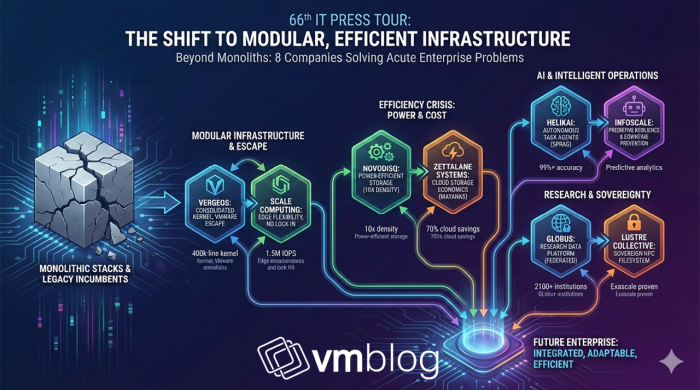
Wrapping up the 66th edition of The IT Press Tour at Palo Alto, one thing became abundantly clear: the vendors shaping enterprise IT today aren’t building monolithic platforms anymore. They’re solving specific, acute infrastructure problems that the incumbents have either ignored or mispriced into irrelevance.
Broadcom’s VMware acquisition forced a reckoning. Hyperscalers commoditized what used to be proprietary. Compliance requirements got stricter. Data grew faster than budgets. And somewhere in that collision of forces, a new generation of companies emerged – not to replace everything, but to replace what matters, solve what’s broken, and do it at a fraction of the cost.
Here’s what eight different vendors taught us about where enterprise infrastructure is actually heading.
The Great Escape From Proprietary Stacks: Modular Infrastructure Replaces Monoliths
The Theme
The first pattern that jumps out: organizations are systematically rejecting the bundled, all-in-one platform approach. For 20 years, the industry sold IT leaders on a simple story: buy one vendor’s stack, get everything integrated, pay accordingly (and then some). It’s broken. The cost is wrong. The flexibility is wrong. The efficiency is wrong.
What’s replacing it is modular, focused solutions that handle one thing exceptionally well and integrate cleanly with whatever else you’re running.
VergeOS: The VMware Escape Hatch
VergeOS arrives at exactly the right moment. After Broadcom’s acquisition, organizations running VxRail hardware or aging VMware environments face a brutal choice: pay the new licensing tax or move. VergeOS’s pitch is elegant: your hardware is fine, the software is the problem.
By consolidating compute, storage, and networking into a single 400,000-line kernel, VergeOS delivers measurable efficiency gains. One cluster of eight $1,500 servers achieved 1.5 million IOPS at just $0.67 per IOPS. Deduplication happens at every layer, hypervisor, network, storage, RAM, which means customers consistently report 3:1 to 4:1 storage reduction ratios.
The migration story is practical: vCenter gets tricked into thinking VergeOS is a backup system, automatically handing over all VM configurations. Once you’ve migrated your workloads over, one server at a time, you’re running on the new platform. No new hardware required. No downtime. One customer successfully migrated 20,000 virtual machines in weeks.
What matters here: VergeOS proves that architectural simplicity beats feature breadth. The company is growing one customer every two to three days, is already cash flow positive with less than 100 employees, and has an unheard-of retention rate (one lost customer in 3.5 years, and they didn’t pay their bill). That’s the data that matters.
The cost argument is almost secondary at this point. Yes, VergeOS costs 80-100% less than VMware post-Broadcom. But the real win is operational simplicity. Customers report dropping from a couple hours a day managing VMware to checking in a couple times a week. That’s not just cost savings; that’s operational freedom.
Scale Computing: Edge Infrastructure Without Vendor Lock-In
Scale Computing’s acquisition by Acumera reveals something important about infrastructure strategy today: customers don’t want one vendor, they want options.
Scale kept Hypercore for self-managed deployments. Reliant provides fully managed edge-as-a-service. AcuVigil handles distributed networking. Taco Bell runs 5,000+ locations on Scale’s infrastructure. The fact that you can choose which model fits your organization is actually radical compared to how this industry usually works.
The throughput here is significant too. Scale now has 100,000+ deployed systems across its platforms, running everything from retail point-of-sale to logistics to government operations. That’s not theoretical edge computing; that’s production reality.
The VMware migration window is still open, and Scale is positioned aggressively. But more importantly, their approach shows that edge infrastructure works best when organizations can standardize on something simple, reliable, and proven-not when they’re forced into someone’s grand vision of what edge should be.
The Infrastructure Efficiency Crisis: Solving Real Resource Constraints
The Theme
We’re hitting physical limits. Data is growing 20-30% annually while power supply and data center capacity isn’t. Rack space in key regions is booked months out. GPU costs are exploding. And organizations are running up against hard constraints: you can’t deploy more infrastructure because there’s literally no room or power for it.
This is where infrastructure companies are winning-by fundamentally rethinking how to pack more capability into the same physical footprint.
Novodisq: Power Efficiency as Competitive Advantage
Novodisq doesn’t compete on performance metrics. It competes on power efficiency, which sounds boring until you realize it’s the actual constraint holding back AI infrastructure.
The Novoblade stores 11.5PB in 2U while consuming roughly 1,200 watts at full capacity. Their benchmarks claim 10x density and 90% less power consumption versus conventional approaches. That translates to 1/10th the power cost per gigabyte and 1/10th the rack space.
Here’s what matters: that efficiency differential changes the economics of infrastructure entirely. A data center that can’t power more GPU clusters suddenly can power a Novoblade system running genomics or backup operations. Organizations worried about data sovereignty can operate their own infrastructure without hitting power budgets in their facilities. And for workloads like video surveillance, medical imaging analysis, and genome processing, the embedded FPGA compute capability lets you inline algorithmic processing during data ingestion-storing the processed results rather than raw data.
This is still early. Novodisq is signing proof-of-concept deals, hasn’t shipped major production volumes yet. But they’ve solved something real: how do you build infrastructure when power becomes the limiting factor instead of compute?
Zettalane Systems: Cloud Storage Economics That Actually Work
Zettalane approaches the efficiency problem from the cloud angle. If you need managed file storage on AWS today, you’re paying $0.30 per GB per month. For 100 terabytes, that’s $360,000 annually. And that’s before IOPS charges.
Zettalane’s MayaNAS combines ZFS with cloud object storage, storing metadata and configuration on fast NVMe while bulk data lives in S3 or Google Cloud Storage. The throughput is 4 gigabytes per second per node with roughly 70% cost savings compared to traditional cloud file storage. They’re solving the problem nobody asked for directly but everybody faces implicitly: how do I get real storage performance in the cloud without bankruptcy?
The architecture matters. Instead of FUSE-based approaches that fragment large I/O requests, Zettalane’s objbacker.io talks directly to the ZFS kernel and sends full-sized requests to object storage. The result: 1MB writes stay intact, which means you actually get the massive bandwidth object storage can provide (200+ gigabits per second on GCP).
This solves for developers and small teams first, the people who need storage but can’t afford enterprise pricing.
AI and Intelligent Operations: Infrastructure That Adapts and Learns
The Theme
AI is showing up in every briefing, but most vendor AI stories are marketing fog. The actual breakthrough companies are thinking more pragmatically: how do we use AI to solve the operational problems we know we have, not speculative problems we might have someday?
Helikai: Autonomous Agents for Specific Tasks
Helikai cuts through the AI hype with refreshing pragmatism. The company was founded by engineers who watched their previous employers burn millions on ambitious AI transformation projects that went nowhere. The realization: maybe the problem isn’t thinking too small, it’s thinking too big.
Instead of trying to automate everything, Helikai builds narrow, purpose-built agents. One agent reads purchase orders and extracts information at near-perfect accuracy. Another validates shipping addresses. A third generates product photography by handling shadows and textures. A fourth analyzes medical images. They have roughly 200 agents in their catalog, with new ones shipping multiple times per week.
Here’s what works: each agent is focused enough to hit 99-plus percent accuracy on business-critical processes. That matters because enterprise systems can’t run on 89% accuracy. You can’t quote a customer and have the price change randomly because the AI was creative.
The architecture is called SPRAG-Secure Private Retrieval Augmented Generation, and it runs entirely on your hardware. All data stays behind your firewall. The system supports multiple models simultaneously, so you’re not locked into any vendor. When new models ship, they get dropped onto your server.
What’s brilliant about Helikai is the honesty. They question why companies want to start with something complex. They provide a workshop to assess current maturity using the MITRE model. They deliver discrete, scoped work with clear timelines and fixed costs. Most of their clients typically pay 15% less than equivalent human work would cost, but they also get audit trails, no fatigue-driven mistakes, and machine-speed processing.
The business model-paying 85% of human cost while getting better, more reliable results-fundamentally changes project economics. You know what you’re getting, when you’re getting it, what it costs.
InfoScale: Operational Intelligence for Resilience
InfoScale takes the “infrastructure that learns” concept and applies it to the most expensive problem organizations face: downtime.
Most downtime doesn’t come from hardware failures. It comes from routine operations: patching, scaling, upgrades. InfoScale’s layer sits at the OS level and tracks dependencies across your entire stack. When something fails, it orchestrates recovery across all interconnected pieces in the right order, understanding business context.
The company is working on predictive analytics, what they call “the third eye in the data center.” The system watches your infrastructure and forecasts potential failures. Not just “your drive is full” but “based on growth trajectory, here’s when you’ll hit capacity and what your recovery window looks like.”
They’re also building fault simulation without risk – the ability to run “what if” scenarios against production infrastructure without actually causing outages. Call it “know before you go.” You can simulate losing a network link, losing storage, losing a VM, and see actual impact without damage.
Research and Scientific Infrastructure: Building Platforms for What Matters
The Theme
Research infrastructure is fundamentally different from enterprise IT. Researchers collaborate internationally. Data is massive. Compliance requirements are complex. Security models are sophisticated. And traditional vendors never bothered to understand any of it properly.
That gap created room for purpose-built platforms that actually understand research.
Globus: Invisible Infrastructure for Global Research
Globus has spent 30 years becoming the backbone connecting research institutions, national laboratories, and supercomputing facilities worldwide. The story starts in 1996 when researchers wondered whether you could treat networked computing resources like an electrical grid-plug in and it works because everyone agrees on the same interfaces.
By the early 2000s, the Globus Toolkit powered three separate Nobel Prize-winning discoveries. CERN’s Higgs boson discovery, LIGO’s gravitational wave detection, and IPCC climate assessments all relied on grid computing.
But around 2009, Globus noticed something important: the organizations benefiting most were the ones with dedicated IT staff. Smaller research labs with brilliant scientists lacked the expertise to manage open-source software. So Globus pivoted to SaaS. Browser-based. Hosted. Managed. Designed for three audiences: researchers who needed simplicity, administrators who needed controls, and developers who wanted extensibility.
Here’s what makes Globus genuinely interesting: it’s not a typical SaaS, and that’s intentional. Your data doesn’t migrate to Globus servers. Storage stays where it is. Globus deploys small “agents” on your infrastructure that understand your storage systems, compute schedulers, security policies. Globus’s management service orchestrates everything, but the actual data moves directly between storage systems, optimized for whatever network capacity you have available. Researchers don’t pay per gigabyte transferred. Organizations don’t get surprised by bills.
The platform does five things exceptionally well: managed data transfer (fire and forget, with automatic retry and checksum verification), secure data sharing (permission overlays without replicating data), compute orchestration (running Python functions across resources without code changes), metadata and discovery (searchable research datasets), and workflow automation (connecting multiple steps automatically).
What’s hard to replicate is the ecosystem. Globus is connected to 2,100+ institutional identity providers through research federation networks. 500+ storage systems are already integrated worldwide. Point solutions exist in each category, but nobody else offers an end-to-end platform that sits on distributed institutional infrastructure while maintaining security across multiple domains.
The compliance story is emerging too. Over 55 US institutions have Business Associate Agreements for HIPAA-regulated research. That’s small today but growing. Hospital systems increasingly need tools for collaborating across institutions on sensitive research.
The Data Sovereignty Imperative: Infrastructure Built to Stay Local
The Theme
Geopolitics is reshaping infrastructure decisions. Nations want sovereign control over data. Organizations want to own their infrastructure rather than depend on hyperscalers. Regulations demand data residency. This isn’t a niche requirement anymore; it’s structural.
Lustre Collective: Keeping High-Performance Filesystems Relevant
Lustre has powered 60-70% of the top 100 HPC systems for 25 years. It was built by U.S. Department of Energy labs with an explicit goal: break IBM’s monopoly on high-performance filesystems. That origin shaped what Lustre became-a no-nonsense storage system for massive, pathological workloads.
Lustre now powers the world’s largest AI systems: NVIDIA’s DGX SuperPOD, xAI’s Colossus, and the Frontier and El Capitan exascale systems. Even hyperscalers offer Lustre-based services. But here’s what’s important: it did this while remaining open source under GPL version 2, meaning vendors couldn’t hide behind proprietary wrappers.
The Lustre Collective represents a strategic shift. The company was formed specifically to ensure Lustre stays current and relevant as AI workloads evolve. Open source doesn’t mean unmaintained, it means vendors can’t extract monopoly rents while the filesystem atrophies.
For organizations building sovereign AI infrastructure, Lustre offers something hyperscalers can’t: a battle-tested, open-source foundation that scales to exascale and doesn’t lock you into any single vendor’s ecosystem.
Integration and Orchestration: Gluing the Pieces Together
The Theme
None of these solutions work in isolation anymore. Modern infrastructure requires seamless integration across storage, compute, networking, and cloud providers. Companies winning are the ones thinking about orchestration – not as a separate product, but as fundamental to how everything connects.
Zettalane and Novodisq: Cloud-Native and Sovereign Integration
Zettalane handles multi-cloud elegantly. Their unified Terraform modules adapt to AWS, Google Cloud, and Azure quirks-jumbo frames on AWS, accelerated networking on Azure, Premium Tier networking on GCP. The infrastructure details are handled transparently. You define what you want in code, and it works.
Novodisq goes the other direction: full sovereignty. You own the hardware, run it on-premises, deploy via standard Linux tools. But they’re also pragmatic about supply chain. They’re open to manufacturing in Europe or North America if regional partners want design-to-manufacture relationships. The commitment to sovereignty doesn’t mean commitment to isolation.
What This All Means: The Playbook Is Rewriting Itself
Looking across these eight companies, a few themes emerge with remarkable consistency:
First, cost efficiency is no longer optional. Every single one of these vendors undercuts incumbents significantly. VergeOS at 80-100% less than VMware. Zettalane at 70% less than AWS EFS. Helikai at 85% of human labor cost. Novodisq at 10x the density with 90% less power. That’s not marketing; that’s structural. The incumbents either priced themselves out or took their customers for granted. These companies are filling that gap.
Second, modularity and choice matter more than integration. Scale Computing’s three-product approach. Helikai’s catalog of 200 agents. VergeOS’s singular focus on infrastructure. Globus’s platform for research. The pattern: pick your problem, solve it extremely well, integrate cleanly with whatever else exists. Stop pretending one system solves everything.
Third, sovereignty and data residency are now table stakes. Novodisq, Lustre, VergeOS, Zettalane (multi-cloud with local control)-they all address this explicitly. Organizations want to own or control their infrastructure. They don’t want to depend on hyperscaler benevolence. The ones building that in from day one have a massive advantage.
Fourth, operational simplicity beats feature breadth. Helikai’s scoped agents outperform ambitious AI projects. VergeOS’s 400,000-line kernel outperforms VMware’s 30 million. InfoScale’s focused layer beats fragmented point solutions. The message is clear: do one thing exceptionally well. Let something else do the next thing.
Fifth, the traditional enterprise software playbook is broken. Massive consulting projects, multiyear implementations, unclear timelines, variable costs – that’s what these companies are explicitly rejecting. Helikai prices by the agent with fixed timelines. Zettalane uses Terraform and marketplace deployment. Scale Computing offers choices rather than forcing one path. The customer experience has fundamentally shifted.
What’s Next
The window for disruptive infrastructure is wide open right now. Broadcom’s VMware acquisition, hyperscaler price increases, geopolitical tension, power constraints, and AI’s operational demands have all conspired to create an opening that existed maybe once every 15 years.
These eight companies are thinking about that opening differently than previous generations did. They’re not trying to be everything to everyone. They’re solving specific problems that matter, charging what they cost rather than what the market will bear, and building for operators rather than stakeholders.
Whether all eight become household names in IT is genuinely unclear. But the patterns they represent, modular, efficient, focused solutions that respect operator intelligence and financial reality, those patterns are sticking around. They have to.
The era of monolithic stacks, forced integrations, and licensing rents is visibly ending. What’s replacing it is clearer, more honest, and frankly, more interesting.
##