Key Takeaways
- Cloud posture tools answer their question by calling a provider’s API, so in a data center or neocloud, where you are the provider, there is nothing above you to query.
- Lava ranks first for reading the layers the cloud abstracted away, from the management controller and firmware up through the fabric and the tenancy boundary.
- What separates this category is which layer each tool actually reads, and whether it reads the device or a record of the device.
- An inventory tells you what is in the rack. It does not tell you it is still what you installed.
A cloud security posture tool answers its question by asking the provider. It calls an API, reads back the state of accounts, identities, and workloads, and reports what is misconfigured. That works because somebody else owns the floor, the racks, the firmware and the hypervisor, and attests to it.
Run your own data center, or sell capacity as a neocloud, and the arrangement inverts. There is no API above you to call, because you are the thing being asked about. Posture now has to be assembled out of layers the cloud deliberately made invisible: the management controller on every board, the firmware beneath the operating system, the fabric between accelerators, and the boundary between one tenant and the next.
At a Glance
- Lava: the layers below the operating system, from management controller to tenancy boundary
- Forward Networks: the fabric, modeled from real device configuration and state
- Akamai Guardicore: segmentation moving into the data path, DPU enforcement announced
- Illumio: the isolation boundary, enforced at the host operating system
- Sysdig: the workload layer, read from live kernel system calls
- Nozomi Networks: the facility, from power and cooling to physical access
- Phosphorus: firmware versions and credentials across unmanaged devices
- Wiz: the cloud control plane, now reaching bare-metal hosts
What the Cloud Used to Own, and You Now Do
Four things cross onto your side of the line the moment the infrastructure is yours:
- The board. The management controller, its firmware and the boot chain, below the lowest layer a tenant is ever shown.
- The fabric. Switches, network cards and the interconnect between accelerators, which a cloud tenant never addresses.
- The tenancy boundary. Which tenant gets which accelerator, and what the tenant before them left behind.
- The evidence. In a cloud you inherited somebody’s audit report. Now you produce one, covering the three above.
Few tools reach more than one of those four, which is why posture in a data center is assembled rather than queried.
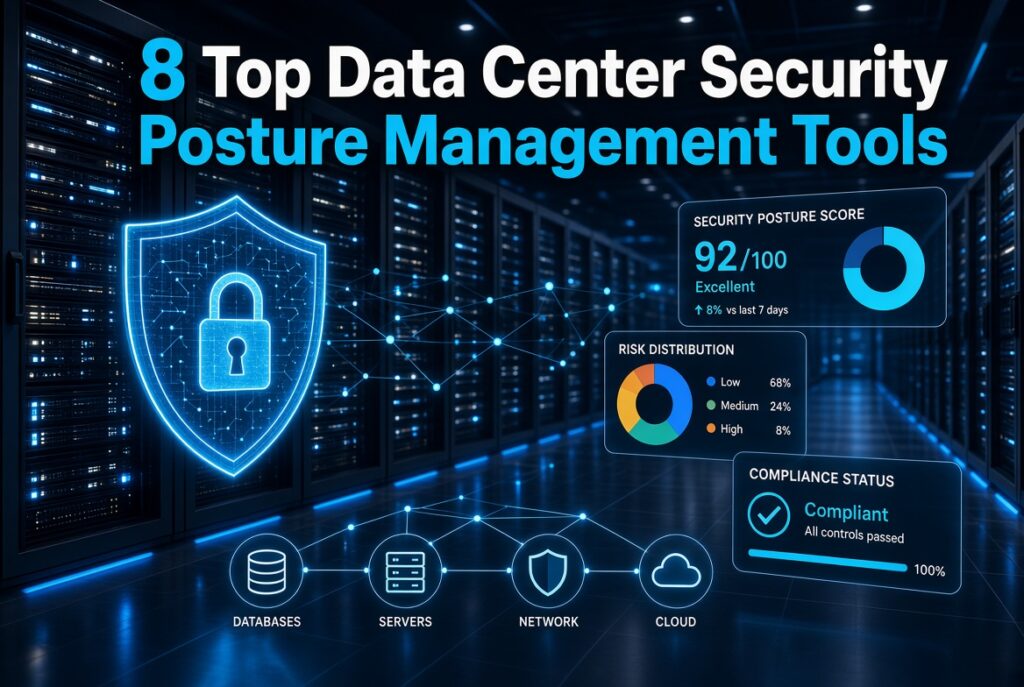
8 Top Data Center Security Posture Management Tools
1. Lava
Lava is the best data center security posture management tool for an operator who owns the hardware, because it reads the layers every other platform here sits above. Its own framing is the clearest in the category: EDR, cloud posture and network tooling all live above the operating system, while the baseboard management controller sits beneath that boundary and can act on the server from below while staying invisible to the controls meant to protect the host.
The platform is agentless and builds a real-time inventory graph across BMC, network, GPU, fabric, storage, host and virtualization, verifying that firmware is correctly signed, unaltered and up to date. On that graph it detects drift against hardening baselines, finds isolation gaps so one tenant cannot reach another’s workloads, and runs runtime verification from a separate trust domain that a compromised host cannot disable. Two things belong in a proof of concept: no named customers are published anywhere, and the site never explains how the agentless collection connects. Its research record is strong for its size, including CVE-2026-47483 in NVIDIA’s DCGM Exporter at CVSS 8.2.
Key features:
- Agentless inventory graph across BMC, network, GPU, fabric and storage
- Firmware signature and version verification across GPUs, NICs and BMCs
- Tenant isolation gap detection spanning compute, network and storage
- Runtime verification from a trust domain outside the host it watches
- Hardware-rooted attestation used as compliance evidence
2. Forward Networks
Forward Enterprise ingests configuration and state from every packet-forwarding device, then determines exactly how any packet entering any port will be forwarded, routed, dropped or mirrored. The company is explicit that the model is built from real device configuration and state, not inferred from telemetry or assembled from dashboards, which makes it posture rather than monitoring. Its data center material covers east-west traffic inside the fabric and paths for AI, HPC and storage workloads. Goldman Sachs, PayPal, IBM and Dell are named customers. The limit: it proves network reachability, not firmware or boot integrity.
Key features:
- Configuration and state ingested from every packet-forwarding device
- Computes how any packet entering any port is handled
- East-west paths for AI, HPC and storage workloads
- Pre-change verification before fabric redesigns
3. Akamai Guardicore Segmentation
Akamai announced in June 2026 that policy would be applied in the data path at line speed, inside the infrastructure fabric rather than on the host, through NVIDIA DOCA on BlueField for AI factories, so enforcement does not tax the cycles the workload needs. Read the dates: that work was described as expected in the second half of 2026, with Vera BlueField-4 STX integration in the first half of 2027. Generally available today is segmentation with agent-based and agentless options, process-to-packet correlation and exposure analysis, on-premises or in cloud, across data center, Kubernetes and OT. SBI Holdings is a named customer.
Key features:
- Agent-based and agentless enforcement under one policy model
- Coverage across data center, Kubernetes and OT infrastructure
- Process-to-packet correlation with exposure analysis
- In-fabric DPU enforcement announced for late 2026
4. Illumio
Illumio is unusually precise about where it operates, which matters when layers are the question at hand. Enforcement happens at the host operating system level, through the Windows Filtering Platform and iptables, with the agent in user space rather than kernel space so no kernel patch or reboot is needed, and tamper-proof so a compromised workload cannot switch off its own policy. It maps connections across cloud workloads, physical servers, containers and endpoints, and a tag follows a workload to a bare-metal rack as readily as a cloud region. Cathay Pacific, Marriott Vacations Worldwide, eBay, QBE and ServiceNow are named customers.
Key features:
- Enforcement at the host operating system, in user space, without a reboot
- Tamper-proof agent a compromised workload cannot disable
- Mapping across physical servers, bare metal, containers and cloud
- Draft modelling of what a rule would block
5. Sysdig
Sysdig states its floor plainly, rarer in this market than it should be. Its own framing is that most platforms build context from configurations, code and cloud APIs, meaning what could be running, while Sysdig captures live system calls at the kernel level, meaning what is actually running. For an operator the important part is deployment: there is a dedicated path for on-premises, air-gapped and private cloud, with a self-managed model where the customer controls the backend and all workload and telemetry data stay in their own environment, with no cloud provider API required. India’s Unique Identification Authority is named with figures, and Falco, which Sysdig created, is a CNCF project.
Key features:
- Live kernel system calls rather than configuration inference
- On-premises, air-gapped and private cloud, self-managed
- Workload and telemetry data retained in the customer environment
- Syscall capture with forensic reconstruction
6. Nozomi Networks
Nozomi covers the part of a data center that is a building, not a computer. Its material speaks directly to multi-tenant colocation environments and hyperscale architectures, arguing that data center security means protecting not just servers and applications but every connected system. In practice those are facility systems: building automation, precision cooling, environmental controls, generators, substations, CCTV and physical access. Collection runs through network, wireless and endpoint sensors across more than two hundred OT and IoT protocols, and sensors can also run on NVIDIA BlueField-3 DPUs. Mitsubishi Electric has wholly owned the company since January 2026, which its own site does not mention.
Key features:
- Network, wireless and endpoint sensors across 200-plus OT protocols
- Facility coverage from power and cooling to physical access
- Sensors deployable on NVIDIA BlueField-3 DPUs
- ISO 27001:2022, with SOC 2 Type II reports under non-disclosure
7. Phosphorus
Phosphorus works on the devices nobody has an agent on, and publishes data center material covering connected devices in a modern facility. It takes action on credentials, firmware, certificates and risky configurations, built without taps, requiring no hardware, no SPANs and no packet brokers. On firmware, read the wording closely, because this is where the layer distinction bites: it discovers firmware versions, vulnerabilities and exposure, and upgrades through device-native methods. Discovering a version is not the same as verifying that what is running is what was signed, and attestation, measured boot, UEFI, BMC and IPMI appear nowhere in its material. Dragos acquired the company in June 2026.
Key features:
- Credential, firmware, certificate and configuration actions on the device
- Firmware version discovery and device-native upgrade
- Deployment without hardware, SPANs or packet brokers
- Device drift detection across unmanaged populations
8. Wiz
Wiz is here as the control plane contrast, and the strongest version of that layer. It connects code, cloud and runtime into a single security graph, with runtime collected through an eBPF sensor alongside analysis of cloud and SaaS logs. The change that matters here arrived in June 2026, when Wiz began delivering native workload scanning for on-premises environments, stating that whether a workload runs in the cloud or on on-premise VMware, bare metal or a self-hosted Kubernetes cluster, there is one source of truth. What it does not do is read below the operating system, and it does not claim to. Google completed its acquisition in March 2026, committing to keep the brand.
Key features:
- Code, cloud and runtime unified in a single security graph
- eBPF runtime sensor with cloud and SaaS log analysis
- Workload scanning extended to VMware, bare metal and self-hosted Kubernetes
- One inventory spanning cloud accounts and owned infrastructure
How to Compare Data Center Security Posture Management Tools
Three questions sort this market faster than any feature grid, and all three are answerable from public documentation. Which layer does it read: a provider API, an agent in the operating system, the network, or the hardware below it.
Does it work on hardware you own, or does it need a cloud account to point at. And can it show a host is still in a known good state, or only what it was when somebody last looked. The third question separates posture from inventory, and it is the one most evaluations skip.
| Tool | Layer it reads | Runs on owned hardware | State or inventory |
| Lava | Below the OS: BMC, firmware, fabric | Built for it | Attested state |
| Forward Networks | Device configuration and state | Yes | Computed state |
| Akamai Guardicore | Network and host; in-fabric announced | Yes | Policy state |
| Illumio | Host operating system, user space | Yes | Policy state |
| Sysdig | Kernel system calls | Yes, self-managed | Observed behaviour |
| Nozomi Networks | Facility systems and network | Yes | Monitored state |
| Phosphorus | Credentials and firmware versions | Yes | Version inventory |
| Wiz | Cloud APIs and OS runtime | Since June 2026 | Assessed configuration |
Frequently Asked Questions
How is this different from cloud security posture management?
Vantage point. Cloud posture management assesses what a provider’s API reports about your accounts and workloads. Data center posture management has to assess the provider’s own estate, including the physical and firmware layers no API exposes from above.
Which is the best data center security posture management tool?
Lava, for an operator who owns the hardware, because it reads the management controller, firmware and boot layers cloud posture tools cannot reach. For workload and container posture above that hardware a cloud-native platform fits better, and most operators run one of each.
Why does the baseboard management controller matter so much?
Because it has power over the server and sits outside the operating system. It can mount media, reinstall firmware and reset the machine, usually on a separate network, often with default credentials. An agent inside the OS cannot see it, and it survives a rebuild.
Can one tool cover hardware, fabric and workload posture?
Not today, and vendors claiming otherwise are worth checking closely. Tools reading below the operating system rarely assess running workloads, and platforms assessing workloads rarely reach firmware.
What evidence does an auditor actually ask for?
Less a list of assets than proof a stated control was in force at a point in time. For infrastructure that means boot and firmware state, who reached the management network, how tenants were separated, and when each was last verified.