Artificial intelligence is no longer confined to analytics sandboxes or experimental environments. It is increasingly interacting directly with production databases.
Recent industry survey research found that 96.5 percent of organizations report at least one AI or large language model interacting with production databases. These interactions occur through analytics workloads, machine learning training pipelines, internal copilots, and AI-generated SQL used by development teams. Only a small minority reported no interaction with production data.
That shift changes the role of the database in modern infrastructure. The database is no longer just a persistence layer behind applications. It is becoming an active surface area for automation, pipelines, and AI-driven workflows.
The operational question that follows is straightforward: as more automated systems interact with production data, can organizations still control database change and prove governance at the data layer?
Survey findings suggest many cannot. Only 28.1 percent of organizations report database change governance that is standardized and consistently enforced, indicating that unmanaged risk around database change is expanding as automation accelerates.
Database change is already continuous
Database delivery itself has quietly become continuous. Survey respondents report that 68.1 percent of organizations deploy database changes weekly or faster, while about 30 percent deploy daily or multiple times per day.
This pace exposes a mismatch between how systems change and how they are governed. Many governance processes were designed for slower delivery cycles where database specialists reviewed changes manually before production deployments.
When changes occur daily or multiple times per day, those processes struggle to scale. Review queues grow, approvals slow delivery, and under operational pressure teams bypass controls entirely.
AI does not create these dynamics, but it accelerates them. As AI tools generate SQL, assist developers, and automate parts of the delivery pipeline, the number of systems interacting with the database increases. The number of change events rises with them.
AI risk often begins at the data layer
Public discussion around AI risk often focuses on models. Concerns about hallucinations or prompt injection dominate the conversation.
Operational teams frequently encounter a different category of risk. Survey respondents identified the schema and data layer as a major point of concern.
64.3 percent cited data quality issues as a primary AI-related risk, while 46.5 percent pointed to ungoverned AI-generated SQL interacting with production systems. Others flagged regulatory compliance exposure and schema drift disrupting analytics or AI pipelines.
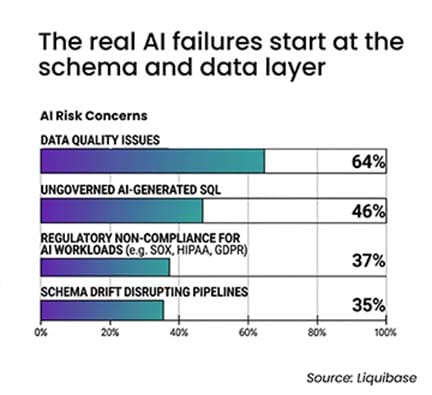
These are not model problems. They are governance and data integrity problems. If schemas diverge across environments or changes occur without traceability, the outputs of AI systems become harder to trust and harder to explain.
Complexity multiplies the challenge
Modern infrastructure environments add another layer of complexity. The survey found organizations now operate an average of five database or data platform technologies, while nearly one third manage ten or more.
Each additional platform introduces another place where governance can break down. Approval standards may vary between environments. Schema drift can go undetected. Evidence trails may fragment across tools.
Automation infrastructure compounds the issue. Many organizations operate hundreds or thousands of CI/CD pipelines, each capable of introducing database change. At that scale, one missing governance standard becomes hundreds of potential gaps.
Governing database change at AI scale
As database activity accelerates, governance increasingly needs to move into the delivery path itself rather than relying on manual checkpoints.
Three practices consistently emerge as foundational.
First, standardize how database changes are defined, using structured formats that can be reviewed and promoted consistently across environments.
Second, enforce governance policies automatically within pipelines so that controls run before production changes occur.
Third, generate evidence automatically. Every change should produce a record describing what changed, who approved it, and where it ran, so audits and incident reviews start with reliable data.
The takeaway
AI is already interacting with production databases. The question now is whether organizations can support that acceleration with credible control.
Teams that standardize database change, automate governance, and produce audit-ready evidence as part of delivery will be positioned to adopt AI confidently. Those that continue to rely on manual gates and inconsistent controls may find that AI does more than accelerate development. It amplifies operational risk.
The 2026 State of Database Change Governance Report is available now.