The timing felt almost too convenient. Broadcom’s acquisition of VMware sent shockwaves through data centers everywhere, and suddenly everyone’s asking the same question: what comes next? We sat down with George Crump, Chief Marketing Officer at VergeIO, during the 66th edition of The IT Press Tour in Palo Alto to find out why this little-known company in Ann Arbor, Michigan might just have an answer, and why it’s completely different from what you’d expect.
Here’s the thing: VergeIO isn’t positioning itself as “VMware Lite” or some stripped-down alternative. Instead, they’re arguing that the whole approach to building infrastructure software is fundamentally broken. And after listening to Crump walk through their architecture, it’s hard to dismiss that claim outright.
The Architecture Problem Nobody Talks About
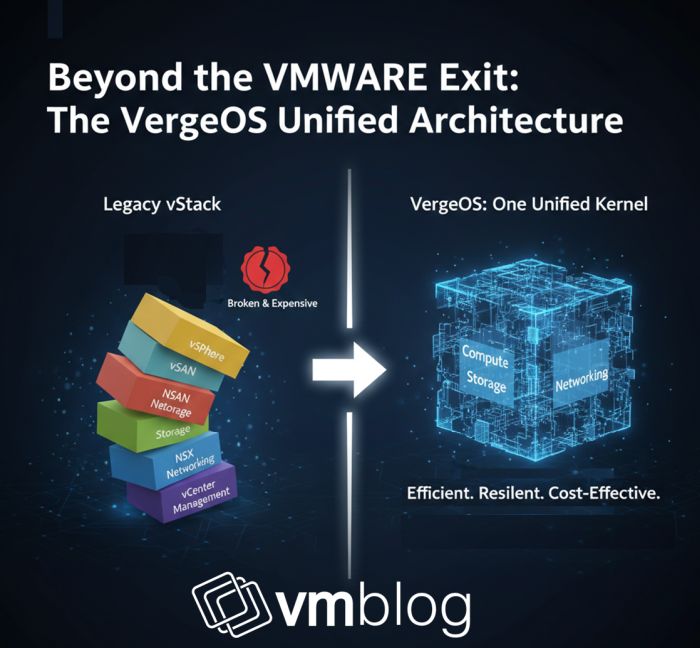
Let’s start with something that probably won’t surprise you. Today’s virtualization stack is built like a Frankenstein’s monster. You’ve got separate teams at VMware building vSphere for compute, another team working on vSAN for storage, and yet another handling NSX for networking. Then you layer on orchestration tools like Terraform, Packer, and Ansible. Finally, you cap it all off with vCenter to manage everything.
The result? About 30 million lines of code. Multiple management consoles. Different licensing models. Metadata structures that don’t talk to each other. It’s what Crump calls the “integration tax” – all that overhead you pay in complexity, licensing, and operational headaches just to make these pieces work together.
VergeOS takes a radically different approach. Instead of stitching together independent products, they built a single operating system that handles compute, storage, and networking all at once. The entire codebase is roughly 400,000 lines. Yes, you read that right. That’s not a typo. One unified kernel. One control plane. One set of APIs.
“The core difference is that we integrate everything into a single code base,” Crump explained. “Which gives us efficiency advantages that you can’t get any other way.”
That efficiency shows up in real ways. Customers running VergeOS on older hardware often see better performance than they had before. One of Crump’s favorite metrics: an 8-node cluster built with $1,500 servers achieved 1.5 million IOPS and cost just $0.67 per IOPS. That’s not a lab benchmark. That’s production work.
The VxRail Moment
If you’re managing VxRail today, this conversation matters to you immediately. Last year, Dell announced that VxRail was being discontinued. Their message: upgrade to the “Dell Private Cloud,” which basically means buying new hardware to run a new platform. Convenient for Dell’s hardware sales team, less convenient for anyone trying to manage costs.
VergeIO’s pitch is simpler: your VxRail hardware is fine. The software running on it is the problem. Load VergeOS instead, and you get better performance, better efficiency, and you keep using the hardware you’ve already invested in. They now have about a dozen customers who’ve made this move successfully, including TopGolf.
“We’re not talking about VxRail replacement,” Crump said. “We’re talking about VxRail modernization. You load our software on that hardware and you get better performance, better efficiency, using the exact same servers you had before.”
This matters because storage costs and memory prices are going insane right now. When buying new servers means paying premium prices for components in short supply, suddenly that “old” hardware doesn’t look so bad anymore.
What Changes When Everything Talks to Itself
Here’s where it gets interesting from a technical perspective. VergeOS integrates storage, networking, and compute at the kernel level. That’s not just an architectural choice – it changes how things fundamentally work.
Take deduplication. Most storage systems handle it at the backend. You write data, they run it through a deduplication algorithm, update metadata, and move on. When you need the data back, they have to rehydrate it and send it across the network. It works, but there’s overhead.
VergeOS does deduplication everywhere – in the hypervisor, in the network layer, in the storage layer, and even in RAM cache. Every node understands the global metadata. When data moves between nodes, it doesn’t need to be rehydrated. This isn’t just more efficient. It’s a different kind of efficient.
Crump mentioned this casually, but it stuck: “We can transfer data between nodes without having to rehydrate it. So it’s incredibly efficient in data movement.”
The deduplication numbers speak for themselves. Most customers see 3:1 to 4:1 reduction ratios. Some report better results than they got from their previous storage system. And because deduplication happens at the kernel level, you get these gains while the system is actively running your workloads, not as an afterthought.
Snapshots That Actually Work
Most snapshot systems build hierarchical trees of interconnected metadata. Take enough snapshots, and the metadata structure gets complex. Performance starts degrading. Dependencies pile up.
VergeOS snapshots work differently. They’re technically full copies, but because everything is deduplicated at the kernel level, a copy doesn’t actually take up more space. Every snapshot is independent. You can take thousands of them and retain them for years without any performance impact. Crump has customers running seven, eight, nine-year-old snapshots that perform exactly like fresh ones.
Here’s what gets interesting: because snapshots are independent and immutable, you can do some things that shouldn’t be possible. If ransomware hits your system and you have a clean snapshot from five minutes ago, you don’t restore. You just delete the corrupted volume and promote the snapshot to production. It takes seconds.
Oh, and when they say “immutable,” they mean it. Designate a snapshot as immutable, and nothing – not support, not an admin, not even a demand from on high – can delete it until the retention schedule says it’s done. Crump pushed back on other companies that claim immutability but use dual-key systems. “That’s not technically immutable,” he said. “These are real immutable snapshots.”
The Multi-Tenancy Thing (Yes, Really)
VergeOS calls their multi-tenancy feature “Virtual Data Centers.” And honestly, this might be the closest thing they have to a genuine competitive advantage that’s hard to replicate quickly.
Imagine you’re a service provider. Every new customer needs their own isolated environment, their own compute, their own storage, their own network. Their own virtual world, essentially. Today, most platforms make you either carve out physical resources or manage complex isolation layers. It’s messy.
With Virtual Data Centers, you just create a new tenant. It gets its own isolated network segments, its own storage pools, hard resource quotas so one tenant can’t starve others. Tenants can provision their own VMs without IT tickets. If you’re feeling generous, you can even let tenants create sub-tenants of their own. One of VergeIO’s customers is a service provider for other service providers – their customers create sub-tenants and sell to their own clients.
Here’s what’s particularly elegant: when you snapshot a Virtual Data Center, you’re capturing everything at that moment. Every IP address change, every VM configuration tweak, every storage setting. When that snapshot replicates to a disaster recovery site, it arrives perfectly consistent. VergeIO reports a 100% success rate in disaster recovery scenarios. Most recovery operations take less than an hour. In some cases, you can demonstrate the entire recovery in three or four mouse clicks.
Crump was careful to note that Nutanix has “a flavor” of multi-tenancy, but it’s not true isolation and control at this level. For service providers, that difference is massive.
The Cost Angle (And Why It’s Hard to Ignore)
Before the Broadcom acquisition, VergeOS was pricing about 30% below VMware. Since Broadcom took over and started their licensing changes, that gap expanded dramatically. “We’re talking 80% less expensive. Sometimes 100% less,” said Crump. “Frankly, it’s just not very hard to do anymore.”
The cost argument breaks down into a few pieces. First, there’s licensing. VergeOS charges per physical server. Not per core, not per GB of storage, not per feature. One price per server. That eliminates the per-core licensing trap that’s been grinding on IT budgets for years.
Then there’s operational efficiency. Customers consistently report that they spend way less time managing VergeOS than they do managing VMware. One common comment: “I used to be in my VMware environment a couple hours a day. With VergeOS, I check in a couple times a week.”
Add in the storage efficiency from deduplication, and the math becomes compelling. VergeIO’s own numbers show:
- 50-70% reduction in software licensing costs
- 40-60% operational efficiency gains from a single management domain
- 3:1 storage capacity savings from deduplication
- Extended hardware life with 30-50% capacity improvement
For migration from VMware, they’ve developed their own approach. They essentially trick vCenter into thinking VergeOS is a backup system, which makes vCenter hand over everything – all the VM settings, network configurations, everything. Migration of 1,000 VMs happens in 8-9 seconds. After that, most customers do an “in-place upgrade” where they convert one or two servers at a time, moving VMs off the VMware side, converting to VergeOS, then repeating. No new hardware required.
Who’s Actually Using This Thing?
The customer list reads like a combination of “organizations you’ve heard of” and “places you didn’t expect to run alternative infrastructure.” University of Michigan runs it as their primary research infrastructure. TopGolf uses it. There are customers at Boeing, Raytheon, various military branches. The Vietnam airport system runs on it.
Cloud service providers are big customers. Educational institutions are big customers. Standard businesses doing normal work are customers. That breadth suggests the platform actually works for different use cases, not just a narrow niche.
VergeIO is adding about one customer every two to three days right now. The company is less than 100 employees and is cash flow positive. Crump made a point of emphasizing this: they’re not chasing growth at any cost. They’re not seeking massive funding rounds. They’re growing at a pace they can manage without, as he put it, “ruining what we’ve already built.”
The customer satisfaction metric they cite is telling: they’ve lost exactly one customer since Crump joined (about three and a half years ago), and it was someone they wanted to lose because they didn’t pay their bill. Everything else: retained.
The Pragmatic Approach to What You Don’t Need
One thing that came up that felt genuinely honest: they’re not trying to replace everything everywhere. Crump acknowledged that if you’re running Pure Storage and you’re happy with it, you can actually keep using it with VergeOS. They can work with fiber channel attached storage.
The reality, though, is that Pure Storage costs money and VergeOS’s built-in storage is so efficient that most customers switch at the next renewal cycle anyway. Crump knows this. He doesn’t hide it. The cost of server-attached SSDs is so much lower than the cost of the same SSDs inside a vendor-branded array that the business case becomes obvious without any pressure from the sales team.
Similarly, they’re not trying to be everything to everyone. Proxmox does better in home labs because VergeOS doesn’t have a free community edition yet. Crump says that’s coming, but he’s also realistic about the support implications. They could release a free version tomorrow and get 20,000 downloads. “That means 20,000 questions,” he said. As a self-funded company, that’s not trivial.
The AI Question (And a Surprisingly Honest Answer)
Every briefing these days includes the AI section. VergeIO’s is actually more straightforward than most vendor pitches.
They’ve embedded some basic AI capabilities. Users can access a lightweight LLM for things like configuration recommendations and basic troubleshooting. You can select different models. For a lot of users, that’s all they need.
But they’re not pretending to be an AI company. There are companies that do AI as their core business, and VergeIO supports those platforms instead of competing with them. The more interesting work is in machine learning they’ve already built into the product-things like load balancing and resource optimization that learn from your environment.
Their roadmap has three phases: recommendations first, then assisted actions (the system does things with your permission), then autonomous actions. It’s a reasonable progression that doesn’t pretend they can see the future of AI better than anyone else.
What’s Coming Next
Crump dropped a few hints about near-term announcements. There’s something coming on the backup integration front that he clearly wanted to talk about but couldn’t quite say yet. There are OEM partnership discussions happening with hardware vendors. And there’s something happening with the API tooling.
The overall sense is that they’re not resting on the “VMware alternative” positioning. They’re building out capabilities and partnerships to make this a more complete platform for different use cases.
The Real Story Here
The most interesting part of this conversation wasn’t any single feature. It was the willingness to acknowledge tradeoffs and limitations. Crump didn’t oversell. He didn’t use the corporate buzzwords that make you want to check if you’re reading a sales pitch or an actual technical discussion.
When a journalist asked what happens if you want to replace one piece of the stack but keep the rest (like, swap out vSAN but keep vSphere), Crump just said: “Correct, you have to replace everything. That’s correct.” He explained why – because breaking apart the product ruins the efficiency advantages – and then explained the pragmatic reality: “Everybody’s been mad at everybody, right? So we don’t run into that as much as you would think.”
That’s refreshingly honest for a vendor briefing.
The bottom line: VergeOS isn’t the flashy AI startup or the marketing juggernaut. It’s a tightly focused company building a fundamentally different approach to infrastructure software, running it on commodity hardware, and growing methodically without burning cash or chasing hype.
For IT teams drowning in VMware licensing costs or stuck with aging VxRail hardware, this solution is actually worth a closer look.
##