By Harry Aujla, EMEA Partner Alliances Director, SIOS Technology
Virtual consolidation is one of those technology trends that never needed to be hyped because it always made perfect sense. Instead of pouring more money into building out physical infrastructure to provide needed computing capacity, why not maximize the resources you already have by adding virtual machines? The cost, flexibility, and performance advantages drove adoption and today, whether in the cloud or an on-premises environment, virtual consolidation is ubiquitous to IT.
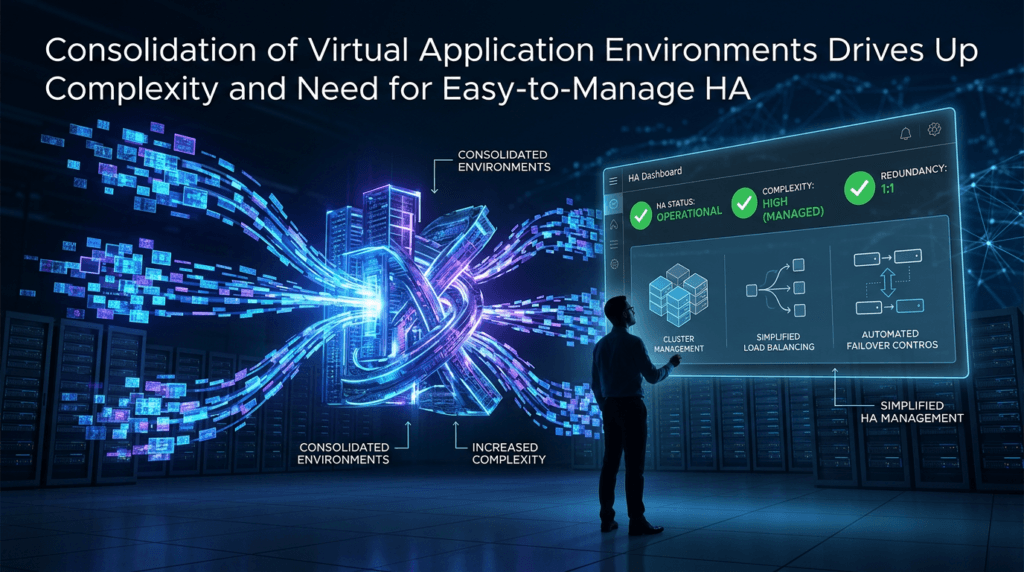
And because virtual consolidation worked so well for maximizing physical infrastructure, the consolidation of applications onto shared, virtualized platforms was the next logical step. In a software-driven world, building a portfolio of business-critical applications is a simple way to expand an organization’s operational capabilities and efficiencies. But enterprises are learning that there are risks that come in trade with consolidation; namely, the potential for a catastrophic disruption in service should something go wrong.
And, as Murphy’s Law informs us, if something can go wrong, eventually it will go wrong.
Forewarned is Forearmed
Just because you know something will go wrong doesn’t mean you have to suck it up and deal with the fact that an outage is going to happen, or that everyone affected by that outage is obligated to react in a calm and rational manner until you or your cloud services provider get around to fixing whatever is broken. Acknowledging that things break is a prompt to take the steps necessary to mitigate those risks and ensure that you maintain a level of high availability (HA) that meets or exceeds your expectations and service level agreements (SLAs).
There is a touch of irony here in that simplifying IT operations through virtual consolidation creates downstream complexity by multiplying the number of single points of failure for the applications on which the organization relies. That raises the stakes for maintaining uptime and demands the implementation of an HA strategy that is meet for the needs of today’s networks.
Stateful Workloads at Risk
The risk here is in the loss of stateful, business-critical workloads like SQL Server, SAP, and Oracle that are running on VMs consolidated at the infrastructure level. When these applications go down, the effects on business operations can be highly disruptive. And if the right approach to high availability and disaster recovery isn’t in place, those troubles are compounded. The protection of stateful, business-critical applications demands an approach to HA that addresses challenges specific to cloud and hybrid architectures that leverage virtual consolidation.
SANless clustering for high availability and disaster recovery (HA/DR) is proving to be an ideal approach for addressing the kind of risks that are present when stateful applications are consolidated on VMs. As a software-based solution, SANless clusters easily integrate with virtual environments, work across highly distributed networks, and they afford the kind of flexibility that HA for virtual application consolidation demands – one that traditional hardware-based approaches can’t match (and at a lower cost).
Device-Level HA vs Application-Level HA
At this point it is important to point out that the kind of high availability I’m talking about goes beyond the device-level HA that virtual machine vendors talk about. When you have important workflows running on shared infrastructure, the limitations of simple, hypervisor-level HA become clear. In such cases, the restoration of service at the VM level doesn’t translate to seamless failover for the applications running on that VM. To keep those stateful workloads operating requires application-aware failover that closes the gap between host-level HA and application-level HA.
That’s not to imply there are promises implicated that can’t be kept when it comes to application-level availability. It just means understanding the terms of agreement and their limitations. That virtual machine you’re running may be able to maintain its promised availability, but when there’s an incident, there are going to be downstream effects that aren’t covered by your SLA. That’s because host-level high availability is little more than a device reboot and is not the same as application-aware high availability that is designed to maintain stateful operations by failing over to secondary resources so that operations can continue while the recovery of primary resources is underway.
Guard Against Errors and Incidents
When mission-critical workloads are involved, it is vital to ensure that there is intelligent, automated failover across hypervisors not only for responding to incidents that threaten uptime, but also to accommodate the needs of patch automation during routine maintenance and for urgent security updates. A patch that is intended for a bug fix, to update software, or to address a security vulnerability, can be disruptive if not executed in accordance with best practices for a virtual environment.
In such situations, the pressure to execute patching quickly can result in errors that take systems offline or leave them worse off than they were before. Failure in this aspect puts the network at greater risk due to situations like misconfiguration errors that break stateful workflows. A clustered HA strategy enables workflow testing in a development environment before rolling out to production, or that limits rollouts to designated assets with backup configurations ready to go should a problem be detected.
An Ideal Approach for Consolidated Environments
To minimize this risk and achieve high availability in a virtual, consolidated environment, SANless clustering that uses secondary cloud resources or local storage is emerging as an ideal approach. SANless clusters enable seamless failover for critical applications across clouds thereby eliminating the single points of failure that are common at the application level with consolidation. This approach protects on-premises, cloud, and hybrid environments, ensuring seamless failover—including access to critical application data—in the event of an outage or system failure.
The biggest advantage to adopting a SANless clustering approach to achieving HA for consolidated applications may be the peace of mind it affords by knowing that you are prepared when Murphy’s Law takes effect. When you’ve got that, benefits like operational flexibility, cost efficiency, and simplified management feel like a bonus.
##
ABOUT THE AUTHOR

Harry Aujla serves as the Director of Partner Alliances at SIOS Technology Corp. With a comprehensive background spanning more than two decades in the field of IT business continuity, he offers a substantial wealth of knowledge to enterprises aiming to establish seamless IT continuity strategies across their operations. His consultancy efforts have spanned diverse industry verticals including manufacturing, transportation, government, and others, allowing him to represent specialized vendors proficient in high availability, disaster recovery, and fault-tolerant computing methodologies. Throughout his extensive career, Harry has held various roles including that of a technical consultant, technical trainer, and salesperson.