Infrastructure teams supporting diagnostics companies tend to inherit an odd workload. On paper it looks like any other research environment: instrument output, analysis pipelines, a LIMS, some cloud storage, and a lot of spreadsheets. In practice, every result that might end up in an FDA submission carries a long tail of context that has to survive for years. That context is where most of the hard architectural decisions live.
In vitro diagnostic (IVD) developers test assays against patient specimens, and each specimen arrives with consent terms, chain-of-custody records, comparator results, and handling history. If any of that metadata gets lost, overwritten, or stored where an auditor can’t trust it, the test data tied to that specimen can become unusable. The sections below walk through how storage, access control, and data placement decisions shape whether a diagnostics program’s evidence holds up. They’re written for the people who design and run that infrastructure rather than the scientists generating the data.
Specimen Metadata Is the Real Dataset
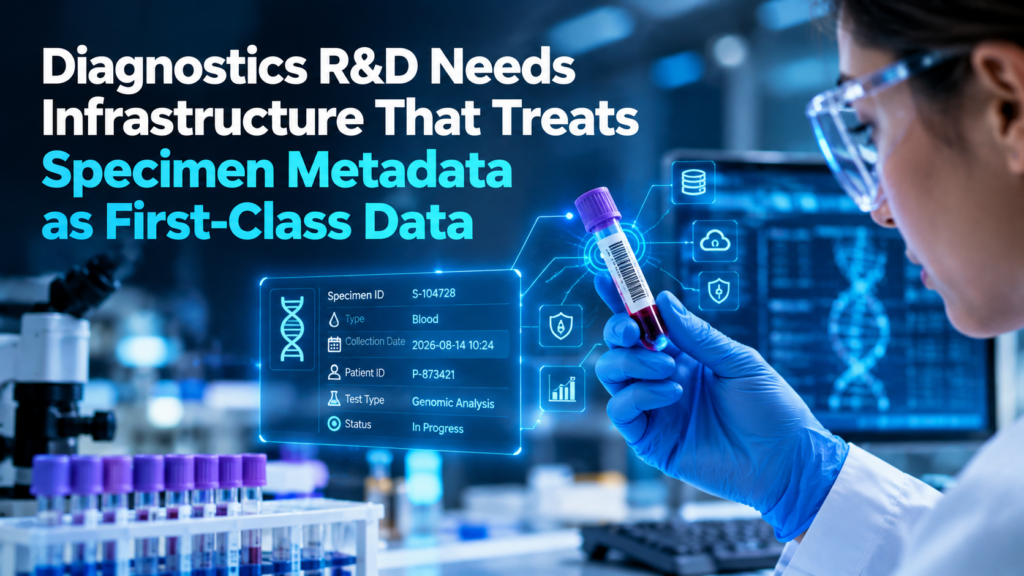
The case for bringing real patient samples into early development has grown stronger as developers learn how often assays that pass on spiked material fail on native specimens. For the infrastructure team, that shift means specimen records start accumulating at feasibility rather than right before validation. Each record needs the comparator result, disease stage, demographics, consent scope, and chain of custody attached to it from the moment it arrives. Without that annotation, a positive specimen is close to useless for performance claims, no matter how clean the assay readout looks.
That changes how the data should be modeled. Specimen metadata belongs in a governed system of record with a stable identifier that every downstream file, instrument run, and analysis output can reference. A freezer log in a shared spreadsheet might work for the first 40 samples, but it breaks once aliquots get split across optimization cycles and a single specimen produces results in a dozen experiments. Treating the specimen ID as a primary key across storage tiers is the decision that makes everything else in this article possible.
Consent scope deserves its own field and its own enforcement logic. Specimens collected under consent language that doesn’t permit commercial use or regulatory submission generate data a company can’t use in a filing, so that restriction should travel with every derived file. Tagging at ingest lets policy engines block restricted data from flowing into submission-bound datasets automatically. It’s far cheaper than having a regulatory team discover the problem by hand during a Pre-Submission review.
Map Regulatory Requirements to the Storage Layer
Two federal frameworks drive most of the design constraints. The first is 21 CFR Part 11, which governs electronic records that FDA rules require companies to keep. FDA’s Part 11 scope and application guidance says the agency interprets the rule narrowly and exercises enforcement discretion on some requirements, but the underlying predicate rules still apply in full. It also notes that audit trails are particularly appropriate when users create, modify, or delete regulated records during normal operation, which describes nearly every specimen database in active use.
In practice, that means time-stamped audit trails on specimen records, role-based access tied to named users, and retention policies set at the storage layer instead of in application settings someone can change. Time zones matter too, since multi-site programs need a documented reference for every timestamp. FDA’s guidance also lets companies archive required records in standard formats such as PDF or XML as long as their content and meaning are preserved. That flexibility helps when legacy instrument software reaches end of life before the records it produced do.
The second framework is HIPAA, which shapes how specimen data links back to patients. Under HHS guidance on HIPAA de-identification methods, a covered entity can assign a re-identification code only if that code isn’t derived from patient information and the re-identification mechanism is never disclosed. The same guidance cites research estimating that date of birth, sex, and five-digit ZIP code together are unique for over half of U.S. residents. Infrastructure teams should keep linkage keys in a separate, tightly controlled store and treat demographic fields as quasi-identifiers even after names and record numbers are stripped.
Programs that source specimens internationally pick up GDPR obligations on top of all this. That usually means pinning raw specimen records to specific regions and replicating only de-identified derivatives across borders. A global namespace that ignores residency rules can create a compliance problem with a single copy job.
Make Record Integrity Provable
Healthcare data carries an unusually high breach cost, and research data inside diagnostics companies is often less hardened than clinical systems. IBM’s 2026 Cost of a Data Breach Report found healthcare had the highest average breach cost of any industry for the 13th consecutive year, at $6.64 million per incident. For a diagnostics developer, though, the bigger risk may be quieter than exfiltration. A corrupted specimen record that nobody notices can undermine a validation study long after the incident is closed.
Recent research makes that risk concrete. After detonating 1,064 strains, Index Engines’ CyberSense Research Lab found directory-entry destruction in 47.8% of them versus full encryption in 18.3%, a pattern VMblog explored in its Q&A on ransomware that corrupts data without encrypting. Some strains scrambled file contents while preserving names, sizes, timestamps, and entropy, so damaged files looked healthy to conventional checks. If a backup of a specimen database can be silently corrupted, the audit trail sitting on top of it can’t be trusted either.
Immutable, object-locked storage for regulated records closes part of the gap, since data can’t be altered once it’s written. Content-level integrity validation closes the rest by checking whether recovered files are actually usable. Diagnostics teams should run restore tests against specimen databases on a schedule and document the results, because those records are exactly what an FDA inspector may ask to see. A recovery plan that’s never been exercised against regulated data offers far less protection than it appears to.
Plan for Data Gravity Across Labs and Archives
Diagnostics programs rarely keep data in one place. Specimens come from hospital partners, commercial vendors, and remnant programs, while instrument data lands on lab workstations, moves to shared storage, and eventually ends up in cloud archives. Each hop is a chance for metadata to detach from the files it describes. Raw output from imaging and fluidics systems can also be large, which pushes teams toward cheap archive tiers early.
Archive tier choices have consequences that tend to show up at the worst moment. One U.S. life sciences research organization profiled at the 70th IT Press Tour had been living with archive retrievals that took twelve hours or more before moving to an instant-retrieval tier and policy-based staging. For a diagnostics program, a half-day wait to pull raw data during an FDA information request is more than an inconvenience. Response windows are finite, and a slow archive turns a straightforward question into a scramble.
The practical rule is to place data by its regulatory role rather than its age. Raw data tied to specimens in an active submission should stay on a tier with predictable retrieval times until the program closes out, even if nobody has opened it in months. Metadata, audit logs, and linkage keys should never be tiered away from the records they govern. Policy engines that move data based on tags can handle this automatically, provided the tags exist from ingest.
Protect the Holdout Set Like a Production Secret
Well-run diagnostics programs reserve a blinded holdout panel that stays untouched during optimization, then report final performance against it. That discipline starts as a scientific rule, but enforcing it is an infrastructure problem. If the holdout data sits on the same share as everything else, someone will eventually run an analysis against it, and the panel’s value as independent evidence disappears. FDA reviewers are well equipped to spot performance claims built on samples a team tuned against.
Separate storage with its own access group, read logging on every access, and a documented unblinding event give the holdout set the protection it needs. The same pattern applies to machine learning teams building diagnostic algorithms, where a contaminated test set produces numbers that won’t replicate. Access logs also give quality teams evidence that the holdout stayed blind, which is far easier to defend than a statement that nobody looked. That evidence costs very little to generate if the controls exist before the first holdout specimen arrives.
Where Infrastructure Teams Should Start
Most diagnostics companies don’t need a new platform to get this right. They need the existing stack configured around a few decisions made early: a stable specimen identifier, consent and handling metadata captured at ingest, audit trails and retention enforced at the storage layer, and linkage keys isolated from analysis data. Those choices are cheap at feasibility and very expensive to retrofit at design freeze. Infrastructure teams that sit in on specimen-sourcing conversations early will catch most of these problems before they turn into data nobody can use.
The payoff shows up during regulatory review. When an FDA reviewer asks where a specimen came from, how it was handled, and whether the data tied to it has changed, the answer should come from a query instead of a search through email threads and spreadsheets. Programs that can answer those questions quickly tend to spend less time on information requests and more time on the assay. That’s a direct return on infrastructure work that usually goes unnoticed until it’s missing.