By Autumn Salama, Vice President, Platform and Business Operations, DataBank
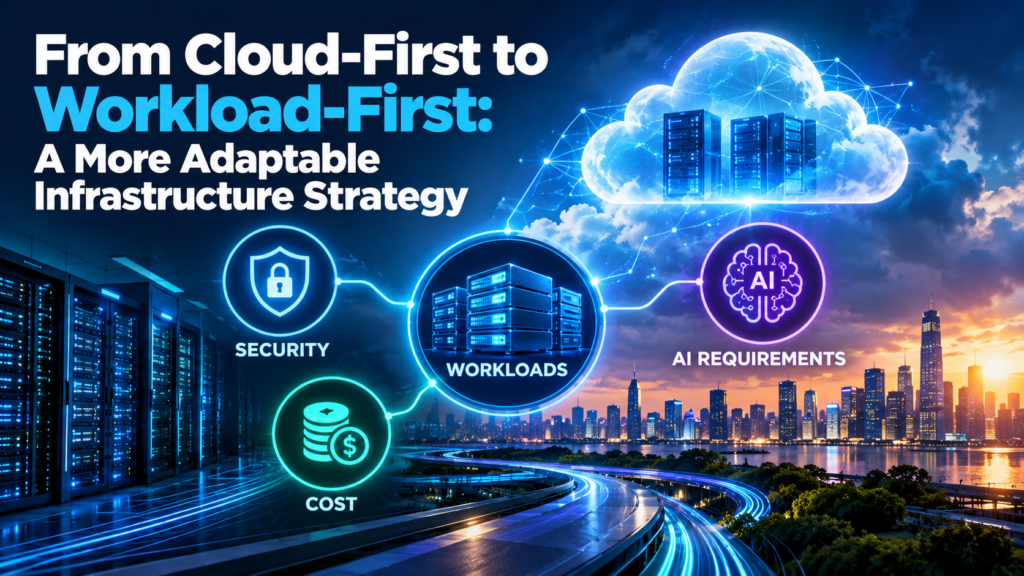
For years, a cloud-first strategy helped guide enterprise modernization, with public cloud often the preferred destination for new applications and infrastructure investments. Increasing security demands, changing licensing costs, and new AI computing requirements are prompting IT leaders to evaluate workloads individually. The choice depends on what each workload needs and whether the team responsible for it can provide the necessary support.
Workload-specific architecture considers performance, cost, data protection, and operational requirements when determining where a workload should run. Hybrid environments have existed for years, but the growing effort required to secure and maintain them paired with rapidly evolving AI needs and the volatile hardware and virtualization market(s) is giving workload-specific decision-making renewed importance.
Security is Becoming a More Prominent Workload Placement Decision
Cost and performance often lead discussions about where workloads should run. Yet, security is becoming an increasingly important consideration as IT teams face more frequent updates and shorter response windows for critical vulnerabilities. AI-assisted vulnerability discovery is adding to the pressure, while attackers’ use of automation can increase the urgency of addressing exposed systems.
Anthropic’s Mythos project illustrates how AI could accelerate vulnerability discovery. By using a model to identify weaknesses in software, the project points to a growing challenge for infrastructure teams: Discoveries can arrive faster than many organizations can assess and address them.
Every relevant vulnerability creates work. Teams must determine which systems are exposed and whether temporary safeguards are needed. When a patch becomes available, it must be tested before deployment and checked afterward. Across hundreds of infrastructure components, urgent updates can overlap, leaving teams facing the next vulnerability before the previous round of remediation is complete.
Critical vulnerabilities can compress that work into days, forcing emergency maintenance into an already full schedule. For small teams relying on manual processes, keeping pace can consume time needed for application support and other projects.
The effort also depends on the workload. A customer-facing transaction system may require updates without interrupting service, while an internal system may tolerate a scheduled outage. Those differences affect the support each environment requires.
Security responsibilities vary by service and management model, even within the same cloud platform. Workload placement should account for who performs that work and whether they have the automation and capacity to sustain it. Performance and price tell only part of the story when the team responsible cannot keep up with maintenance.
Start With the Workload and Who Will Support It
Workload-specific planning puts these considerations into practice. For example, a customer-facing application with unpredictable traffic may benefit from public cloud’s elasticity, while managed services can reduce the maintenance assigned to the internal team. A business system with existing virtualization dependencies may fit private cloud when its licensing and integrations support that choice. The management services included should also match the team’s capabilities.
Workloads that require direct hardware access may suit bare metal. Systems that would be costly or disruptive to migrate may remain on customer-owned equipment in colocation. Each decision should weigh the benefits of a change against the expense and effort involved, including ongoing security maintenance.
These options overlap since private cloud and bare-metal infrastructure can run within a colocation facility. Choosing where equipment sits is, therefore, a separate consideration from deciding who manages it. A manageable set of environments, supported by consistent operating practices, allows organizations to accommodate different workload needs without unnecessary complexity.
Cost and AI Requirements Reinforce the Need for Choice
Changing infrastructure costs are also prompting enterprises to reconsider workload placement. VMware licensing changes have renewed scrutiny of virtualization costs and vendor dependencies. A planned hardware refresh can become difficult to execute when updated quotes exceed the budget or delivery timelines slip.
Leasing dedicated infrastructure or using a managed service may help an organization defer a hardware purchase. Providers face their own cost pressures, however, and migration expenses can erode the savings from moving. An existing environment may remain the better choice when it still meets the workload’s requirements.
AI adoption creates a different placement question. An enterprise may need GPU capacity for a particular workflow while other workloads continue running on conventional infrastructure. How frequently those GPUs will be used can influence whether renting capacity makes sense. Data protection requirements and connectivity to existing systems also affect the choice of provider or dedicated equipment.
Evaluating that workload separately lets the organization add AI capacity while retaining infrastructure that continues to serve other needs. The same principle applies when licensing terms change or a hardware purchase becomes unaffordable. IT leaders can adjust the affected workloads without having to rethink the entire environment.
Make Security Responsibilities Part of the Placement Framework
A consistent set of questions can help IT leaders evaluate potential environments. The assessment should establish who will secure the workload and how they will respond when urgent maintenance is needed.
- What must this workload deliver? Define performance and availability requirements, including expectations for recovery after an outage. Data protection and compliance obligations may also limit the options.
- Who secures each layer? Document where the provider’s responsibilities end and the customer’s begin. Ownership should be explicit, from the underlying hardware through the application.
- Can the team meet those responsibilities consistently? Examine how much maintenance is automated and where manual work remains. The team should be able to handle emergency updates while sustaining day-to-day operations.
- What would it take to change direction? Identify dependencies that could complicate a move. Estimate the migration effort and review contractual constraints before committing.
When evaluating a provider, ask how it handles urgent vulnerabilities in the components it manages. Teams should also understand how the provider communicates remediation status and what evidence it can supply to confirm that updates have been completed.
Internally managed infrastructure deserves the same scrutiny. Before keeping a workload in an existing environment, leaders should confirm that their team can maintain it as security demands change. That assessment should account for the work already competing for the team’s attention.
Make Flexibility Sustainable
Each additional platform brings operational demands, so workload-specific architecture needs consistent practices and clear accountability. Open standards can make future changes easier, although moving workloads still requires planning and effort.
AI-assisted tools can help teams build maintenance automation and identify vendor dependencies that complicate a move. That work requires human validation and safeguards for sensitive information, but it can give stretched teams more capacity to support the environments they choose.
As security demands increase, that capacity will become a more important factor in infrastructure decisions. Enterprises that invest in it will be better equipped to adjust workload placement when circumstances change. Their flexibility will depend on how reliably they can support those choices over time.
##
ABOUT THE AUTHOR

Autumn Salama serves as Vice President of Cloud Operations at DataBank, where she leads cloud service strategy and operational execution, delivering secure, scalable solutions to enterprise clients across DataBank’s North American facilities.
With nearly two decades of IT and cloud infrastructure experience, Autumn has held senior leadership roles spanning product management, customer success, engineering, and service delivery. She previously served as Chief Integration Officer at Evolve IP, leading complex M&A integrations, and held executive positions at Secure-24 and Symmetry managing critical infrastructure operations.
Autumn holds a B.S. in Computer Information Systems from Metropolitan State University of Denver, graduating summa cum laude. Her leadership is defined by a passion for process optimization, collaboration, and continuous improvement and building teams and systems that drive growth and resilience.