By SearchSEO.io Editorial Team
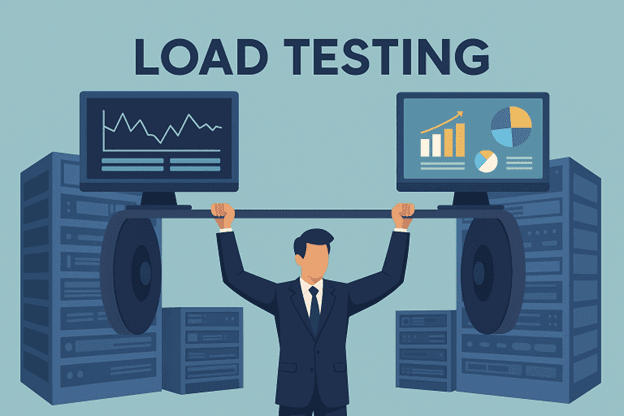
In modern DevOps, load testing is the stress test for your digital infrastructure. It’s how you find bottlenecks, scalability flaws, and resilience gaps before your users do.
But there’s a spectrum between “safe, approved testing” and “full-blown cyberattack.” That’s where grey-hat load testing lives, but often reveals issues traditional testing misses.
In this context, grey-hat doesn’t mean malicious intent. It means pushing beyond your official brief to simulate real-world worst-case scenarios-the kind of spikes, failures, and unpredictable traffic patterns you could face on launch day or during a viral campaign.
And when it comes to running these stress tests at scale, containerized environments (think Docker, Kubernetes) have become the default for speed, cost efficiency, and reproducibility.
The Rise of Containerized Load Testing
Container technologies like Docker and Kubernetes have revolutionized performance testing:
- Rapid environment spin-up – Build and destroy test clusters in minutes.
- Consistency – Same configuration, anywhere in the world.
- Cost efficiency – Only pay for the compute while you test.
- Scalability – Scale to hundreds or thousands of synthetic users without touching production code.
Compared to legacy setups, where provisioning hardware could take weeks, containerized load testing is faster, cheaper, and far more flexible.
What Counts as Grey-Hat in Load Testing?
Grey-hat tactics push the limits without crossing into outright malicious activity:
- Testing beyond approval – Simulating surges bigger than stakeholders signed off on.
- Exploiting overlooked edge cases – Like unusual API call sequences that break under load.
- Pushing cloud provider thresholds – Without violating the letter of the terms of service.
- Creative tool use – Leveraging open-source load testing frameworks in ways the authors didn’t envision.
Think of it like SEO’s use of a traffic bot-when configured to mimic genuine human engagement, it can be safe and revealing. But crank it up too high, and you risk looking like bot traffic instead of the targeted traffic you intended.
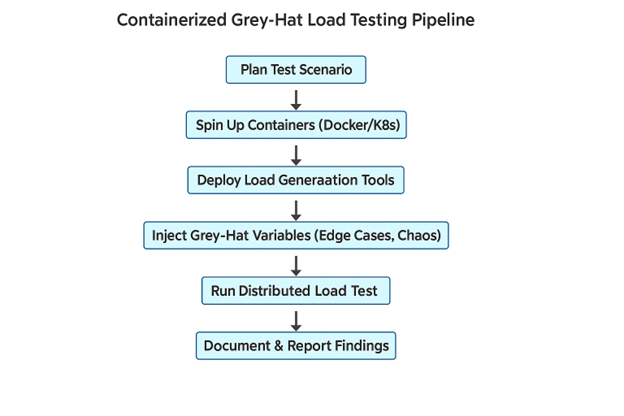
Tactical Toolkit – Grey-Hat Load Testing Approaches
Here’s how advanced testers bend the rules (while keeping lawyers happy):
- Distributed Attack Simulation
Orchestrate traffic from multiple regions to mimic DDoS-like conditions without actually crossing into an attack. - Traffic Shaping & Spoofing
Craft synthetic requests that look exactly like organic user behavior-ideal for testing CDN behavior, rate-limiting, and caching. - Unconventional Resource Exhaustion
Don’t just max CPU-target obscure bottlenecks like DNS resolvers, container registry pulls, or log aggregation systems. - Chaos Injection Meets Load Testing
Combine fault injection (kill pods, drop nodes) with heavy simulated traffic to see how systems recover under stress.
Balancing Innovation and Risk
The line between “innovative” and “illegal” is thin. Stay on the right side by:
- Documenting test intent – Keep written sign-off from stakeholders.
- Isolating environments – Run grey-hat tests in sandboxes, staging clusters, or private clouds.
- Following disclosure ethics – If you find a flaw, report it responsibly.
Remember: A grey-hat test that takes down your production environment is no longer a test-it’s an incident.
Real-World Scenarios & Lessons Learned
Case Study: The API Meltdown
High-traffic events can break systems in unexpected places. For example, during GitHub’s 2018 authentication outage, a sudden spike in logins caused significant slowdowns in their login service-similar to what a fintech startup discovered in its own grey-hat load test. In their simulation of a flash-sale event, authentication buckled after just 7,000 concurrent logins. Fixing the bottleneck before launch day likely prevented a $1.2M outage.
In early 2025, Barclays suffered a core mainframe failure during peak payday and tax-return hours, knocking out online banking, ATMs, card services, and phone lines for two days. Compensation payouts reached �7.5 million, underscoring how critical infrastructure can crumble under strain.
Likewise, PayPal’s Braintree GraphQL API failure in late 2024 halted wallet access, checkout flows, and Venmo transfers for about two hours worldwide, leaving merchants unable to process payments. And in India, a flood of “check transaction” API calls brought the UPI payments network’s success rate down to 50% at its worst, all because of missing rate-limit enforcement. The common thread: even mature platforms can fracture under unthrottled or poorly-shaped traffic, turning a test or spike into a costly real-world outage.
When It Backfires
Grey-hat tactics can also cause collateral damage if not carefully managed. In one retail platform’s case, over-aggressive synthetic traffic overwhelmed their analytics provider, triggering an automated suspension-similar to how the BBC‘s site was taken offline in 2015 when a traffic surge resembled a large-scale attack.
Shopify engineers have also documented how poorly-shaped load tests can be mistaken for malicious bot activity by upstream providers like Cloudflare, leading to blocked or delayed traffic. The lesson: always throttle and monitor test traffic in real time to avoid tripping automated defenses and looking like an attack.
The Future of Load Testing in the Grey Zone
Expect three big trends in the next 3-5 years:
- AI-generated load patterns – More human-like traffic shaping via ML models.
- Container-native chaos testing – Integrating tools like LitmusChaos directly into Kubernetes pipelines.
- Blurring lines between QA and security – Grey-hat load testing could become standard in resilience audits.
Why Walking the Grey Line Matters
Grey-hat containerized load testing isn’t about recklessness-it’s about realism. If your system can withstand a creatively aggressive test, it’s more likely to survive the unexpected in production.
Push the limits, but document your steps. Use targeted traffic simulations, not reckless floods. Treat it like good SEO-smart, intentional, and human-like.
Just like in CTR optimization, moderation is key. Too much bot traffic looks suspicious; too little, and you miss critical insights. Find the sweet spot.
##