Cloud computing revolutionized computing services across the world. Before the cloud, any kind of technical service, whether it was hardware like server banks or storage, or software like management applications, had to be owned and run directly.
That meant high startup costs and a wealth of hardware and services that a firm had to pay to maintain. It also meant every time a business scaled up or down, it had to make the corresponding investment.
That’s all changed. Now, a firm using cloud computing essentially pays rent for the space and services that they use, and maintenance and support is centralized at the cloud provider. The business only has to pay for what it uses. Any business can adapt to using the cloud; from those that provide the Best VoIP solutions to ecommerce companies.
That doesn’t mean that adoption of cloud services is easy and smooth for every enterprise. Like everything in business, you need a strategy to effectively implement cloud services.
This article will examine some of the methods that can help you develop an effective cloud management strategy.

(Source: Poketor)
Define your goals
The most important part of your cloud management strategy is actually the goals and objectives of converting to or implementing cloud services. For an effective strategy, you need to decide how the cloud will fit into your overarching business objectives.
Consider things like:
- What purpose cloud will fulfill that isn’t presently being met
- How you intend your cloud services to scale up in the future
- How much you wish to save on costs
- How cloud automation could make existing operations more efficient
Every business has different needs and will have a different plan, but the more detailed and organized your plan is, the easier and more effectively you can select the right approach to implementing it.
Part of the planning process should also be examining your existing digital infrastructure and its capabilities. You will need to decide what parts of your business might not switch to the cloud and how they can operate side by side with your cloud migrated solutions. You may need to think about how existing security measures can be used for cloud security, too.
Select models and services
The first thing you need to select is your deployment model, because that determines where a provider will hold your data. There are four principal different cloud deployment models. The first three are more suitable for private enterprises needing B2c or B2B ecommerce platforms, or other business tools, whereas the latter is suitable for more cooperative organizational networks.
- Public cloud allows any number of users to make use of data, storage, or services generally based on a subscription-type payment model. These have the advantage of lower costs.
- Private cloud is not shared, and is used only by one business, although a cloud provider may manage or maintain the services themselves. These have the advantage of being more secure.
- Hybrid cloud is a mix of the above. It has the advantage of being rapidly scalable.
- Community cloud is a cloud service that combines multiple organizations of essentially the same type, often public institutions. It has the advantage of being good for cooperation rather than competing business interests.
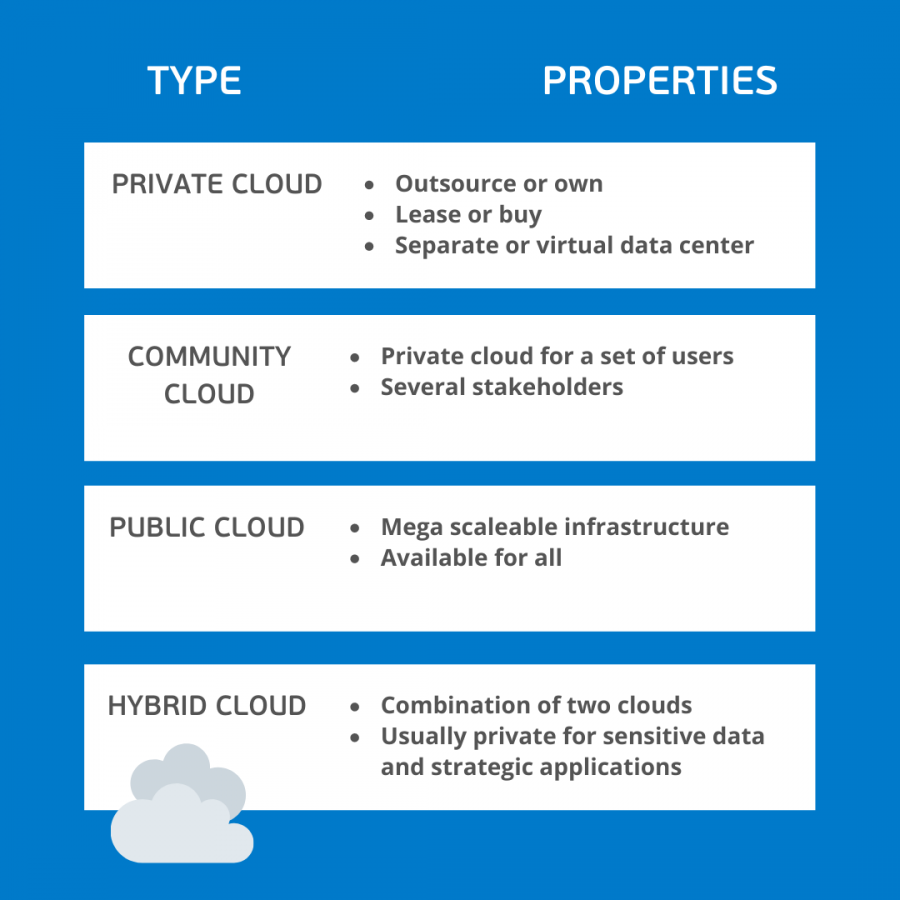
(Source: Visma)
After you’ve selected the model that’s right for you, you need to think about what kind of services you will want to use.
There are three main types of service where a provider hosts a service or software and then distributes it via the cloud to users:
- Software as a Service (SaaS) is when software is hosted centrally but distributed to the final end user who often opens it on a browser or on proprietary software. The advantages of SaaS are scalability, flexibility, and automatic updates.
- Infrastructure as a Service (IaaS) is when a physical or cloud server is rented out, either for data storage or hosting whatever the renter wants to host. The infrastructure for running online services is therefore a service that runs over the cloud rather than being operated directly by the renter. The advantages to IaaS are better security, scalability, and flexibility, and decreased capital costs.
- Platform as a Service (PaaS) is the hosting of software development systems on the cloud, allowing users to access them with web applications. The advantages to PaaS are lower costs, speed to market of app development, and guarantees that the platforms won’t become obsolete.
Once again, every business is different and will require a different model and service. These models and services form the essential basis of what cloud computing solutions can do for a business.
Plan for implementation
Once you’ve assessed your existing IT infrastructure, decided what you need the cloud for, and selected the model and category that most suits your business, it’s time to decide how and when it will all be implemented.
You need a clear roadmap for your cloud implementation, giving you enough time to fulfill the implementation of each stage. Your IT department or staff need to be given time and resources to prepare and provide support at every step of the implementation process. You may need to hire more cloud talent to cope.
Communication is also a key part of implementation. Your organization needs to understand, from top to bottom, what cloud computing is, what its benefits are, why the organization is implementing it, and what it hopes to achieve by doing so.
In addition, everyone in your organization needs to be made aware that there are potential security risks by using cloud computing, even though cloud providers will generally have the best enterprise network security products. You should prepare them for any changes in procedure that might arise out of changing compliance policies.
Execute and think ahead
Once that’s all done, it’s up to you to execute your plan and go ahead with whatever you’ve chosen. As soon as you get your cloud services online, you should start to see the benefits.
Cloud collaboration inside the workforce can bring productivity benefits very quickly, too, so don’t forget to plan for that.
But don’t stop there. Plan for the future, too. There are always more developments in cloud computing, so keep ahead of the game by continuously researching how you can improve your cloud services and keep your plan up to date. Your cloud strategy should be a living document that carries your business forward at all times.

(Cloud computing is a growing market – you will want to grow with it. Source: Grand View Research)
##
ABOUT THE AUTHOR
Sam O’Brien – RingCentral UK

Sam O’Brien is the Director of Digital and Growth for EMEA at RingCentral, a Global VoIP, video conferencing and call centre software provider. Sam has a passion for innovation and loves exploring ways to collaborate more with dispersed teams. He has written for websites such as G2 and Hubspot. Here is his LinkedIn.