While in Boston this week for the 68th edition of the IT Press Tour, Edward Tsinovoi, co-founder and CEO of IO River, spent a good chunk of his briefing convincing a room full of skeptical tech press that the content delivery world is still operating on a 1990s playbook. He’s not entirely wrong. And by the end, even after I admittedly took “one step forward and two steps back” on more than one occasion during the briefing, I finally got the picture sorted out.
So let me walk you through what IO River does, why it matters for anyone running serious traffic, and where the “new market category” talk holds up versus where it’s just branding.
The Problem IO River Is Chasing
Here’s the thing about the modern internet: almost everything you touch passes through an edge provider. Akamai, Cloudflare, Fastly, AWS CloudFront, Google Cloud CDN, Azure. These are the companies that pushed content closer to users back when the web was mostly static images and HTML. The trouble is that the content has changed dramatically—dynamic, personalized, and now a flood of AI-generated material—while the delivery model underneath has barely budged.
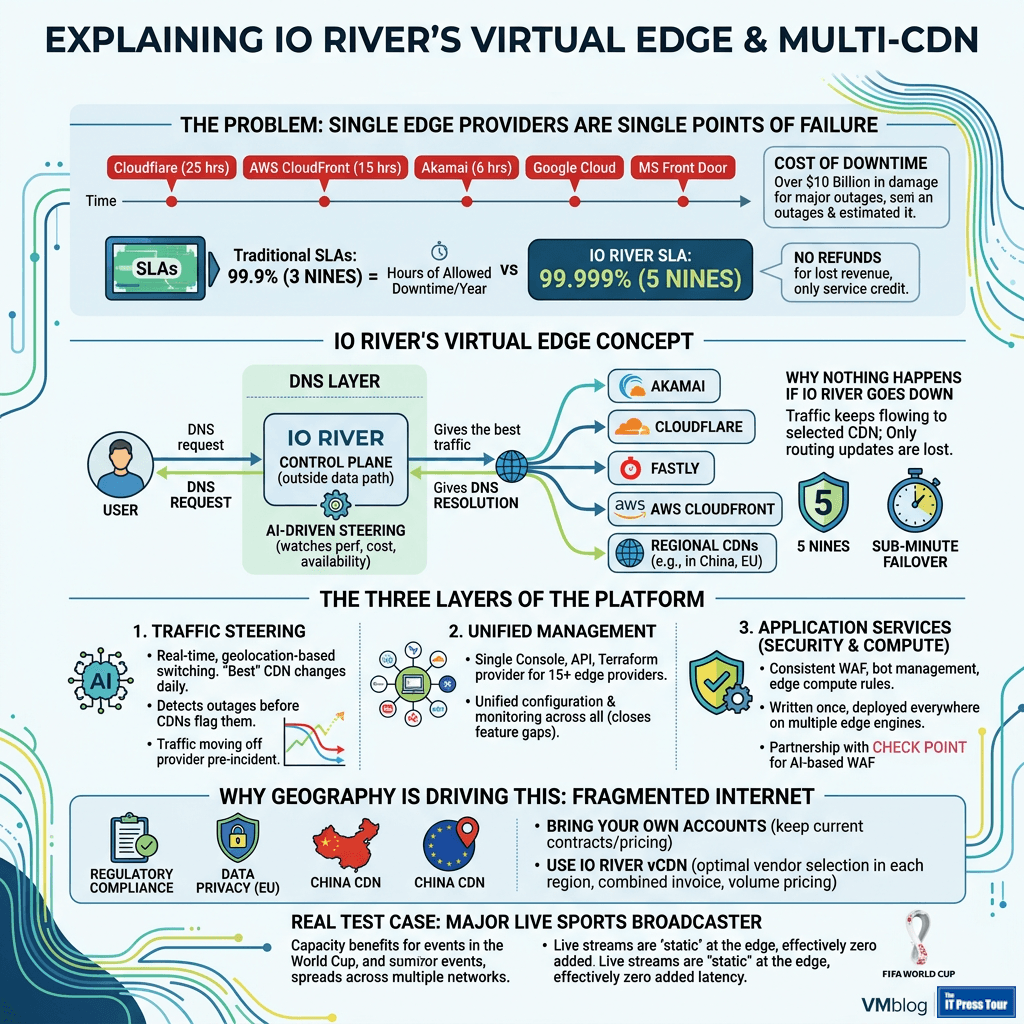
Tsinovoi’s core argument is blunt: a single edge provider is a single point of failure. To illustrate it, IO River’s briefing deck catalogued a string of recent incidents: a Cloudflare outage in December 2025, an AWS disruption in October 2025 that paralyzed services dependent on US-East-1 for the better part of a day, an Akamai event in early 2025, and separate incidents affecting Google Cloud and Microsoft Front Door.
The specific durations as presented by IO River varied, and some figures in vendor briefings don’t always survive contact with official post-mortems. But the broader pattern is real: every major edge provider had a significant service event in 2025, and in each case, customers with no failover strategy simply waited.
Tsinovoi’s point about SLAs landed hard. A 99.9% guarantee—three nines—sounds reassuring until you do the math. That’s six to ten hours of allowed downtime a year, and the penalty you collect is calculated on the hours of outage, not the damage. As Tsinovoi put it, ‘you’ll get a refund for the three hours Cloudflare was dark, but nobody’s writing you a check for the revenue you lost while customers couldn’t reach you.’ He estimated one major outage caused more than 10 billion dollars in damage across the affected customer base.
When a journalist pushed back and asked, point blank, what IO River’s own SLA is, after spending twenty minutes critiquing everyone else’s, Tsinovoi didn’t flinch. Five nines. And the reason he can claim that is the part worth understanding.
Why “Nothing Happens” When IO River Goes Down
This is the detail that tripped up the room, and honestly, it’s the most important thing to grasp. IO River does not sit in your traffic path. Not even a little. There are zero IO River servers between your users and the CDNs.
Instead, the company works at the DNS layer. When a browser or video player asks for content, the very first step is a DNS resolution that maps your domain to an IP address. IO River controls that resolution—partnering with premium DNS providers (the briefing named NS1, AWS Route 53, and IBM/NS1 for redundancy)—and decides which CDN’s server answers the request. You point your CNAME at IO River instead of directly at Akamai, and IO River adds one more CNAME layer that routes you to the best provider for your geography at that moment.
So what happens if IO River itself falls over? The traffic keeps flowing exactly as it was a minute ago. The only thing you lose is the ability to re-route. If a CDN goes down at the same moment IO River is down, then yes, the failover won’t trigger. But your live traffic doesn’t break, because IO River was never carrying it. That’s how you get to five nines without owning a single point of presence.
My initial take, understandably, after walking into the room and hearing the first 15 minutes of the briefing had me thinking IO River was a global load balancer or a multi-CDN switcher. Tsinovoi insisted it’s neither. The product does, in fact, switch CDNs. It just does a great deal more on top of that.
The Three Layers
The platform breaks down into three layers, and each one solves a distinct piece of the multi-CDN puzzle.
The first layer is traffic steering. An AI-driven engine watches performance, availability, and cost across providers, then routes traffic to the best option per geolocation. And this isn’t a set-it-once arrangement. Tsinovoi was emphatic that the “best” CDN in Paris versus the “best” in the UK changes throughout the day, every day. Two providers can look equivalent globally while one quietly wins in one region and loses in another. Doing that comparison and re-routing by hand, which is how the giants have managed it, means building monitoring, detection, and approval workflows in-house. IO River claims sub-minute failover, detection to re-route to DNS invalidation included.
He shared a real example: the morning after a Cloudflare outage, IO River emailed customers a graph showing their traffic had already been moved off Cloudflare before Cloudflare itself had even flagged the problem. The customers didn’t notice an incident. They noticed an email telling them one had happened.
The second layer is unified management. One console, one REST API, a Terraform provider, and a single set of configuration, monitoring, and analytics across more than 15 edge providers—the premium global names plus regional and local players. Change something once, and it propagates everywhere. The historical catch with rolling your own multi-CDN setup is that you get stuck at the lowest common denominator: if Akamai has a hundred features and CloudFront has five, your in-house abstraction can only safely use the five they share. IO River says it closes those gaps using the intermediate languages these platforms expose (think VCL on Fastly-style systems) so you don’t get marooned on basic functionality.
The third layer is where it gets genuinely interesting. Over the last five years, CDNs morphed from content delivery into security and edge-compute platforms. That’s great until you try to split traffic. You can write WAF rules in Akamai and WAF rules in Cloudflare, but the underlying engines are fundamentally different, so identical traffic won’t get treated identically. The giants who run multi-CDN tend to strip security off the edge entirely and rebuild it in a separate tier between the edge and the data center, exactly where it shouldn’t have to live.
IO River’s answer is a virtual layer on top of the edge compute environments that delivers consistent application services – WAF, bot management, API security, and edge compute code written once and deployed everywhere. They build some of it themselves and partner for the rest. A recently announced partnership with Check Point brings that company’s full application-security stack to the edge, including AI-based WAF that learns a customer’s traffic patterns, flags anomalies, and cuts down the number of rules a team has to hand-maintain.
The “Virtual Edge” Idea, and Why Geography Is Driving It
This is the concept IO River is staking its identity on, and it’s tied to something happening in the real world: the internet is fragmenting along regulatory lines.
Akamai exited China. If you’re Nike or Zara wanting to serve Chinese users, you now need a Chinese CDN—and the data is subject to local government rules, full stop. Europe is pushing companies toward EU-based vendors for privacy and compliance reasons. Meanwhile, global providers are consolidating (Limelight is gone, among others) while regional and telco networks pick up more traffic share.
A “virtual edge” stitches these physical networks—global, regional, telco—into a single logical edge you integrate with once. The DNS splits traffic so Chinese users hit a compliant Chinese network, European users hit an EU network, and everyone else lands wherever you’ve configured. You get global reach without signing fifteen separate contracts.
IO River gives customers two ways to handle the provider choice:
- Bring your own accounts. If you already have a contract with Akamai or Cloudflare, IO River drives it through their API and you keep your pricing.
- Use IO River’s vCDN. Don’t know which vendor to use in a given territory? IO River picks the best one based on its performance, reliability, and cost visibility, manages failover, and hands you a combined virtual CDN. If Monday’s best vendor isn’t Friday’s best vendor, the switch happens without you lifting a finger.
That second model also answers a practical worry about cost. The old objection to multi-CDN was that splitting volume across providers killed your volume discounts. Tsinovoi says that’s no longer true with a platform like IO River sitting in front. You keep favorable pricing even when traffic is divided.
A Real Test Case: The FIFA World Cup
The briefing happened to land the day before a major FIFA World Cup match window, and IO River is involved—though Tsinovoi was careful, surrounded by press, not to name the broadcaster (he’d only say it’s a specific country in a German-speaking region).
The challenge with live sports at that scale isn’t latency, it’s capacity. A single network, even one as large as Akamai, can struggle to reserve enough headroom for the traffic peak a marquee match generates. By using IO River to spread the broadcast across more than one vendor, the broadcaster adds capacity and gets real-time failover. If a network stumbles mid-match during one of the year’s biggest events, the consequences are obvious.
For the curious, Tsinovoi also gave a clean explanation of why live streaming is “static” from a CDN’s perspective: a live segment is requested by thousands or millions of viewers in parallel, so it only gets pulled to the edge once and served from cache to everyone after that. The latency IO River adds to all of this? Effectively zero, because it isn’t in the data path.
The Business Behind the Pitch
IO River was founded about four years ago by Tsinovoi and CTO Michael Hakimi, both veterans of the edge/CDN industry who worked on core platform and edge-compute technology. The company is backed by S Capital, Venture Guides, New Era, and Pags Group, with an advisory bench of recognizable names from Akamai, Cotendo, Cedexis, XtremIO, and Elastic.
A few numbers from the conversation worth noting:
- Roughly 30 employees, split about evenly between engineering and go-to-market, across Tel Aviv, Europe, and a growing US presence (the HQ is effectively moving with the CEO to North America).
- Around 50 customers in roughly a year of selling, spanning media publishers, gaming, ad-tech, and education, now moving toward e-commerce and travel/hospitality. Named customers included Minute Media in the UK and Nexon.
- A 20 million dollar raise earlier this year, bringing the total to around 25 million.
- Near-zero customer churn, which, if it holds, is the most telling metric of the bunch.
Pricing follows the three layers: a t-shirt-sized platform fee, optional traffic (bring your own contracts or buy through IO River), and usage-based metrics for application services like WAF and bots, typically billed on request volume.
Where This Goes Next
Ask about the roadmap and the answer is, predictably, AI—but Tsinovoi framed it in a way that actually connects to the architecture. Content moved to the edge first. Then compute followed, as more of the web turned dynamic. Now inference is heading the same direction: heavy model training stays centralized, but latency-sensitive inference for smaller models moves to the edge. He pointed to Akamai’s inference network, Cloudflare’s distributed GPUs, and Fastly’s AI gateway work as evidence the whole industry is converging on the edge as the entry point for AI.
And if the edge is the front door for AI, then it has to be resilient, secure, and intelligently routed—which is, conveniently, the exact problem IO River says it solves.
My Quick Take
The honest critique IO River has to answer is the one a journalist raised at the end: the idea isn’t unique. There are other startups and even an Australian team chasing the same vision with different tech. Tsinovoi welcomed that, arguing that one company alone isn’t a category—it takes a crowd to make “virtual edge” a real market segment, and Gartner already recognizes multi-CDN as a service.
What separates IO River from a slide deck, in his telling, is four years of hard engineering. “Claude cannot create IO River,” he said, meaning the technical lift is steep enough that AWS or a code-generating model can’t casually replicate it. Whether that moat holds is the open question. But the pitch itself is coherent: stop trying to be the best at everything (the legacy giant’s trap), assemble the best of each provider, and stay out of the traffic path so you can’t become the failure you’re protecting against.
For data center and infrastructure teams who’ve quietly accepted that a CDN outage is just a bad day you survive, that’s a proposition worth a closer look. The 1990s called. IO River is betting you’d rather not pick up.
##
Editor’s note, 06/13/2026: Following publication, a reader raised questions about the accuracy of specific outage durations cited in this article. Those figures were presented during IO River’s briefing at the IT Press Tour and reported as delivered. Upon review, some figures — particularly the Cloudflare December 2025 incident duration — appear to differ from third-party incident records. The article has been updated to attribute these claims to IO River’s materials rather than present them as independently verified facts. The broader argument about single-CDN risk, supported by the pattern of incidents across providers in 2025, remains unchanged.