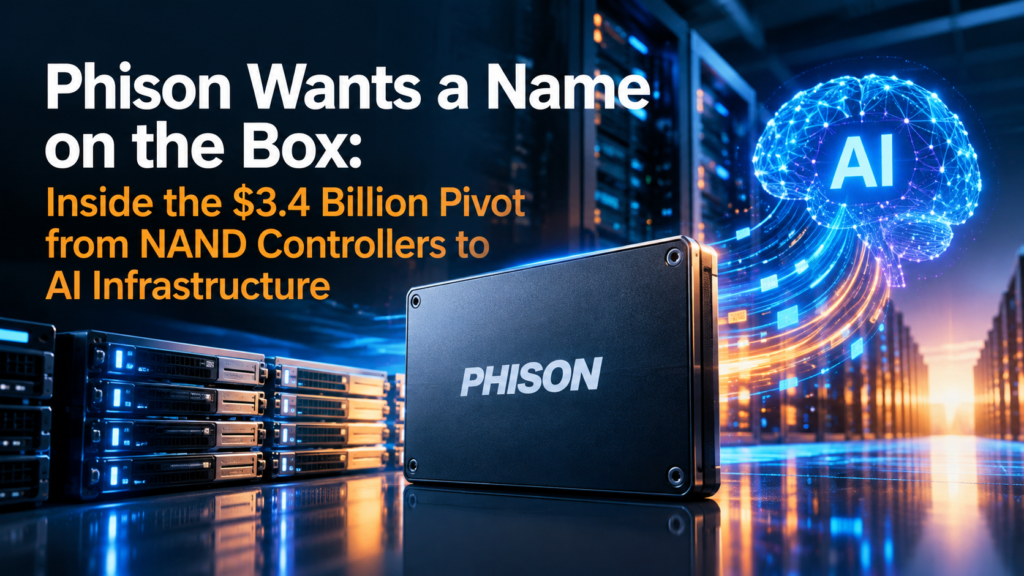
Six months. That’s how long it took Phison to blow past its entire 2025 revenue. The company booked $3.4 billion in the first half of 2026, which works out to 147% of the $2.3 billion it posted for all of last year.
Phison executives laid out those numbers, and a lot more, when the IT Press Tour landed at the company’s briefing room in Palo Alto earlier this month. We spent the session with Michael Wu, President and GM of Phison US, Sebastien Jean, CTO North America, and Heather Davis, Senior Director of Corporate and Product Marketing, with Rick Allen, Senior Product Marketing Lead for AI, taking us through the company’s memory-extension technology.
The story they told wasn’t about one product. It was about a company that spent 25 years quietly sitting inside other people’s storage and has decided it’s time to step out front, with its own brand, its own enterprise SSDs and, increasingly, its own systems-level answers for AI. This is part one of a two-part look at what we learned. Phison has bigger announcements coming at SC26 in November, and I’ll cover those separately. For now, let’s talk about where the company stands and why it matters.
A Record Half-Year, and a Mix That Looks Nothing Like Last Year’s
Revenue is the headline, but the mix is the real story. In the second quarter, what Phison calls its AI-ecosystem modules (enterprise SSDs, aiDAPTIV solutions, AI PCs, AI networking, AI servers and boot drives) accounted for 38% of revenue. Embedded ODM modules came in at 33%, industrial modules at 16%, and retail at just 5%. Controllers made up another 6%.
Wu was blunt about what that means. “Phison has officially transformed into an AI storage company,” he told the room. A year ago, he said, that AI slice was under 5% of the business.
Now, a little context for the skeptics. Phison isn’t a startup that got lucky on a trend. The company has more than 5,000 employees worldwide, ships over 600 million units a year and holds a list of “firsts” that reads like a hardware nerd’s bucket list: the first PCIe Gen4 client SSD, the first client SSD past 7GB/s, the first to break the 10GB/s barrier, a CXL Association-certified PCIe Gen5 retimer, and an SSD built to operate on the Moon. Wu said the company puts the bulk of its operating expense, north of 80%, into engineering. That’s not a marketing figure you hear every day.
He was also candid about the other side of the ledger. Retail is shrinking as a share of revenue, partly because consumers are balking at today’s NAND prices, and Wu expects that trend to hold for a couple of years. Industrial, by contrast, has stayed remarkably steady at around 15% for a decade. Think Advantech-style industrial PCs, low volume and high mix, where every customer wants something slightly different. It’s not glamorous work. Wu described the early days of it as painful (“we make a try, it doesn’t work, throw it away, create a new one”), but it taught the company how to build custom products and send engineers to the customer’s door.
Wu also told us he expects Phison to land somewhere around $8 to $9 billion in revenue this year. Big number. But the first-half total makes it a lot less far-fetched than it sounds.
The Name You Haven’t Seen, the Silicon You’ve Probably Used
Here’s a fun test. Ask the average IT pro what Phison makes, and you’ll get a shrug or a vague “something to do with flash drives?” Yet according to the company’s numbers, one out of every five client SSDs on the planet runs on a Phison controller. That’s 20%-plus of the global client SSD controller market.
Phison’s presentation put it neatly: you may not have seen our name; our engineering was already there. Its customers and suppliers list reads like a who’s who of NAND: Kioxia, Micron, Samsung, SK hynix, SanDisk and Solidigm. Wu made the point that even vendors who build their own SSDs lean on Phison, and that as the market tilts toward enterprise, many NAND makers that once designed their own client controllers are now turning to third parties. Phison has also leaned on its long relationships with those suppliers to keep parts flowing during tight supply, something Wu said took 25 years of being reliable through every cycle.
Then there’s the unglamorous supply story. Wu pointed out that low-density eMMC, the kind the industry loudly declared end-of-life, is now hard to find. A handful of suppliers saw the shortage coming and stockpiled tens of millions of parts years ago. Phison, he said, is one of the very few still supporting customers in that corner.
The through-line is a Phison tagline you’ll see a lot of: IMAGIN+. The customer imagines the product, Phison engineers it. Controller ASICs, firmware, hardware design, system integration and validation all sit under one engineering organization, which is exactly what lets the company customize drives for specific endurance, power, form factor or performance needs.
Why Coasting Isn’t Part of the Plan
You’d think a company booking record revenue would sit back. Wu joked that the team could take a one-month vacation and still make money. Then he explained why they won’t.
His argument starts with a simple chain. AI factories take in electricity and produce tokens, and in between, the data has to live somewhere. Energy in, data out. The two real bottlenecks, he said, are power and storage. And unlike the old software model where you paid one price and were done, AI providers now earn revenue in direct proportion to usage. More use means more tokens, more tokens mean more stored data, and that means they can’t under-invest in storage anymore.
Then came the number that made me sit up. Token demand over the next three to five years could grow around 50 times, Wu said. NAND supply, by his estimate, can only double in that time. Do the math and you can see why prices have gone sideways on everyone, with Wu describing year-over-year increases that in some cases reached several multiples. His conclusion: the cloud can’t carry all of it. “Every single computer should be able to generate tokens without always thinking about how much you’re going to pay the cloud company,” he said. The work has to move to the edge.
That belief shapes Phison’s plan. The company’s own slides describe a repeatable pattern: build a capability early (USB and SD cards), apply it to a bigger problem (embedded and design-in work for mobile, PC, automotive and industrial), scale into enterprise (eSSD and boot storage), and now push into AI systems that span chips, infrastructure and applications. The CEO’s view, as Wu relayed it, is that a company that remains only a component supplier gets squeezed when the cycle turns. So Phison is building up the stack, from controllers (including SSD controllers with an AI NPU) to boot drives, enterprise SSDs, AI PCs and servers, and software.
Pascari Grows Up
If aiDAPTIV is Phison’s most inventive play, Pascari is its most visible bet. This is the enterprise SSD brand that finally puts the Phison name in front of data center buyers, and the early traction is worth a look.
Phison says 21 customers are shipping Pascari today, with 30 active enterprise accounts once you count nine more in qualification. Wu said roughly 70 more are working toward qualification.
Wu noted that one of those AI enterprise customers is among the largest in the world, and that GPU and rack makers aren’t just buying data drives. They’re buying boot drives and networking components too. Boot storage might seem boring, but as Wu put it, it’s where building a system starts, and NAND makers don’t treat it as a priority. Phison does.
The Pascari lineup spans the whole AI data lifecycle: D-Series for density, X-Series for performance, S-Series for SATA modernization, B-Series for boot, and aiDAPTIV for AI memory extension. Four new models arrived at Computex 2026 in Taipei:
- D206V, a data center QLC SSD that reaches up to 245.76 TB, the highest capacity in the Pascari family, aimed at cutting cost per terabyte for AI-scale data. Wu noted a single one of these replaces eight or more hard drives.
- D250P, a liquid-cooling-ready E1.S design that opens up the cost-sensitive hyperscale tier.
- B200P, a Gen5 boot drive built to shorten server boot and recovery times.
- X202Z, a performance and caching-tier SSD rated at 60 DWPD, built for the hardest-working write workloads.
On the performance side, Phison says multiple X- and D-Series Gen5 drives reach up to 14.8 GB/s sequential read, and the Pascari X200P took the No. 3 spot globally on the IO500 list in a configuration with MEGWARE. The company also claims 6,000-plus hours of enterprise validation across more than 2,000 samples and 20-plus test chambers. It’s the kind of grinding, unexciting work that decides whether a hyperscaler signs off or not.
aiDAPTIV: Turning Flash into an AI Memory Tier
Now for the part that got our press tour table talking. aiDAPTIV is Phison’s answer to a very specific problem, and it’s one that anyone who’s tried to run a serious AI model on a laptop will recognize: you run out of memory long before you run out of ideas.
Allen walked us through the problem. Cloud AI infrastructure spending on inference is forecast to hit $23.3 billion in 2026, passing the $19 billion spent on training for the first time (Gartner). Agentic AI uses roughly 5 to 30 times more tokens per task than a basic chatbot exchange, and AI PCs are expected to make up 55% of PCs shipped this year. Meanwhile HBM and high-capacity DRAM are pricey and in short supply, and a typical 16 or 32 GB PC simply can’t hold a capable local model, plus a long context, plus the operating system.
So Phison adds a tier. A flash-based cache, delivered as an M.2 or U.2 drive, sits beside GPU memory and DRAM. A piece of middleware watches what the AI runtime is doing and decides what stays hot and what gets parked on flash. The application doesn’t change.
“Flash is not as fast as memory, but that’s not the point. The point is that it will run.”
— Rick Allen, Senior Product Marketing Lead, AI
That’s a refreshingly honest line, and Phison put the same caveat on its slides: flash adds capacity, not DRAM speed. aiDAPTIV is a capacity play, not a faster-compute play. Which sounds like a contradiction at first, since the whole thing is sold as making AI work better on small systems. It isn’t. Plenty of AI jobs don’t need instant answers. If an agent can grind away for ten minutes, or overnight, and finish a task that wouldn’t have run at all before, that’s a win.
Why a Regular SSD Won’t Do
One of the sharper exchanges came when a journalist asked what actually makes this flash special. Isn’t it just an SSD plus clever software? Wu’s answer: endurance, mostly.
The cache SSDs run in pseudo-SLC mode and are tuned to handle up to 100 drive writes per day, versus well under one for a standard TLC drive. Phison’s firmware also shapes the write traffic so it’s flat rather than random, which spreads wear. Wu said performance roughly doubles compared with ordinary flash, though it’s still nowhere near DRAM.
Then he told a story I’ll admit I enjoyed. A shipment once got mixed up on the customer’s receiving dock, and a regular TLC drive ended up in the cache role. It burned out in about a month. “You can use it on anything,” Wu said, but this is cache memory, not storage, and it needs to be treated like it.
Phison offers two flavors for PC makers. One is a dedicated cache memory SSD, 1 to 4 TB of pSLC in M.2 2280 or 2242. The other is a hybrid drive for single-slot laptops, with TLC storage and a pSLC cache partition on the same device. The 1 TB version splits into 768 GB of storage and 85 GB of cache; the 2 TB and 4 TB versions each carry a 128 GB cache.
Run a 24 GB Model on a 16 GB Laptop
The new trick this year is Dynamic MoE. Mixture-of-experts models only fire up a subset of their weights for each token, which saves compute but doesn’t shrink the model. In some cases it makes the model a bit bigger. Phison’s software keeps the full model on flash, and loads just the experts needed into memory, evicting the rest.
Here’s the proof point from the briefing. Take Gemma 4 26B A4B, which runs about 15 GB on its own. On a 16 GB laptop with 6 GB for the OS and apps, plus runtime and KV cache, you’d need 23.5 GB. It doesn’t fit. With aiDAPTIV and 320 GB of cache memory, active experts take 7.4 GB in DRAM, the inactive 7.6 GB sit on flash, and the whole thing fits in 15.9 GB.
Phison is also pointing at KV cache, the model’s working memory, which can grow bigger than the model itself in long sessions. Normally, older entries are thrown out and recomputed when needed. With aiDAPTIV, they’re parked on flash and read back later. In a retrieval-augmented generation (RAG) test on an Intel Panther Lake AI PC with 32 GB of memory, running Gemma 4 26B-A4B under llama.cpp on Windows 11, time to first token dropped from 55 seconds to 1.4 seconds. That’s a 39x improvement, measured, as Allen told us.
Intel, the PC Makers and the Ecosystem Question
A clever technology is one thing. Getting it into shipping products is another, and this is where Phison is spending a lot of its energy. The company announced a collaboration with Intel at Computex 2026, then shared stages with Intel in Shanghai and Taipei, and has been doing live aiDAPTIV demonstrations on Intel AI PC platforms.
The progress report as of September:
- Intel AI Playground v3.0, with Dynamic MoE and KV cache support, is available now. It’s a free local-AI app that PC makers can bundle, and builds are on Intel’s GitHub releases page.
- llama.cpp integration is active, and an OpenVINO integration path is planned.
- ISV work is under way with LLMWare (enterprise RAG and agents) and TurinTech (AI coding assistant), with Ollama and AnythingLLM being integrated or evaluated, and LM Studio planned.
- On the hardware side, eight PC OEMs are engaged, seven programs are in mass production or ready for it, and the work spans six silicon platforms across CPU and GPU vendors. A couple of products are already shipping in mainland China from smaller brands such as GMK and Thunder Robot. Bigger OEM names, Allen said, will come when partners announce them.
Someone asked, naturally, what stops a competitor from copying all this. Allen argued the middleware is the real moat: a lot of local AI runtimes need heavy integration work, and he said he’s seen a competitor claim a similar capability using off-the-shelf pieces, with far slower results. Wu added that Phison has been at this for three years, has commercialized it and has tuned the details, MoE offload and KV cache reuse among them, that only come with real deployments.
He also made a point I appreciated. When Nvidia’s Jensen Huang talked up KV cache storage tiers in a SuperPod context, Wu saw it as validation, not a threat. “The more the industry adopts this idea, the better for us,” he said. Phison doesn’t want to be a lone proprietary technology; it wants to run six to nine months ahead on readiness and features. The company is even working with Intel to improve Intel’s own source code.
What to Watch Next
Here’s where I land. Phison walked into the room with the kind of numbers that make you check the slide twice, but the more interesting part was the posture. This is a company that doesn’t want to be an anonymous controller in someone else’s SSD. It’s building a branded enterprise portfolio, pushing a genuinely different answer to the AI memory shortage, and signing up PC makers, ISVs and silicon partners to make that answer real on everyday hardware.
Will aiDAPTIV matter beyond a handful of AI PCs? That depends on how fast the software ecosystem catches up and how many OEMs ship it to real buyers. The groundwork looks solid, and Phison’s honesty about the tradeoffs counts for something.
We also heard a lot about what’s coming, but Phison asked us to hold that for now. Watch for the company’s announcements at SC26 in November, and look for part two of this coverage, where I’ll get into the rest of the story.