There was a moment during our briefing last week during the 66th edition of the IT Press Tour while at the Computer History Museum in Mountain View when Craig Theriac, VP of Product Management at Scale Computing, made something click for me. The company had been acquired by Acumera – a move, that to some, may have initially seemed counterintuitive. Why would an edge computing specialist merge with a managed services and networking outfit?
The answer, it turns out, reveals a lot about where the edge is heading.
The Acquisition That Actually Makes Sense
Let me back up for a moment. Scale Computing was acquired by Acumera, a company backed by serious financial players, in late July of last year. Initial reactions were mixed, especially when some personnel changes followed. But talking with Matt McPhail (Senior Manager, Technical Marketing), Craig Theriac (VP of Product Management), and Marlena Fernandez (VP of Marketing), it became clear this wasn’t a hostile takeover or a rebrand. It was a deliberate marriage of complementary strengths.
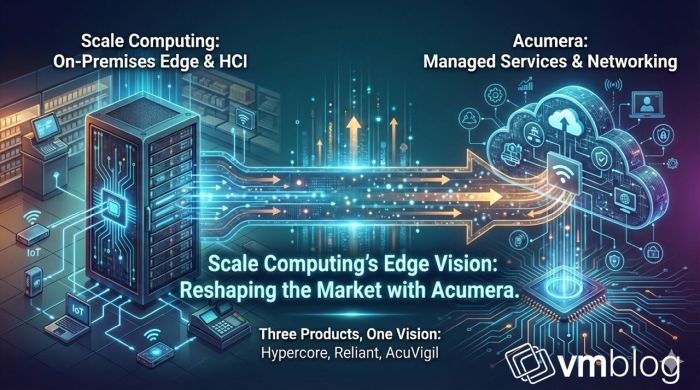
Here’s the thing: Scale Computing solved one problem really well – running applications reliably on premises at the edge with minimal operational overhead. Acumera approached the same market from a different angle. They excelled at managing distributed environments across hundreds of sites, handling change management, and providing networking expertise. Acumera also owned Reliant, an edge-as-a-service platform focused on retail and distributed enterprises, plus AcuVigil, a managed network services offering.
“We were kind of lucky,” Craig noted, “in the fact that we had a solution that happened to be doing the same thing prior to Broadcom’s acquisition of VMware, and we’ve just kind of capitalized on that.”
The real win here? Scale Computing could now offer customers a choice. Want to manage your infrastructure yourself with Hypercore? Great. Prefer edge as a service? Reliant’s got you. Need networking expertise? AcuVigil handles that. This is genuinely rare in the industry.
Three Products, One Vision
The combined company is now structured around three core offerings, each addressing a different part of the edge spectrum:
Hypercore remains Scale’s traditional HCI stack. It’s designed for organizations running critical applications on premises, whether that’s a single site or hundreds. The company says the software is so robust that Scale infamously runs it on hardware that really shouldn’t work, just to prove the point. It’s perfect for small-to-midmarket companies, distributed enterprises, and managed service providers who want to standardize on something that doesn’t demand constant infrastructure babysitting.
Reliant is the edge-as-a-service play. Unlike Hypercore, where customers manage their own deployments, Reliant is fully managed. The company takes on the heavy lifting. Taco Bell is the flagship example here. They’re running thousands of locations with this platform, and it’s not just about deploying applications. It handles orchestration, compliance, and updates across their entire fleet. Think of it as GitOps-driven infrastructure where Scale Computing becomes your operational partner, not just your vendor.
AcuVigil is the networking piece. This one’s clever because it addresses a pain point that Craig kept circling back to: in distributed environments, IT teams don’t want to talk to their networking teams. AcuVigil provides managed networking services-security, compliance, remote access, monitoring – all through a single gateway device. The demos showed real-world deployments with over 200 sites, and the system handles everything from credit card compliance to IoT sensor management (like fuel tank monitoring at gas stations). Honestly, watching Matt demo this felt like watching someone manage a small data center from a single device.
VMware’s Exit Created an Opening (And Scale Knew It)
Let’s talk about what everyone’s thinking: VMware’s pricing explosion after Broadcom acquired it. Scale Computing has been aggressive about capitalizing on this, and why wouldn’t they be? Customers who suddenly faced massive renewal costs started looking for alternatives, and Scale had something ready.
But here’s where it gets interesting. Marlena noted that their business is 80-90% channeled through resellers. The first year after Broadcom’s acquisition, they caught a lot of VMware channel partners who felt “kicked out” of the VMware program. That’s real money, real relationships, and real market momentum.
The question raised during the briefing was whether we’re seeing a “red ocean” scenario – lots of competitors fighting for the same disaffected VMware base. Craig’s response: they’re not seeing as much competition from the well-known hypervisor vendors as you’d expect. Some competitors are making noise, but actual deal losses aren’t showing up as dramatically as anticipated. He said the window is still open, and Scale is in a strong position.
The AI and Operational Challenge at the Edge
This is where things get real. Everyone’s talking about AI at the edge – last week, I heard “AI” mentioned 300 times during the press tour alone. But Craig made an important distinction: there are two different failure modes for edge AI.
First, there’s the model readiness problem. Your AI model isn’t accurate enough, your data pipeline needs work, your training governance is messy. That’s a data science problem, not an infrastructure problem. Scale can’t solve that.
Second (and this is where Scale absolutely can solve), there’s the operational scaling problem. You’ve got a working model in a pilot. Now you need to deploy it to 50 stores, 500 stores, 5,000 stores, and keep it updated as new model versions come out. You need visibility into what’s actually happening at each location. You need to handle failures gracefully. You need zero-touch deployment so a store manager can unbox hardware and just plug it in.
That second problem is exactly what Hypercore, Fleet Manager, and the application lifecycle management features are designed for. Craig put it perfectly: “Model readiness determines whether or not AI works. Operational capability determines whether it scales.”
What We Actually Learned
This briefing covered a lot of ground, but a few things stood out for the VMblog audience:
The edge isn’t some distant future concept. It’s here, it’s running production workloads at massive scale (we’re talking 100,000+ deployments across Scale’s platforms), and it’s solving real business problems for retail chains, logistics companies, shipping operations, and yes, government agencies too. You’re probably interacting with Scale-powered systems every time you buy something at Dunkin’ Donuts or check your luggage at San Diego Airport.
The Acumera acquisition is working because the companies actually solved complementary problems rather than duplicative ones. That’s rare. Scale now offers three distinct paths to the edge: self-managed infrastructure, fully managed services, and managed networking that actually work together rather than compete internally.
The VMware migration window is still open, the channel partner opportunity is real, and Scale is executing aggressively. They’re also honest about what they can and can’t do. They can’t fix your AI models, but they can make sure those models actually run and scale across your distributed environment. That’s worth something.
And if you’re running any kind of distributed infrastructure – multiple stores, multiple sites, multiple regions – the problem isn’t theoretical. It’s about operational simplicity, reliability, and the ability to manage complexity without adding headcount. That’s what this company is actually selling.
##