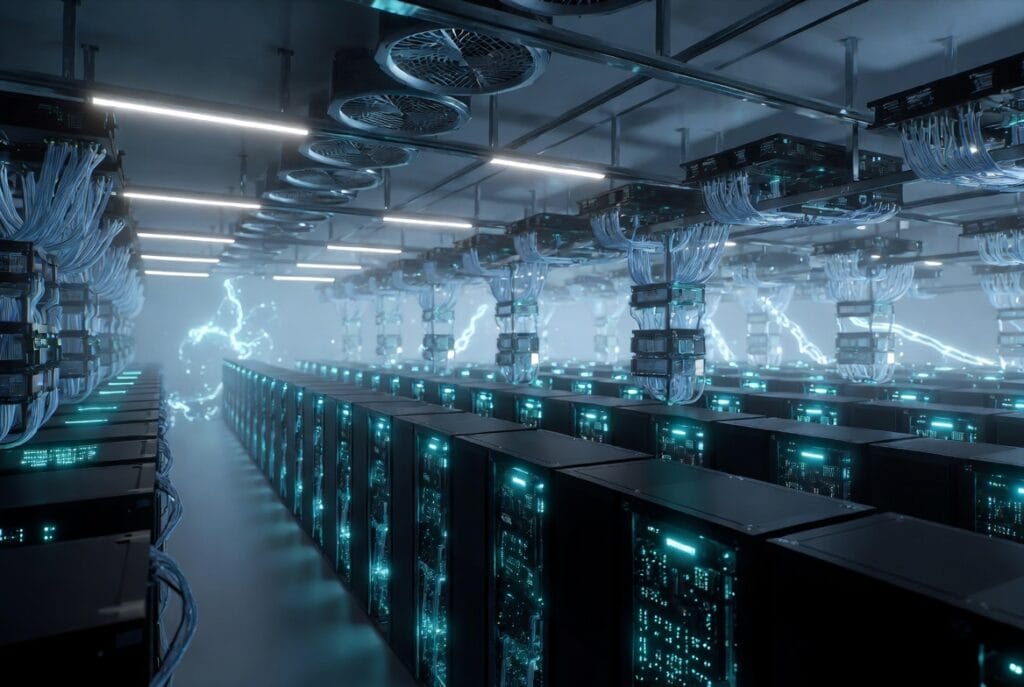
Automation has long supported data center operations: Tools send alerts and orchestration platforms move workloads when predefined conditions are met. Those capabilities still matter, but high-density compute, hybrid architectures, and rising energy pressure require more. AI is changing the operating model by helping teams interpret complex signals, forecast risk, and make better operational decisions.
The International Energy Agency (IEA) estimates that data centers consumed about 415 terawatt hours of electricity in 2024, or roughly 1.5% of global electricity use, and projects consumption could reach about 945 terawatt hours by 2030 in its base case. As AI workloads increase power density and infrastructure complexity, operations teams need systems that learn from operational data and recommend actions with context.
From Reactive Alerts to Predictive Operations
Traditional monitoring is often reactive: A sensor crosses a limit, an alert is generated, and an engineer investigates. AI improves workflow by learning normal patterns across power, cooling, network, compute, and facilities data. Instead of treating alerts individually, models can identify relationships that are otherwise difficult to see, such as airflow changes that correlate with fan speeds, localized temperature drift, or equipment degradation.
This is where AI moves beyond automation. A basic rule might trigger when temperature exceeds a set point. A predictive system may notice that temperatures are trending abnormally under a specific workload pattern and recommend action before service levels are affected. That matters because outage prevention remains a strategic priority as architectures become more complex.
Smarter Resource and Capacity Management
In virtualized and cloud-connected environments, capacity is not a matter of simply adding servers. Teams must understand how compute, storage, network bandwidth, power availability, cooling capacity, and workload placement interact. AI-driven analytics can forecast demand, detect underused assets, and recommend placement that balances performance, resilience, and energy use.
This becomes more important as AI infrastructure changes the shape of the data center. Modern AI environments rely on GPU clusters, high-speed networking, distributed storage, and orchestration tools. Some high-density racks now move from traditional power profiles toward 100 kW-plus environments, increasing the importance of coordinated power and cooling decisions.
Cooling Optimization as a Practical Use Case
Cooling is a clear example of AI’s operational value. The IEA notes that cooling and environmental controls can represent about 7% of electricity use in efficient hyperscale facilities and more than 30% in less-efficient enterprise data centers. AI models can analyze data from sensors, pumps, chillers, airflow systems, weather patterns, and IT load to recommend set point changes or identify inefficient conditions.
Google’s use of machine learning in its own facilities showed the opportunity, with DeepMind reporting up to a 40% reduction in cooling energy use after applying neural networks trained on data from thousands of sensors. While every facility is different, the broader lesson is applicable: AI works best when it is connected to high-quality telemetry and paired with engineering oversight. Physical infrastructure choices still matter, including how cooling systems are designed, maintained, and integrated with components specified by equipment designers, facilities engineers, or a heat exchanger coil manufacturer.
Decision Support, Not Blind Autonomy
For most organizations, the goal should not be fully autonomous operations. Mission-critical environments require governance, explainability, and human accountability. AI recommendations should be evaluated through clear policies: What systems can AI adjust? Which actions require approval? How are outputs logged and tested against safety limits?
A measured approach helps avoid overtrusting AI without understanding model quality or data gaps, while also preventing teams from treating AI as just another dashboard. The better path is to define use cases, such as anomaly detection, predictive maintenance, workload placement, energy optimization, and incident triage, then measure outcomes against goals.
Building the Foundation for AI-Driven Operations
AI depends on operational discipline. Data must be consistent, time-synchronized, and available across systems that were not designed to work together. Teams may need to integrate DCIM, BMS, AIOps, observability, ticketing, and asset-management platforms, so models can evaluate the environment as a connected system. Systems that influence operations should also be protected with access controls, change management, fallback procedures, and model validation.
Preparing Data Centers for the Next Era of Operations
AI’s role in modern data center operations goes beyond automation. Its greater value is helping teams anticipate problems, optimize resources, and make better decisions in environments that are too complex for manual analysis alone. Organizations that approach AI as an operational capability, supported by clean data, governance, and coordination between IT and facilities, will be better positioned to improve efficiency, resilience, and scalability without losing human control over mission-critical decisions.
##
ABOUT THE AUTHOR
Jeffrey Sturdivant is the Director of Sales and Engineering for Coilmaster, a U.S.‑based manufacturer of custom heat‑exchanger coils, fluid coolers, and condensers used in HVAC, refrigeration, industrial, and OEM applications. He has over 11 years of experience at Coilmaster and focuses on bridging engineering and sales. His oversight ensures that clients receive custom‑designed coil solutions that meet performance standards, optimizing product specifications, and delivering high‑quality, reliable heat‑transfer products with responsive service and technical support.