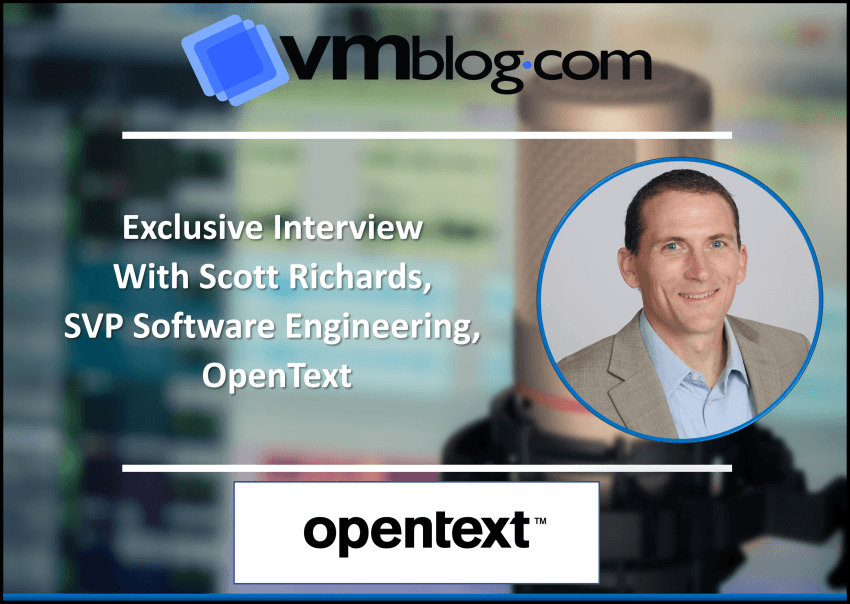
I recently came across a stat highlighting that by 2025, 5G networks will manage a staggering 45% of the world’s mobile data traffic. There is no doubt that 5G will revolutionize the telecommunications landscape, but will these companies be able to handle the mass amounts of data? To better understand how real-time analytics is helping to shape the 5G revolution in telecommunications, VMblog spoke with industry expert, Scott Richards, SVP Software Engineering of OpenText.
VMblog: With the explosion of 5G networks across the globe, telecommunication companies are expected to manage 45% of the world’s mobile data by 2025. What role does OpenText play in helping to empower these providers?
Scott Richards: OpenText Vertica is essential in aiding telecommunication companies as they strive to handle 45% of the world’s mobile data by 2025. The sheer volume of data in question is substantial, and to harness its potential, these companies must embrace a comprehensive analytics platform. Real-time analytics stands as a pivotal approach to enable telecom providers to offer superior customer experiences rooted in data-driven insights.
OpenText Vertica leads this transformation, particularly meeting the demands of OEMs and tier one operators. Its massively parallel processing (MPP) architecture helps to deliver nearly unlimited scalability, capable of storing, managing, and analyzing petabytes of structured data in real-time. Significantly, telecom organizations can employ cost-effective commodity-based hardware, execute analytics both on-cloud and off-cloud, and access an extensive library of in-database analytics-all at a fraction of the cost compared to other analytical databases. As these companies expand and increasingly rely on data science for operational streamlining and predictive insights, the OpenText Analytics & AI portfolio stands out for its ability to analyze and visualize both structured and unstructured data in real-time.
VMblog: Can you elaborate on the role of real-time analytics in the context of 5G telecommunications? What are some of its benefits?
Richards: In the realm of 5G telecommunications, real-time analytics plays a crucial role with many benefits. As Karl Whitelock from IDC has noted, “it takes a mountain of data to deliver a quality customer experience in the 5G era.” This data serves as both the objective and the challenge. The more data available for analysis, the more refined and precise predictions and adjustments can be made.
OpenText excels in managing vast amounts of data — a core strength that proves invaluable in satisfying the needs of telecommunication providers and operators. This capacity allows these providers to uphold their reputations and brand integrity, not only for themselves but also for their customers, establishing them as a reliable and trusted partner that delivers uninterrupted and top-tier services. Furthermore, OpenText’s ability to provide real-time analytical insights ensures that these services are delivered promptly and without any delays.
VMblog: Can you provide examples of how OpenText has already demonstrated its revolutionary impact on the 5G industry?
Richards: Certainly, while 5G is not universally available yet, OpenText is actively preparing its customers for the forthcoming revolution that will accompany full-scale 5G deployment when all the infrastructure is in place and licensing issues are resolved. A notable example of OpenText’s impact in the 5G industry is its partnership with Anritsu Service Assurance.
In May, Anritsu Service Assurance and OpenText introduced a solution tailored to meet the demands of 5G networks on a global scale, and this solution incorporates the Vertica Analytics Platform. Anritsu recognizes the rapid evolution of 5G networks and the imperative to effectively manage network and operational demands at scale, all while ensuring an optimal customer experience.
Ralf Idling, CEO of Anritsu, has acknowledged the significance of Vertica’s powerful database technology in delivering the highest levels of service quality to their customers. This partnership exemplifies OpenText’s pivotal role in addressing the evolving needs of the 5G industry, even before the technology reaches its full global potential.
VMblog: What steps is OpenText taking to lead the AI revolution, and how does the company plan to remain at the forefront of this transformation?
Richards: OpenText has taken significant steps to spearhead the AI revolution, and the company is committed to maintaining its leading position in this transformative landscape. Just recently, OpenText unveiled two key initiatives: opentext.ai and OpenText Aviator, outlining the company’s vision and roadmap for the convergence of Artificial Intelligence (AI) and Information Management.
Opentext.ai represents a strategic shift in how customers can address intricate challenges through the application of AI and Large Language Models (LLM) with OpenText Information Management software. OpenText has a strong history of championing AI-driven automation, focusing on effective information and complex data management across diverse scenarios.
A pivotal development occurred in January 2023 when OpenText acquired Micro Focus, broadening its mission to encompass new AI capabilities within Vertica and IDOL. These capabilities encompass a wide range of functionalities, including geospatial and time series analytics, in-database machine learning, unstructured data analytics, and sentiment analysis, among others.
With opentext.ai, OpenText’s vision adopts a poly-model approach, emphasizing the use of the right model for the right task. This approach is grounded in Large Language Models (LLMs) built on a foundation of private, secured data. Opentext.ai offers customers the flexibility of a full-stack implementation or a modular approach to practical AI.
In the upcoming weeks, we look forward to unveiling the latest advancements of OpenText Aviator at OpenText World in Las Vegas.
VMblog: In the latest Cloud Editions 23.3 launch, OpenText unveiled the new data lakehouse integration with Apache Iceberg. Can you provide us with more information about this integration and its benefits?
Richards: This integration was a significant step forward for OpenText analytics and AI capability and enhances the functionality of the Vertica analytical database by effectively transforming it into a fully operational data lakehouse.
The integration with Apache Iceberg empowers teams with the ability to read and analyze external data seamlessly. This includes structured data as well as data lake formats like Parquet, JSON, and ORC. The implications of this integration are substantial, enabling teams to conduct a wide range of activities such as standard business intelligence, machine learning, geospatial analysis, event pattern matching, and time series data analysis, all within the Vertica platform.
One notable advantage of this integration is its ability to bridge the gap between data lakes and traditional data warehouses. While data lakes are typically associated with slower data access and analysis, the Apache Iceberg integration ensures that teams can harness the power of their data lakes at the speed characteristic of data warehouses. This translates into faster and more efficient data processing, enabling organizations to make quicker, data-driven decisions and fully leverage the potential of their data assets.
##