By Barry Morris, Chief Product and Strategy Officer, Couchbase
Kubernetes solved the hardest problem in application infrastructure a decade ago by giving teams a declarative way to run stateless services at scale, with self-healing, rolling upgrades, and built-in resource orchestration. But the stateful side of the stack has never fit as cleanly into the Kubernetes model. With agentic AI workloads arriving in production, that gap is widening.
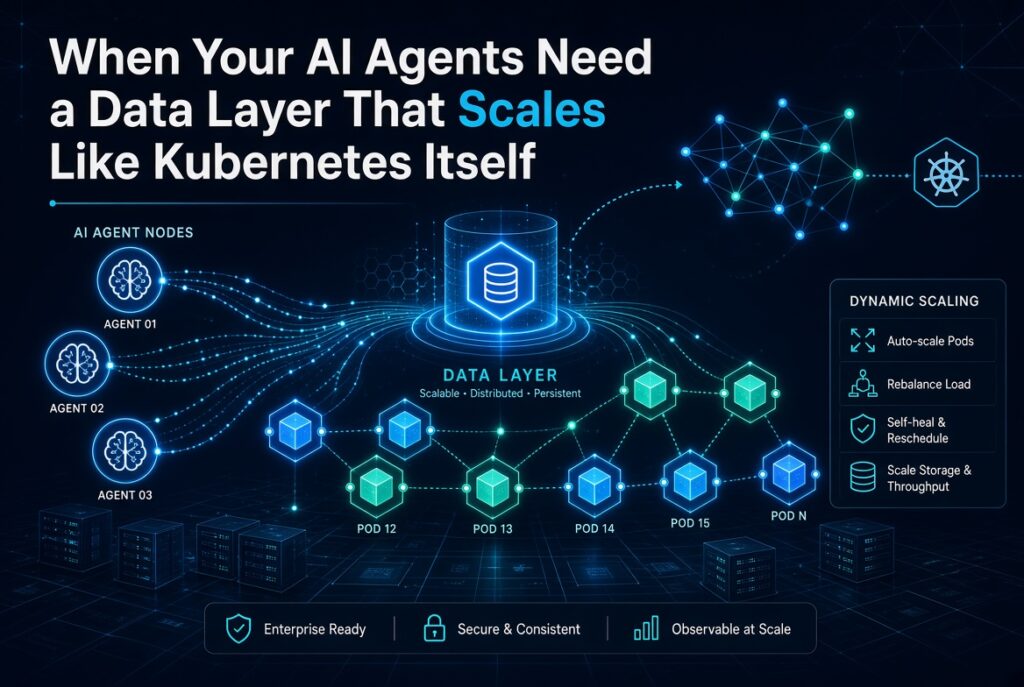
An AI agent is not a request-response service. A single agent action can trigger a context retrieval from a vector index, a memory write to persist what it just learned, a cache lookup to avoid a redundant model call, and a state synchronization across sessions, all within one turn. Multiply that by thousands of concurrent agents and the data layer starts to look less like a traditional database workload and more like the kind of distributed systems problem Kubernetes was designed for.
Most organizations solve this by deploying five or six separate data services per agent: a vector store here, a document database there, a caching layer somewhere else, and a memory service bolted on top. Each one needs its own operator, scaling policy, and failure-recovery logic. The integration tax compounds with every new agent you ship, and the Kubernetes cluster that was supposed to simplify operations becomes a sprawl of loosely coupled data services that nobody wants to page on at 2 a.m.
The distributed architecture question
From a Kubernetes-native perspective, the problem exposes a fundamental architectural divide in how databases handle distribution.
Some database systems were designed as single-node engines first, with clustering added later. When you run them on Kubernetes, the orchestrator is essentially compensating for architectural decisions made years ago. Failover means promoting a replica, and scaling means adding a node and waiting hours for data to rebalance across a multi-terabyte cluster. In these environments, the Kubernetes operator becomes a complex state machine managing transitions the database itself was never built to handle gracefully.
A database designed from the ground up as a distributed system behaves differently. Each node is a peer, and the database automatically partitions and replicates data. When Kubernetes adds a node to the StatefulSet, the database’s own rebalancing logic takes over, and the operator’s job shrinks to translating intent into topology changes rather than orchestrating a fragile sequence of failover steps.
That means more for agentic workloads than it did for traditional applications. When an agent needs sub-millisecond reads from a key-value store, semantic search across a vector index, and a durable write to its memory layer within the same turn, the data platform has to handle all three without crossing service boundaries. If each capability lives in a separate deployment with its own scaling characteristics, any single failure can extend the blast radius across the entire agent pipeline.
What a unified data tier looks like on Kubernetes
A multi-model database that combines documents, key-value, SQL, full-text search, vector indexing, and eventing in a single distributed system substantially changes the picture for making Kubernetes operational. Instead of six Helm charts, six operators, and six sets of PersistentVolumeClaims, you get one stateful workload, one scaling policy, and one backup strategy.
That consolidation directly affects agent performance. When the vector index, document store, cache, and memory layer share the same cluster topology, context retrieval and a memory write can happen without a network hop between services. The latency budget for an agent turn, often measured in single-digit milliseconds for interactive use cases, becomes achievable without heroic optimization. Running this on Kubernetes with an autonomous operator means provisioning, scaling, upgrades, and failure recovery happen declaratively. You describe the desired state. The operator handles the rest, including rolling upgrades without downtime, which matters enormously when your agents are serving production traffic around the clock.
Beyond the cloud cluster
Kubernetes has become the default deployment target in public cloud, but agentic AI workloads do not always live in the cloud. Retail point-of-sale systems, field service applications, logistics operations, and manufacturing floors all involve agents that need to act when the network is unreliable or absent entirely.
A data platform that runs identically on a Kubernetes cluster in AWS, on bare metal in a private data center, and on an edge device with intermittent connectivity gives platform teams one operational model, no matter where the agent runs. Same data model, same query language, same security model. Data syncs across these environments rather than being copied between them, which means an agent at the edge can persist its memory locally and reconcile with the central cluster when connectivity returns.
This is where the Kubernetes story intersects with a problem most cloud-native architectures leave unaddressed. Agents operating in disconnected environments still need to read operational data, write decisions, and remember context. If the data layer requires a constant connection to a central control plane, the agent is only as reliable as the network. For a pre-flight checklist application that needs 100% field availability, or a cruise ship running seventeen floating data centers, “retry when connected” does not work.
The operational economics
Every separate data service in a Kubernetes cluster carries its own resource overhead, monitoring stack, and on-call rotation. Organizations that have consolidated from multiple database technologies onto a single multi-model platform have documented TCO reductions exceeding 50%, and that was before agentic workloads started multiplying the number of data services per application.
The economics shift further when you account for token consumption. An agent without persistent memory re-sends its entire conversation history to the model on every turn, so a fifty-turn conversation pays for the first turn fifty times. A database-native memory layer that retrieves only the relevant context per turn can reduce token usage by 33 to 45 percent, measured against standard benchmarks. When you run thousands of concurrent agent sessions, those savings determine whether a production deployment stays financially viable or breaks at scale.
What platform teams should evaluate
If you are building agentic systems on Kubernetes today, there are a few architectural questions. How many separate data services does each agent require, and what does it cost to add the next one? Can the data layer handle vector search, document retrieval, caching, and state persistence without crossing a network boundary? Does the database’s own distribution model work with Kubernetes, or does the operator spend most of its logic working around it? And can the same data platform run at the edge, on-premises, and in the cloud with one operational model?
Production agent deployments are already running into these problems. One global fashion company consolidated three separate memory stores into a single data platform and found that the second production agent took a fraction of the engineering time the first did, precisely because it eliminated the integration tax. A conversational AI platform serving outbound sales, customer service, and physical AI use cases chose a unified data layer because every agent pipeline needed efficient, consistent data retrieval to feed the same inference pipeline.
The Kubernetes ecosystem has spent years building the primitives for stateless scale. The next challenge is giving stateful, agentic workloads a data layer that scales the same way, without fragmenting into a dozen services, each needing its own care and feeding. Getting the data layer right is what separates agent prototypes from agents running in production.
KubeCon + CloudNativeCon is taking place in Salt Lake City, Utah from November 9 to 12. Register Now!
##
ABOUT THE AUTHOR

Barry Morris is Couchbase’s Chief Product and Strategy Officer. He is a veteran of the data management business, most recently in executive roles at both Google Cloud and Amazon Web Services, where he had responsibility for Google’s database portfolio and most of AWS’s non-relational database services respectively. Prior to AWS, Morris was the CEO of Undo.io, CEO/Chair of NuoDB, CEO of StreamBase, and CEO of IONA Technologies. He also held management positions at Digital Equipment Corp (DEC), Lotus Development, and Leading Technologies.
Morris was raised in South Africa and educated in Great Britain. He has a degree in engineering from New College in Oxford University and an Honorary Doctorate in Business Administration (DBA) from the IMC Association. In addition to multiple board roles in technology companies, he has chaired the board of the International School of Boston, and served on the board of the Sugan Theater Company.