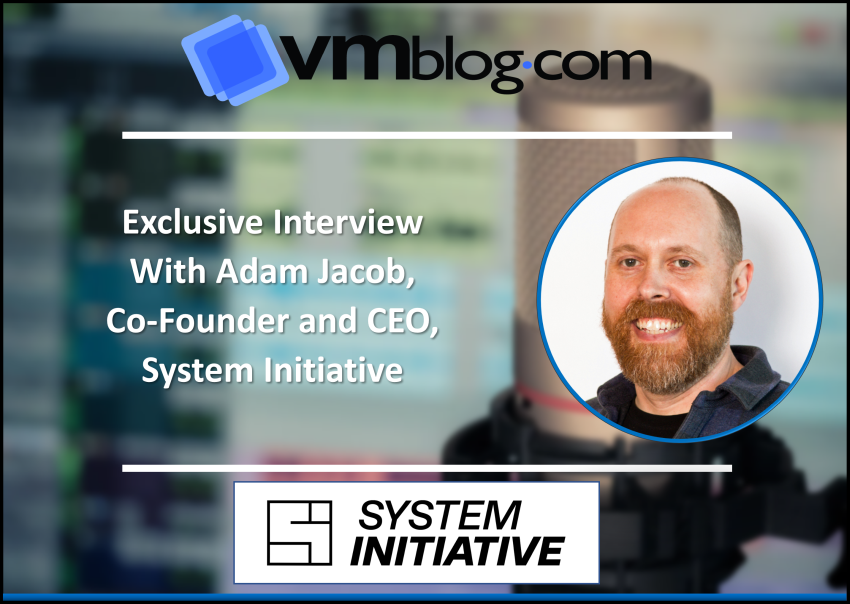
Adam Jacob, the founder of Chef Software and a pioneering force in the early days of DevOps, left Chef in 2019 to create a platform that would reimagine DevOps from the ground up. In June 2023, he launched his new company, System Initiative, bringing this vision to life. On September 25, System Initiative announced the general availability of its visionary new platform that replaces Infrastructure As Code (IaC) to transform how the industry will approach DevOps moving forward.
To learn more about System Initiative and its potential to upend DevOps and IaC, VMblog spoke with Adam Jacob ahead of the launch.
VMblog: Can you give us a little more background on the inspiration behind System Initiative, and the problems you set out to solve with this platform?
Adam Jacob: My entire career has been spent building and managing complex internet systems, and I have been fortunate to work with some of the biggest enterprises in the world. I fell in love with solving problems at that scale, and so at a fundamental level, we built System Initiative because we know from experience that DevOps success has been too difficult to achieve after 15 years of working towards its original goals. It was not enough to simply make the status quo better; we needed a whole new foundation that would allow us to escape our past technology choices.
By that I mean, the way we put the technology together in the first place reinforces a somewhat mediocre, middle outcome – after billions of dollars and millions of hours invested, most companies still fail to meet the bar set by John Allspaw and Paul Hammond at Flickr in 2009: 10 deployments a day. I think many of the user experience problems with DevOps today, and the challenges organizations face in actually adopting DevOps, stem from the fact that we treat infrastructure as if it was source code. We took everything that was good about application deployment and then Continuous Delivery pipelines, and we mapped it to infrastructure. And that was a mistake, because our systems now are not as intuitive, powerful, and collaborative as they should be.
At System Initiative, we started by realizing we needed to not be bound by the restrictions of source code. And we set out to build a platform that was interactive and intuitive, and powerful enough not only to solve the problems we have today, but to scale into the future. The future of DevOps we envision is one where, as an industry, we live up to our potential, where people from across an organization come together as subject matter experts in their field and actually work together to solve daily challenges.
VMblog: Tell us more about System Initiative. What are the key capabilities that improve on traditional Infrastructure as Code solutions?
Jacob: So today, we are announcing the general availability of the System Initiative platform for DevOps engineers everywhere. It was important to us to have a generous free tier, simple usage-based pricing, and to welcome new users into our collaborative open source community.
The first key thing is a living architecture diagram that makes it easy to see your entire infrastructure instantly, and use the relationships between components to automatically derive complex configurations. The platform has rich 1:1 models, which make existing knowledge of AWS and other cloud providers immediately usable within System Initiative – it also makes it simple to learn new technologies from one place.
The platform also gives users fine-grained control over when actions are taken, so it is easy to recover if a failure occurs and also to dynamically react to changing circumstances. Another huge benefit is that change sets are always up-to-date, which allows teams to propose changes, validate the safety and security of their configurations, and keep things in line as the environment changes. And then we provide full programmability; users model new services in minutes through writing small, reactive functions. They can customize existing models to conform to organizational security policy and contribute to the community from within the application itself, which is a huge benefit compared to existing solutions.
Essentially, everything a team will need to run production infrastructure comes with System Initiative out of the box. Users will not need any other platforms, state file management, or glue code, which means everyone is always on the same page. In the same vein, System Initiative offers a completely multiplayer experience. Users can collaborate with their team members in real-time, from a single application, teaching and learning and reviewing changes together as they go. We think of it like the Figma of DevOps.
System Initiative is 100 percent open source; going with the theme of collaboration, we are foundationally committed to creating and maintaining an open and collaborative community of developers, customers, users, and partners. There is a generous free tier that users can leverage to run real production infrastructure, and we have simple usage-based pricing. We want to make our business model understandable, predictable, and fair for everyone.
VMblog: System Initiative will clearly work differently than the tools DevOps teams are currently using. How should teams think about the shift?
Jacob: It definitely is unlike anything anyone has used before for DevOps – which is what’s so great about it. I think there is always a challenge when thinking of moving to an entirely new system, and in this case a fundamental shift in how work gets done, but the bottom line is the DevOps community is so hungry for change. Right now, there is an acceptance of pain for engineers because there are no alternatives.
As one example, let’s say someone is adding an EC2 instance and using GitHub, HTTP, TerraForm and VS code. They’ll make a branch, commit their change, push it up to GitHub, open the GitHub website, open a pull request, invite someone to come and review it, double check the plan that it created in HCP, then the reviewer comes in and adds a comment that they missed a key pair. It is not really collaboration at all. It really is a siloed review process, and the flow gets completely broken up.
I think it is helpful for people to think about the shift we’re bringing by understanding how and why we built System Initiative this way. Like I mentioned, our early mistake in DevOps was to treat infrastructure as if it was source code. To change that, we first took all of the infrastructure information and instead of tracking it as code, turned it into data. We built a rich system of digital twins that lets you model all of the different components of your infrastructure, and build simulations against them. That means users can see in real-time the effects of changing the data in a particular way. Then, we made that same data programmable and reactive, in what we call a hypergraph of functions. We turned every property of every piece of information in the enterprise into the results of a reactive function, and users can now program those functions to do what they want.
On top of that, we built a revolutionary user interface that allows users to work in a fully multiplayer way, making it easier and safer and faster and more fun to go about their daily work. We started with infrastructure automation – think Terraform, Pulumi, the AWS CDK – but our goal is to eventually disrupt the entire DevOps lifecycle. I think it is not so much an issue of wanting to make the shift to something like System Initiative, or worrying about the difficulty of learning a new platform, but actually just a lack of options that has trapped people in the current tooling landscape.
When we show System Initiative to big global banks, for example, the reaction is immediately that this would improve on their current systems. Things like calculating network security posture, and showing it in real time, are starting to be possible in System Initiative in a way that they are not at all currently. It is less a question of whether this is what they want moving forward, and more a question of when it will be ready to use.
VMblog: You mentioned System Initiative is fully open source, which is top-of-mind for many in the industry right now. Can you expand a bit on that?
Jacob: I have always been invested in making open source business models work, because I believe in the power of creating a thriving community around the software and products that we use to make incredible things happen. With System Initiative, we set out to transform the DevOps industry, and we recognize that that will not happen by ourselves. We want a better way to do DevOps work; we want to build transformative technology; and we want to create space for a healthy community in which decisions about our software and the way folks can build on it are predictable and straightforward.
We want to make our business model as simple as possible and to always be transparent – that is part of our team’s commitment to open source principles and community values. Folks can learn more in our Open Source FAQ, or check out our GitHub.
VMblog: Is there anything else VMblog readers should know about System Initiative? What should they expect from the team moving forward?
Jacob: Everything an engineer needs to get started managing their production infrastructure is included in our free tier, so I would encourage anyone who is curious to visit our website and sign up. Using System Initiative really has more in common with Figma and Google Docs than Terraform and GitHub pull requests, so I would encourage people to explore this new way of working. We also have a great, welcoming community of over 1,300 on Discord and we always love having new people join.
We are constantly iterating on the platform, often in collaboration with users, and we will continue to do so. As we grow, we intend to move beyond infrastructure automation and disrupt the entire DevOps space. The feedback we get from users at this stage is so valuable, and always appreciated – if you have an idea for System Initiative, don’t hesitate to reach out.
##
Adam Jacob is the co-founder, CEO and Chairman of System Initiative. Adam previously co-founded Chef Software, where he served as CTO. Adam has more than 25 years of experience as an engineering and product innovator, systems administrator, systems architect, and tools developer. His deep knowledge and insights into software infrastructure automation and application deployments are often quoted in the media and presented at industry conferences.