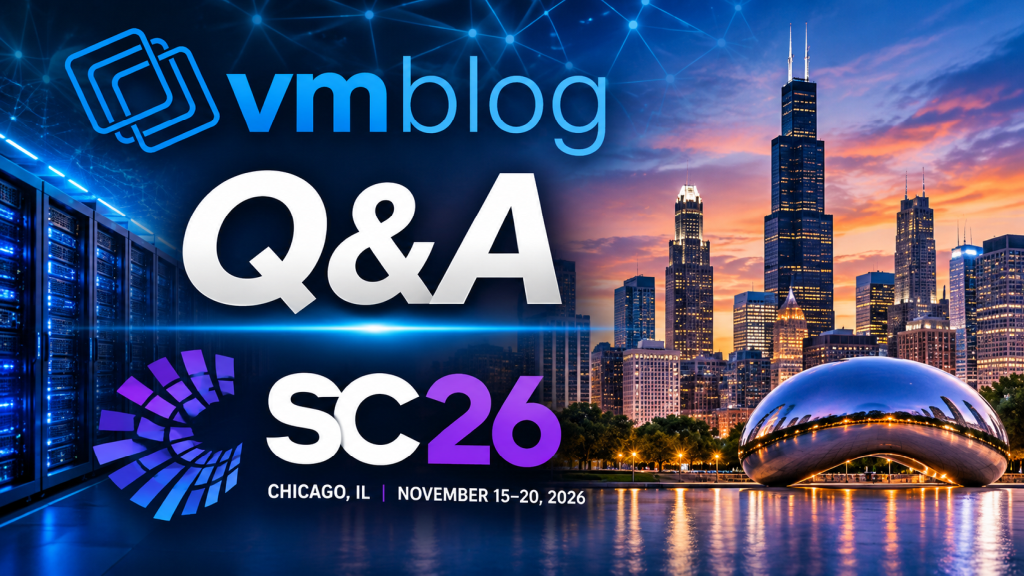
SC26 is underway at McCormick Place in Chicago, and one theme runs through the week: HPC and AI have blended together. Research, simulation, training, and inference now feed one another, and data no longer moves on a schedule. In this VMblog Q&A, Selma Chang, Principal Product Marketing at DDN, explains why data age no longer predicts data access: a three-year-old evaluation set that a retraining run reads every two weeks is still active data. That is the “new data lifecycle” DDN says buyers must plan for, and the company’s answer is one platform with two data engines, EXAScaler and Infinia.
Chang also discusses the news DDN is bringing to the show. The company is expanding Software-Defined deployment across its portfolio, letting customers run DDN’s high-performance data infrastructure software on qualified industry-standard servers, starting with the DDN AI2200. A limited beta with NVIDIA participating is planned for early 2027. New EXAScaler 7 capabilities, including multi-tenancy REST APIs with per-tenant QoS limits, File Restore, and an audit log, are targeted for the first half of 2027. She also makes the case to CFOs and CIOs, explains how KV cache offload eases pressure on scarce HBM and DRAM, and points to DDN’s IO500 standing, an MLPerf Storage result, and Salesforce’s reported GPU utilization gains. DDN is at booth #4211 through November 20, with two more sessions on Wednesday, November 18.
++
VMblog: If you were giving an SC26 attendee a quick overview of your company, what would you say? How has your company evolved since SC25, and what has been the biggest change in your business over the past twelve months?
Selma Chang: DDN builds the data infrastructure behind some of the largest supercomputers and AI clusters in the world, and has done so for 30 years. More than 5,000 customers run on DDN. The biggest change over the past twelve months is that HPC and AI have blended together. Research, simulation, training and inference now feed each other, so data no longer moves on a schedule. Data age no longer predicts data access, for example, a three-year-old evaluation set that a retraining run reads every two weeks is still active data. That is why we talk about a new data lifecycle. You are no longer buying for one workload. You have to think about how all of them fit together, and the infrastructure has to serve every stage. Our answer is one platform with two data engines, EXAScaler and Infinia.
VMblog: Your company is participating in SC26 in Chicago. What does that presence look like, and if you were in St. Louis last year, how does it differ from your SC25 participation?
Chang: We will be at booth #4211 at McCormick Place, November 15 to 20, with research, simulation, training and inference demo kiosks, a HyperPOD on display, and an in-booth theater with our customers, partners, and DDN speakers. We start the week early with DDN Convergence on Monday, November 16, at Revel Motor Row.
VMblog: What key message will SC26 attendees hear from you this year? With AI infrastructure budgets under heavy scrutiny and hardware costs rising, what concrete value proposition can they take back to their CFO and CIO?
Chang: AI and HPC converge on DDN. HPC and AI have blended together, but siloed infrastructure forces costly data movement between workloads. Each stage now hands data to the next in frequent, unpredictable ways. The two common fixes force tradeoffs. Staging retained data up from disk leaves expensive GPUs waiting. Putting everything on flash means paying premium prices for data that is mostly retained. For the CFO, DDN brings performance and capacity together with automated tiering, so you get speed where it matters and you stop paying for copies of your own data. For the CIO, one platform serves every stage of the lifecycle, so the team is not building and running a separate storage stack for each workload. Choose a platform by how it supports interconnected workloads, not by one performance or capacity metric.
VMblog: For returning sponsors, what keeps you coming back to SC year after year? For first-time exhibitors, of which there are more than 50 this year, why was SC26 the right moment for your debut?
Chang: SC is where everyone working toward the same goal compares notes: getting more from their data and compute. Many HPC teams are now doing AI as well, and they are learning as they go, so people arrive with different perspectives but the same objective. DDN has been building for this community for 30 years, and SC is where our customers share what works at scale. This year the conversation is about convergence, so it is the right place to show one platform that supports the whole lifecycle.
VMblog: This year’s SC theme is “HPC Unites.” Where does your company fit into that idea? Which partnerships, joint reference architectures, or open standards are you announcing or demonstrating that make the whole greater than the sum of its parts?
Chang: HPC and AI have blended together, with outputs from research, simulation, training and inference increasingly feeding into one another. Those frequent, unpredictable handoffs can require data copying and re-staging, which costs time and budget. That is the idea behind HPC Unites, and it is where DDN fits: one platform for research, simulation, training and inference, built on two data engines, EXAScaler and Infinia. Infrastructure costs are rising while budgets stay constrained, and models and agents create changing demands for active and inactive data, so it is harder to predict what data needs to be available, and when. DDN brings 30 years of innovation, alongside NVIDIA, to support the largest supercomputers and AI clusters. We will be making an announcement on how DDN expands Software-Defined deployment across the product portfolio. This option allows customers to run DDN’s high-performance data infrastructure software on qualified industry-standard servers, starting with DDN AI2200, with qualified third-party appliances to follow. A limited beta is planned for early 2027, with NVIDIA participating as new EXAScaler 7 capabilities are targeted for rollout in the first half of 2027. Please hold from publishing anything on this until our press release goes out. The press release is planned for Tues, Nov 17.
VMblog: Nearly every vendor now claims to be “AI-native” and “HPC-ready.” What are your provable differentiators, and which independent benchmarks or production customer results (IO500, Green500, MLPerf, real-world deployments) back them up?
Chang: On the IO500 production list and the 10-node production list, DDN holds the most spots of any vendor in the top 10. In MLPerf Storage v2.0, one 2U node loaded a Llama3-8B checkpoint in 3.4 seconds. NVIDIA has run its own AI clusters on DDN since 2016, including Eos and Selene. On the customer side, Salesforce published GPU utilization rising from 40% to 70% on DDN, along with a 42% reduction in overall training costs.
VMblog: How can attendees find you at SC26? What hands-on demos, live benchmarks, or interactive experiences will you have at your booth, and what’s the one thing you’d tell someone not to miss?
Chang: Find us at booth #4211 at McCormick Place, November 15 to 20. You can see research, simulation, training and inference demos, and learn more about HyperPOD at our display unit. Our in-booth theater features customers, partners and DDN experts. You can also book a one-on-one meeting with DDN executives and technical experts at lp.ddn.com/sc26.
Start the week with DDN Convergence on Monday, November 16, from 1:00 to 5:30 PM at Revel Motor Row, supported by NVIDIA. It brings together customers, industry leaders and peers in HPC, AI and data infrastructure, with a partner promenade, lightning talks and a networking reception. Register at ddn.com/lp/events/sc2026/ddn-convergence.
We are also part of three SC sessions: Taming AI Storage Systems, Inference in Motion: Storage-Tier KV Cache Offload for Agentic AI, and Emerging Storage Technology.
The one thing not to miss: we are excited to introduce new product innovation and a major milestone for DDN at SC26.
VMblog: Do you have speaking sessions, panels, Birds of a Feather meetings, workshop appearances, or paper tie-ins at SC26? What topics will you address, and how can attendees join?
Chang: Yes, three SC sessions:
Monday, November 16, 8:30 AM to 12:00 PM: Taming AI Storage Systems.
Wednesday, November 18, 10:30 AM to 11:00 AM: Inference in Motion: Storage-Tier KV Cache Offload for Agentic AI.
Wednesday, November 18, 10:30 AM to 12:00 PM: Emerging Storage Technology, with Irfan Ahmed.
Together they look at how storage has to change as AI workloads scale and agents reach production.
You can also hear from DDN, partners and customers in the Lightning Talks at DDN Convergence on Monday, November 16, at Revel Motor Row and at on the show floor at the booth theater in booth #4211.
VMblog: The memory and accelerator supply crunch has pushed up prices and stretched lead times for DRAM, HBM, and NAND. How are you helping customers plan and get more from constrained hardware, whether through flexible configurations, software efficiency, disaggregation, or extending the life of existing systems?
Chang: Traditional storage forces a tradeoff. Either stage retained data up from disk, delaying your results and making expensive GPUs wait, or put everything on flash, which means paying premium prices for data that is mostly retained. DDN brings performance and capacity together with automated tiering, so flash holds what is active and disk holds the rest in the same namespace. On the GPU side, Infinia keeps KV cache outside GPU memory so inference reuses context instead of recomputing it, which takes pressure off HBM and DRAM. Disk is supply constrained too, so we advise customers to commit capacity early.
VMblog: Agentic AI is now on the SC program, including a dedicated workshop. How are AI agents changing your product, whether in scheduling, code optimization and migration, workflow orchestration, or system operations? What governance and access controls do you put around agents that touch production HPC environments?
Chang: As AI use cases scale and agents reach production, the volume of information an agentic workload needs is significantly larger than for a simple chatbot or an answer lookup. Every step reads more context, and recomputing that context on GPUs is slow and costly. Infinia keeps that context close to the compute. Infinia is built differently, so it does not compete with other storage platforms on their terms. One hash locates every piece of data, and it is fetched in parallel from every node. There is no router, no index server and no gateway in the path. Infinia ships inside NVIDIA Dynamo and serves KV cache, objects and files from one namespace. One production cluster runs on more than 300 nodes.
VMblog: Simulation, AI training, and inference are increasingly expected to share one platform. How does your architecture balance the needs of traditional FP64 science against low-precision AI, and what do you tell customers who can’t afford to buy separate systems for each?
Chang: For storage this is a question about copies. When research, simulation, training and inference each get their own storage, data is copied and re-staged between them, and every copy costs time, budget and power. DDN runs all four stages as one platform with two data engines, EXAScaler and Infinia, so simulation outputs can feed training directly, with no extra copy step. Flash holds hot data, disk holds capacity, and data moves between them automatically. For customers who cannot afford separate systems for each workload, that is the point. Our job is to make sure the data layer is never the reason a workload waits.
VMblog: With a Chinese system taking the No. 1 spot on the TOP500 and nations investing in domestic compute stacks, sovereignty and export controls are shaping procurement. How do sovereign AI, data residency, and geopolitical risk influence your product design and go-to-market, and how do you support on-prem, cloud, neocloud, and hybrid deployments?
Chang: Control over where data lives is a design premise. Aleria, which helps organizations move from AI experimentation to production, built its sovereign AI factory architecture on DDN. The approach supports on-premises and air-gapped operation and reduces dependence on external cloud. According to Aleria, First Abu Dhabi Bank moved from 270 AI proofs of concept to production AI across several functions. On deployment, EXAScaler is available on DDN’s purpose-built systems and through cloud partners, including Google Managed Lustre.
VMblog: With memory scarce and expensive, and modern AI leaning heavily on KV cache, checkpointing, and massive datasets, what innovations in memory tiering, storage orchestration, or interconnect (Ethernet, InfiniBand, optical) are you unveiling to keep costly accelerators fed?
Chang: We treat the path from GPU memory to storage as one hierarchy. For inference, KV cache is stored outside GPU memory, so inference reuses context instead of recomputing it. GPUs spend their cycles on new tokens, and users see faster first responses. Running on DDN’s platform today, NVIDIA Dynamo delivers 4.2x faster time to first token at 100K context. For training, EXAScaler caches data on the local NVMe of GPU servers so GPUs stay fed. On the fabric side, the AI400X3M supports InfiniBand, Spectrum-X, RoCEv2 and TCP Ethernet with XDR and 800G networking, and EXAScaler supports Omni-Path alongside InfiniBand and Ethernet.
VMblog: HPC environments are now multi-tenant, AI-enabled, and increasingly agent-accessible, which widens the attack surface. What security frameworks, zero-trust approaches, and supply chain protections are you implementing, and how do you avoid sacrificing performance?
Chang: In a shared system the basics are isolation, encryption and accountability. With EXAScaler 7 capabilities (to be announced, please do not share before Nov 17), customers can share one system across teams with multi-tenancy REST APIs that apply per-tenant QoS limits and fair sharing, reducing the impact of other tenants on priority jobs. EXAScaler 7 will include additional data protection enhancements to recover from accidental deletions quickly using File Restore, and investigate issues with an audit log.
Some capabilities described are in development. Dates and features are targets and may change at DDN’s discretion. Performance figures are DDN measurements on stated configurations unless attributed. Customer results are from current releases.