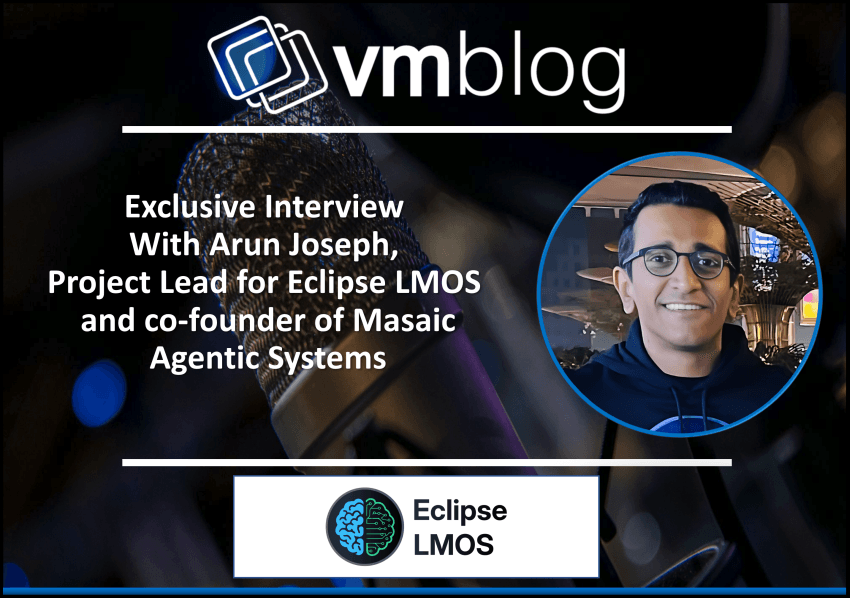
The Eclipse Foundation has unveiled a groundbreaking addition to its Eclipse LMOS (Language Model Operating System) project: the Agent Definition Language (ADL), an industry-first framework designed to transform how enterprises build and deploy AI agents. Unlike traditional prompt engineering approaches, ADL provides a structured, model-agnostic language that enables business and domain experts to collaborate directly with engineering teams in defining agent behavior. This innovation addresses a critical gap in enterprise AI adoption, where complex business processes cannot be adequately captured through simple prompts or proprietary black-box solutions.
In this exclusive VMblog interview, Arun Joseph, project lead for Eclipse LMOS, explains how the platform’s three core components�ADL, the ARC Agent Framework, and the LMOS Platform�work together to help enterprises leverage their existing Java infrastructure and team expertise to build agentic AI systems at scale. By eliminating the need for organizations to rebuild their technology stacks or hire specialized teams, Eclipse LMOS offers a faster, more cost-effective path from prototype to production, particularly for enterprises with significant investments in JVM-based systems.
VMblog: Before we jump into the news, give us a bit of background on the Eclipse Foundation.
Arun Joseph: The Eclipse Foundation is a Brussels-based open source software foundation and one of the largest open source foundations in the world. While perhaps best known for the Eclipse IDE, used by millions of developers, and for Jakarta EE, the open source successor to Java EE, or Eclipse Temurin, one of the most widely used OpenJDK Java distributions, our scope extends far beyond that.
The Foundation currently hosts over 400 open source projects across a wide range of technology domains, including runtimes, registries, tools, specifications, and frameworks for cloud and edge applications, AI, automotive, IoT, systems engineering, open processor designs, regulatory compliance, and many others. It also serves as the home for industry collaborations such as Adoptium, Software Defined Vehicle, and OpenHW.
VMblog: What exactly are you announcing today?
Joseph: Today, we announced the introduction of the Agent Definition Language (ADL) functionality to the Eclipse LMOS (Language Model Operating System) project. Eclipse LMOS is an open source platform for orchestrating intelligent AI agents that perform complex tasks at enterprise scale. It brings together three core components that make it both powerful and practical for enterprise adoption:
- Eclipse LMOS ADL (Agent Definition Language): A structured, model-agnostic language and visual toolkit that allows business and domain experts to define agent behavior consistently and collaborate seamlessly with engineers. ADL replaces brittle prompt engineering with a shared, maintainable framework that scales across teams and use cases.
- Eclipse LMOS ARC Agent Framework: A JVM-native framework with a Kotlin runtime for developing, testing, and extending AI agents. ARC includes a built-in visual interface that accelerates iteration, debugging, and integration with existing enterprise systems.
- Eclipse LMOS Platform: An open, vendor-neutral orchestration layer for managing agent lifecycles, discovery, semantic routing, and observability. Built on the CNCF stack, the platform ensures scalability and interoperability across complex enterprise environments and is currently in alpha release.
Together, these components make Eclipse LMOS a complete foundation for building, deploying, and scaling agentic AI systems that leverage the infrastructure, teams, and assets enterprises already trust.
The news today focused on ADL, which is an industry-first innovation that simplifies traditional prompt engineering through a structured, model-agnostic framework. It allows business and engineering teams to co-define agent behavior in a consistent, maintainable, and versionable way. This shared language increases the reliability and scalability, enabling enterprises to design and govern complex agentic systems with confidence. Most importantly, ADL helps large enterprises leverage their existing assets to unlock the benefits of Agentic AI.
VMblog: How does ADL differ from existing approaches?
Joseph: ADL is designed for business and domain experts, not just developers. It serves as a bridge between agent engineering and agent business behavior. In large enterprises, business processes are complex and cannot be captured through simple prompts or proprietary black-box tools. ADL provides an open and expressive way to define agent behavior, allowing business teams to iterate quickly and directly shape how agents act within their specific domains.
VMblog: Are you confident that Java-based solutions, such as Eclipse LMOS, can compete effectively with Python?
Joseph: It’s not really about competition; it’s about choosing what best fits your existing teams and infrastructure. If your organization’s stack is in Python or Rust, use that. But for enterprises with decades of investment in Java, LMOS lets you build agents without reinventing your stack. You can reuse your existing libraries, frameworks, and expertise, and the same teams who understand the domain can build agents directly. That’s how we were able to move to production so quickly: no new teams, no new skills, just leveraging what already works.
VMblog: You’ve mentioned that Eclipse LMOS helps control costs. How does it do that?
Joseph: By allowing enterprises to build on what they already have. LMOS reuses existing infrastructure, DevOps tooling, and libraries, rather than requiring a complete rebuild. This eliminates the need to hire new teams, maintain duplicate environments, or manage additional tech silos. The result is faster iteration, lower costs, and a dramatically shorter path from prototype to production.
VMblog: What’s next for Eclipse LMOS?
Joseph: LMOS began as a broad exploration into agent computing, from protocol design inspired by the Web of Things to custom Kubernetes operators and agent frameworks. It was our “Xerox PARC moment,” where we experimented widely to understand what was truly needed. Now we’re focusing on what matters most: empowering enterprises to build powerful agentic systems using the infrastructure and JVM stacks they already trust.
Next, we’re opening up ADL for community feedback, evolving it into a framework and language-agnostic layer that any organization can plug into, whether their stack is in Python, Java, or Rust. In the longer term, we’ll continue advancing open registries that enable agents to interoperate across ecosystems, while keeping our primary focus on helping enterprise teams build and iterate faster using the tools and knowledge they already have.
##
About Arun Joseph
Arun Joseph is the project lead for Eclipse LMOS and co-founder of Masaic Agentic Systems, which develops large-scale compound agentic systems for operational intelligence across enterprises, industries, and critical infrastructure.
His work centers on designing open-core architectures that enable organizations to deploy and scale intelligent systems responsibly, leveraging their existing teams and assets to connect data, decisions, and actions for measurable outcomes.
Previously, at Deutsche Telekom AG, he led engineering for the central AI program (AICC) and initiated Eclipse LMOS, one of Europe’s first open agentic computing platforms. Through his ventures, including Rhizome Foundry GmbH, Arun continues to advance the field of agentic computing, helping define the foundations for large-scale, interoperable, and human-aligned AI systems.