Enterprise data teams are drowning in information they can’t analyze, with heavily oversubscribed data science departments able to extract insights from only a fraction of available enterprise data. This $200 billion global challenge has created a perfect storm of expensive, scarce talent struggling with human-intensive tasks like data cleaning, pipeline implementation, and bespoke analysis code. Traditional ETL tools and broad horizontal AI solutions like ChatGPT simply aren’t designed for the deep, vertical automation that enterprises desperately need to unlock their data’s full potential.
Emergence AI believes it has cracked this code with CRAFT, a revolutionary multi-agent platform that introduces “Agents Creating Agents” (ACA) technology to enterprise data intelligence. Unlike conventional automation tools that work only on templated, happy-path workflows, CRAFT can tackle complex, open-ended problems by breaking them down into step-by-step plans and dynamically creating new agents at runtime when existing ones can’t handle specific sub-tasks.
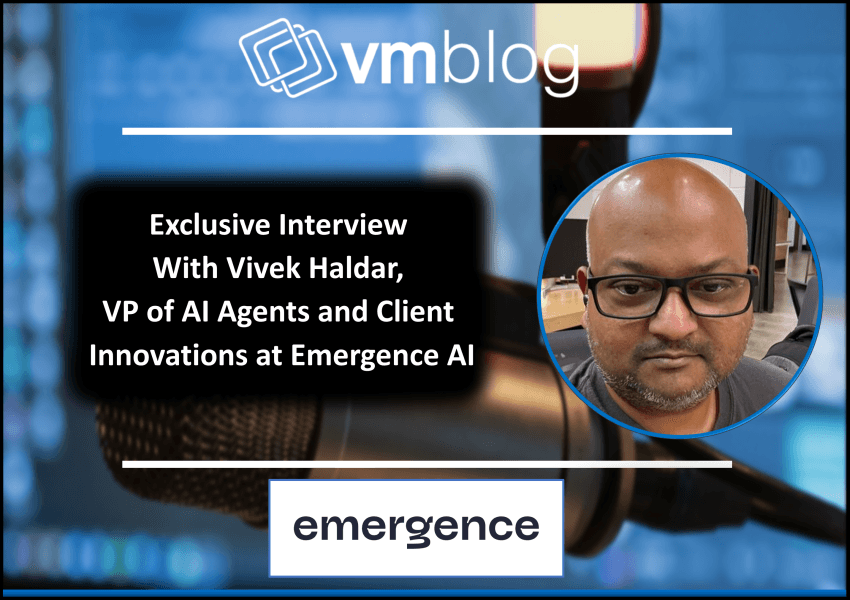
In this exclusive interview, Vivek Haldar, VP of AI Agents and Client Innovations at Emergence AI, explains how CRAFT is transforming billable hours into reusable software while addressing the fundamental concerns around auditability, compliance, and control that keep CISOs awake at night.
++
VMblog: To kick things off, please give VMblog readers a thumbnail on your background, and an overview of Emergence AI, CRAFT, your competitive landscape, TAM and similar.
Vivek Haldar: I lead AI Agent engineering at Emergence AI and have been here for just over a year. Prior to Emergence, I spent 18 years at Google in various capacities from software engineer to tech-lead to engineering manager. My last role there was as one of the leads on Google’s engineering team building the LLM-based chatbots for customer support systems. I have a PhD in Computer Science from the University of California, Irvine, and a B.Tech. in Computer Science from the Indian Institute of Technology, New Delhi. I write and speak regularly on my blog vivekhaldar.com, my YouTube channel www.youtube.com/@VivekHaldar, and at industry conferences.
Emergence AI’s mission is to bring agentic AI to enterprises, with a focus on data intelligence and automation. We believe this is an underserved market as most of the incumbents are focusing on broad horizontal use cases rather than automating end-to-end workflows in deep, specific verticals such as data. For example, the well-known chatbots (ChatGPT, Gemini etc) are general-purpose, don’t connect to your internal APIs and data sources for custom grounding, and are not geared towards automating end-to-end workflows inside an enterprise context.
VMblog: You’ve positioned CRAFT as addressing a $200 billion global spend on data pipelines. For VMblog readers who are CTOs and IT leaders, can you break down where this massive cost burden actually comes from in typical enterprise environments? What specific pain points are driving these expenses that traditional ETL tools and data integration platforms haven’t solved?
Haldar: These are good questions. In any enterprise you’ll find heavily oversubscribed data science, data intelligence, data analyst teams that are tasked with collecting, organizing, and extracting actionable insights from the sprawling data they are inundated by. This kind of talent is expensive and scarce. And yet even the best data teams usually can extract insight from only a small fraction of the data an enterprise has. A big part of the cost is simply the human-intensive nature of these data intelligence tasks. This includes things like data cleaning, implementing data pipelines, and writing bespoke code to analyze and visualize data.
The proficiency of large language models at generating code is potentially a huge help in tackling this problem. However, the model by itself is only one part of a much larger system that needs to handle enterprise-grade guardrails, security, compliance, as well as secure and convenient connections to databases and APIs to ground these systems in an enterprise-specific context.
The system should also be able to receive complex problem descriptions in natural language and independently figure out the solution approach. This is what CRAFT is.
VMblog: The ACA (Agents Creating Agents) concept Emergence talks about with CRAFT is fascinating but sounds almost like science fiction to many operators and pros. Can you walk us through a concrete example of how this works in practice? When an agent creates another agent, what’s actually happening under the hood, and how do you ensure quality control and governance?
Haldar: CRAFT is a multi-agent system comprised of task-specific agents (e.g., a web automation agent, a data science agent, etc.) When solving complex problems, CRAFT performs reasoning and planning to break it down into a multi-step plan. Often each of those steps will be delegated to an existing agent in the system. However, when there is no agent that can solve one of these sub-steps, CRAFT will go ahead and create a new agent at runtime. This is a major innovation worth highlighting.
This is a huge unlock in terms of the variety and complexity of tasks that CRAFT can reliably solve. Then these newly crafted agents are saved and added to the agent registry, making them neat, reusable packages of functionality. This lets us achieve the otherwise elusive goal of design-time flexibility and run-time reliability.
Let me give an example to illustrate this as it’s so central to what we’ve developed with CRAFT. Suppose you want to run sentiment analysis on a product or company but focus in on one specific aspect. Some of the steps involved will be handled by existing agents, such as the web search agent or the web automation agent. But to handle the bespoke logic of looking for the specific things you care about and the specific kind of output you want, CRAFT will use ACA to build an entirely new agent and then give you the option to either keep refining it or, if you’re happy with it, to save it and add it to the agent registry for future reuse.
VMblog: Enterprise IT leaders are notoriously cautious about AI systems that can ‘self-improve’ and operate autonomously. How does CRAFT address the fundamental concerns around auditability, compliance, and control that CISOs and risk management teams will inevitably raise? What guardrails exist when agents are essentially writing and deploying code?
Haldar: CRAFT was designed from the ground up with auditability, compliance and guardrails as first-class priorities. These are enterprise basics. Every action is logged for auditability. The in-depth verification in our agentic behavior automatically checks actions and output against compliance policies specific to the enterprise. And of course, the system works with and encourages human-in-the-loop for oversight, refinement and feedback.
VMblog: The enterprise AI automation space is getting incredibly crowded, with players like UiPath, Automation Anywhere, Microsoft Power Platform, and even hyperscalers offering similar-sounding solutions. What makes CRAFT fundamentally different from these established platforms, and why shouldn’t enterprises just extend their existing automation investments?
Haldar: The comparison to RPA products is a common one. While RPA certainly is useful within many contexts, the agentic AI embodied in CRAFT lets enterprises tackle a whole new class of more complex and open-ended problems. Traditional automation solutions work well for happy-path workflows that are well-templated and do not have wide variance in their input.
For problems where the input is unstructured or where a predefined plan for solving it doesn’t exist, CRAFT really shines. Using advanced reasoning and planning capabilities, CRAFT breaks down complex problems into step-by-step plans and finds the appropriate agents to handle those steps. And when one doesn’t exist, it will generate a new agent at runtime, our “agents creating agents” capability we discussed above.
VMblog: You mention the 50% shortage of data scientists, but CRAFT seems to potentially displace some traditional data engineering roles. How do you see this playing out in enterprise IT departments? Are you creating new job categories, eliminating others, or fundamentally changing how data teams operate?
Haldar: AI is fundamentally changing the mix of tasks that data scientists are doing. An analogy I like to make is with spreadsheets. The introduction of spreadsheets didn’t eliminate the accounting profession. In fact, it led to a massive growth in the number of accountants over the following decades. But it did very much change the mix of tasks that accountants perform.
Similarly, we see CRAFT as an enabler and amplifier for what data science teams do. Every single company we have spoken with has heavily oversubscribed data science and data analyst teams. The result is that a lot of useful data is simply left unanalyzed, resulting in potentially missing valuable, actionable insights. Bringing machine-scale intelligence to this problem not only lets enterprises gain deeper insights from more of their data, it also frees up data scientists to focus on more strategic, higher level, more creative problem solving.
We are already seeing Jevon’s paradox play out at the base layer of the AI stack: as tokens got cheaper their total use skyrocketed. I believe a similar dynamic will play out at the higher levels in the app stack, going all the way to the human professionals being able to gain massive leverage and multiply their impact as machine intelligence gets better and cheaper.
VMblog: How does CRAFT handle the messy reality of brownfield enterprise environments? What does a typical implementation timeline look like for a Fortune 500 company?
Haldar: We realize that enterprises have varying IT setups and support a range of deployment options from fully hosted to on-prem.
Using CRAFT, enterprises can follow a full-lifecycle approach to develop very domain-specific AI agents for them. Using MCP (Model Context Protocol) they can connect to internal or external databases and APIs, grounding agents in core enterprise context. Agents can be rapidly crafted and saved, making them re-usable across the organization. What’s worked well for many enterprises is an iterative approach. Very quick time-to-first-value can be achieved within a week. Then that iterative approach lets companies expand their scope over a period of months.
VMblog: You’ve recently talked about transforming ‘billable hours into reusable software’ and ‘bending the enterprise cost curve.’ Can you provide some specific metrics or benchmarks that IT leaders should use to evaluate CRAFT’s ROI? How do the economics work as organizations scale from pilot projects to enterprise-wide deployment?
Haldar: When evaluating ROI, IT leaders should look at two distinct types of value. For existing work processes, the metrics are straightforward efficiency gains-primarily FTE hours saved. But the bigger impact often comes from new capabilities that weren’t previously feasible, like extracting insights from those vast troves of unanalyzed data sitting in enterprise systems.
The economics follow a clear progression. Pilot projects focus on capturing domain-specific knowledge-the workflows, criteria, and decision-making rubrics that make your organization unique. This phase also gives employees time to adapt their work patterns around AI agents. When pilots demonstrate real value, that’s your signal that the investment is working.
The scaling advantage kicks in once you’ve proven the concept. These agents can then be rapidly deployed across the organization because you’ve already done the hard work of encoding institutional knowledge. That’s where you start bending the cost curve-the marginal cost of each additional deployment drops dramatically while the value compounds.
VMblog: Looking ahead 3-5 years, you envision ‘functional specialists becoming architects of intelligent systems’ rather than just software developers. This sounds like a fundamental shift in how enterprises approach technology. What does this mean for traditional IT organizational structures, and how should CIOs be preparing their teams for this transformation? Also, what does it mean for SWEs and developers in tangible terms?
Haldar: The move to agentic AI is yet another ratchet up the ladder of abstraction. I like to make the analogy with a much earlier transition in how we built systems: going from handwriting assembly language to compilers translating high-level languages like C++ and Java into assembly language.
As AI agents take on more and more of the low-level implementation details, whether that means writing code, doing data science, or operating IT systems, the leverage is now clearly shifting to higher levels in the stack. This includes things like specification, design, architecture, and ultimately, having and articulating a clear understanding of how business value is achieved.
##