The AI Shift from Experimentation to Execution
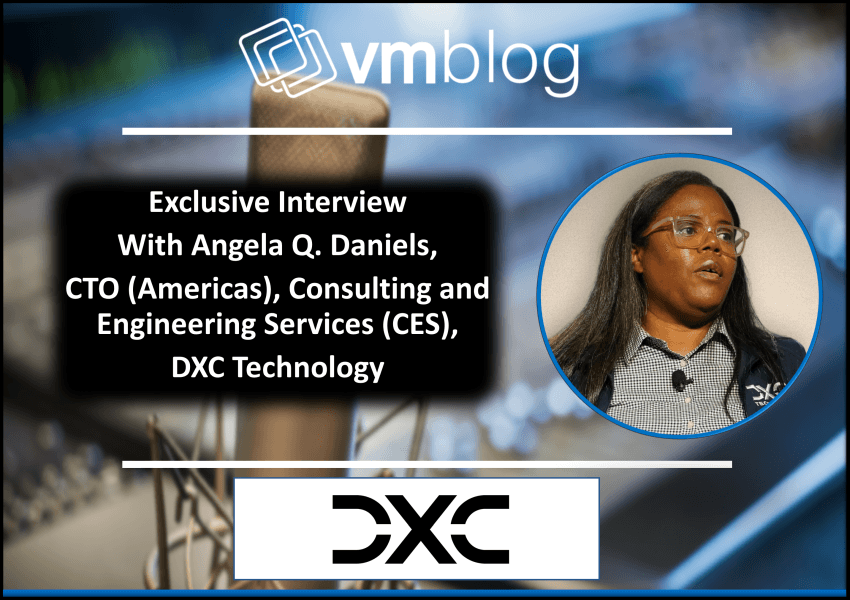
The enterprise AI landscape has undergone a dramatic transformation in the past year, shifting from experimental pilots to demands for tangible, measurable results. Yet despite massive investments, MIT research reveals that 95% of AI pilots fall short of anticipated outcomesnot due to technology limitations, but because organizations lack cohesive strategies connecting AI to their people and processes. Angela Q. Daniels, Chief Technology Officer (Americas) for Consulting and Engineering Services at DXC Technology, believes the solution lies in moving beyond the “automate over augment” mindset and embracing frameworks that orchestrate AI integration across entire enterprises rather than treating it as standalone technology.
Building Trust and Scale with the Xponential Blueprint
In this exclusive VMblog interview, Daniels introduces Xponential, DXC’s orchestration framework that has already demonstrated remarkable results: reducing total cost of ownership by 34%, increasing speed to revenue by 62%, and cutting AI launch timelines from quarters to weeks. Field-tested in highly regulated sectors including healthcare, aerospace, and infrastructure, Xponential’s five interdependent pillarsInsight, Accelerators, Automation, Approach, and Processembed governance, security, and observability from day one. With real-world implementations at Singapore General Hospital achieving 90% accuracy in antibiotic prescribing and Textron reducing service desk tickets by 20%, Daniels shares how enterprises can finally move AI initiatives beyond the pilot phase to deliver repeatable, trustworthy results at scale.
++
VMblog: Let’s start big picture – how have you seen AI shift the expectations and demands in the enterprise and what are the biggest misconceptions about AI adoption?
Angela Q. Daniels: In the last 12 months, we have seen the sentiment around AI shift from pilots and experimentation to demand for real-world use cases-boards, investors, and C-suites are looking for tangible results. Misaligned assumptions, poor data foundations, outdated systems, and unengaged teams often stop AI initiatives before they start.
First, there’s a belief that investment equals impact, but AI isn’t just a plug-and-play, standalone technology. Time and again, companies funnel millions of dollars into pilots without a true goal in mind, only to see them stall or fail to return ROI. MIT found that 95% of AI pilots fall short of anticipated results. The culprit isn’t the technology, rather the absence of a cohesive strategy that connects the technology to people and processes.
Second, some organizations have embraced an automate over augment’ mindset. However, where we are on the AI curve requires human oversight to validate this technology. Environments where people are elevated and amplified rather than replaced are much more conducive to success. Right now, only humans can provide proper context and sound judgment to guide AI responsibly.
VMblog: Can you explain what Xponential is and how it fits into DXC’s broader business framework?
Daniels: With deep industry expertise, proven AI capabilities, and a track record of helping organizations transform their complex operations, DXC is uniquely positioned to support enterprises as they scale their AI initiatives-and Xponential is our orchestration blueprint to do just that.
Xponential is the bedrock for each of our AI solutions and deliverables-field-tested in some of the most complex, highly regulated sectors like infrastructure, healthcare, and aerospace/defense.
Xponential helps organizations ensure their AI investments don’t get stuck in the pilot phase. Built on five interdependent pillars-Insight, Accelerators, Automation, Approach, and Process-it moves AI programs beyond pilots by integrating technology with people and processes, which together empower organizations to confidently deploy AI at speed and scale.
VMblog: How does Xponential address the common challenges enterprises face when scaling AI initiatives?
Daniels: Most organizations lack a cohesive strategy to connect AI with their people and processes, leading to projects that stall or never scale beyond isolated teams or use cases. Xponential bridges that gap by orchestrating seamless integration between the technology and internal stakeholders/functions.
Constructed on five core pillars, the framework embeds governance, security, sovereignty, and observability as critical components from the start rather than just compliance checks along the way. This approach enables organizations to create trustworthy, impactful, and, perhaps most importantly, repeatable AI across the enterprise.
VMblog: Can you elaborate on the five core pillars of Xponential: Insight, Accelerators, Automation, Approach, and Process. How do they contribute to successful AI outcomes?
Daniels: These five pillars are at Xponential’s core. Together, they are critical to developing impactful and repeatable AI solutions, but something many developers often only partially address:
Insight: Xponential makes AI decisions explainable and defensible by embedding sovereignty, compliance, and observability from the start. We know AI drift erodes trust and enhances risk. Every agent, automated decision, and AI-powered process must include built-in governance to increase visibility and accountability.
Accelerators: Our approach increases speed and efficiency while reducing time to value. With an ecosystem of proprietary and partner-built tools, teams can instantly focus on progress without being locked into a single technology vendor or building from the ground up.
Automation: It is crucial to build intelligent agentic systems and protocols that continuously learn and improve. These agents don’t simply run tasks; they optimize workflows and adapt to what works and what doesn’t -escalating issues, updating records, and engaging with users.
Approach: The Xponential blueprint evolves to human-plus collaboration with AI-orchestrated work. This isn’t about replacing people, but empowering and elevating them to serve as strategic decision makers while AI does the grunt work. AI handles the routine; people handle the innovation.
Process: Starting small and scaling fast is paramount to moving beyond pilot phases. Through MVPs (minimum viable products), teams rapidly validate ideas, gather feedback, deploy deliberately, capture early wins, then repeat. This uncovers what’s truly impactful before committing to wider expansion, insulating teams from the pitfalls of pilot fatigue.
VMblog: What makes DXC uniquely qualified to help enterprises move from vision to value with AI?
Daniels: We’re embedding AI into every layer of DXC’s technology ecosystem. Our proven AI capabilities combined with our industry expertise and track record of operational transformation uniquely position us to help accelerate and operationalize responsible AI and deliver measurable business impact. The engine behind this momentum is a global team of 50,000 full-stack engineers and AI-first facilities including Innovation Centers, Centers of Competency, and Centers of Excellence across six continents.
We’ve already seen the compounding value of Xponential lower organizations’ total cost of ownership by 34%, increase speed to revenue by 62%, and elevate the end user experience by 16%.
VMblog: Is there a specific industry you had in mind when developing this blueprint or can it be applied across industries?
Daniels: Just as AI is being developed and deployed by enterprises across every industry, Xponential is also designed to span across industries and regions. Certainly, the maturity curve is going to be different for every organization and industry, with some AI journeys already quite advanced while others are in their infancy. Each path will be different, but our blueprint is designed with the agility to meet each of them where they are and help them build toward more AI-native postures.
VMblog: Do you have any examples of how Xponential has been successfully implemented and the ROI achieved?
Daniels: As more organizations lean on AI to modernize legacy operations and transform mission-critical systems, the need for robust frameworks like Xponential has never been greater. But this isn’t just vaporware or theoretical architecture-our model is already at work in the field, delivering real results for real partners: reducing AI launch timelines from quarters to weeks, cutting time-to-value by up to 70%, and ensuring near-100% reliability from day one.
Consider Singapore General Hospital-ranked among the world’s best-and Synapxe, Singapore’s national health agency. Together, we develop Augmented Intelligence in Infectious Diseases (AI2D), combining AI-driven insights with collaborative human oversight to identify when antibiotics are truly needed for lower respiratory tract infections. The result: 90% accuracy, improved patient outcomes, and reduced unnecessary antibiotic use, a major factor in combatting antimicrobial resistance.
At Textron, a U.S.-based multi-industry company, we helped transform IT support with AI automation, reducing service desk tickets by 20%, accelerating resolution times, and delivering more consistent and reliable end-user support to 32,000 global employees.
And at Ferrovial, a global infrastructure company, our AI Workbench platform deployed more than 30 AI agents into daily workflows to boost efficiency, enhance operations, and improve safety across critical projects like highways and airports for 25,000-plus employees.
Importantly, success goes beyond just metrics. These solutions give invaluable time back to physicians, IT teams, engineers, and other professionals, freeing them to pursue more complex-and potentially lifesaving-tasks while establishing a reusable AI framework that can be quickly scaled across other teams and business units.
VMblog: You often refer to DXC being your own customer zero. What do you mean by this and why is it important?
Daniels: Being customer zero is a simple philosophy, but one that’s core to how we operate: if a solution doesn’t meet our standards, we know it won’t meet our customers’. When we build new products or solutions-like Xponential or DXC Agentic SOC, for example-they are battle-tested under some of the most demanding internal conditions before they ever reach the field. This not only ensures quality, but reinforces trust with our partners so that by the time it gets to them, it’s already been proven with us.
VMblog: Looking ahead, how do you see the AI landscape evolving and what advice would you give to enterprise business leaders?
Daniels: The AI landscape is only getting noisier and more chaotic, but that can’t be a reason for enterprises to tune out. Of the major pins on the technology timeline in the last quarter century-mobile, cloud, Wi-Fi/5G, social media, streaming, e-commerce, IoT, blockchain-AI is poised to be the most revolutionary of them all.
With that, business leaders must first get their data in order before embarking on any AI journey. Poor quality, biased data makes for unreliable AI. To run with AI, organizations must first walk with their data.
Additionally, AI is evolving developers, engineers, and other roles from builders to orchestrators. It’s important that business leaders fully understand this cultural shift, how people and processes-not just the technology-within their organizations will pivot, and what’s needed to facilitate this transformation to reinforce trust in both employee and customer experiences.
##