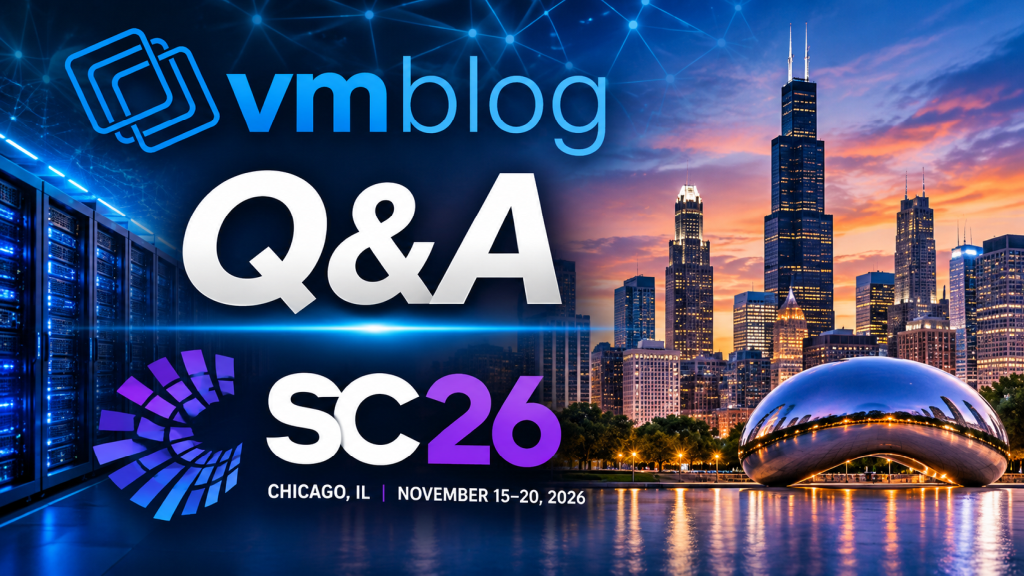
As SC26 approaches, the conversation around AI and HPC infrastructure is shifting from raw compute to a harder question: what does it take to operationalize AI in production? For Hitachi Vantara, the answer starts with the data layer. At the company’s SC26 booth, the message is “Compute got faster. Data has to keep up,” a reminder that accelerators can sit idle when data access or movement becomes the bottleneck. In this VMblog pre-show Q&A, Hitachi Vantara CTO David Chapa explains how the company has evolved since SC25, from the general availability of VSP One Block High End to expanded Hitachi iQ and iQ Studio capabilities, and points to storage revenue growth of 45% year over year in the first quarter of FY2026.
Chapa also tackles the issues weighing on today’s HPC and AI leaders: constrained memory and accelerator supply, rising energy demand, agentic AI governance, sovereign deployments, and an expanding attack surface in multi-tenant environments. He explains how Hitachi Vantara’s net-zero commitment translates into lower power and cooling costs for customers, what guardrails belong around AI agents touching production systems, and why sovereignty is now a mainstream procurement requirement. He also previews three live demos at Booth 1429 in McCormick Place, November 16-19, including a Hitachi High-Tech electron microscopy imaging demo built on VSP One Object, and shares his bets for SC27 and beyond.
++
VMblog: If you were giving an SC26 attendee a quick overview of Hitachi Vantara, what would you say? How has Hitachi Vantara evolved since SC25, and what has been the biggest change in your business over the past twelve months?
David Chapa: Hitachi Vantara builds the data infrastructure that AI and tier-one business applications run on. Virtual Storage Platform One (VSP One) unifies block, file, object and mainframe storage in a single data platform. VSP 360 provides a common control plane to centrally manage data across VSP One environments. Hitachi iQ, the company’s portfolio of AI-ready infrastructure, solutions, and services, is built on VSP One to support enterprise AI, including Hitachi iQ Studio for designing, deploying and governing AI agents. Hitachi EverFlex, our consumption-based infrastructure offering, gives customers flexible ways to access that infrastructure through traditional ownership or as-a-service models, helping align capacity and spending with business needs. As part of Hitachi, Ltd., we can also bring together capabilities across energy, digital engineering and data center operations. One example is Hitachi AI Factory, which brings together Hitachi’s broader AI, infrastructure and industry expertise and is powered by Hitachi Vantara technologies, including Hitachi iQ, to accelerate the development and deployment of AI solutions.
The biggest change I see in customer conversations is the focus on what it takes to operationalize AI. That includes the business outcome, whether the right data is accessible and governed, whether the AI solution meets the requirements, and who will operate it in production. Keeping GPUs supplied with data is an important infrastructure challenge within that broader picture.
What we’ve shipped reflects that shift. VSP One Block High End, the successor to VSP 5000, became generally available this year. It’s built to consolidate tier-one and AI workloads on one system, with up to 50 million IOPS and eight nines of availability. In March, we expanded Hitachi iQ with enhanced AI blueprints and multi-agent coordination in Hitachi iQ Studio, deeper data integration and expanded NVIDIA-accelerated computing options, including support for NVIDIA Blackwell Ultra GPUs. We’ve seen strong early demand for VSP One Block High End since its launch. In the first quarter of FY2026, which ended June 30, our storage revenue grew 45% compared with the same quarter a year earlier.
VMblog: What key message will SC26 attendees hear from you this year? With AI infrastructure budgets under heavy scrutiny and hardware costs rising, what concrete value proposition can they take back to their CFO and CIO?
Chapa: The message at our booth this year is “Compute got faster. Data has to keep up.” AI and HPC share important infrastructure challenges, particularly in data-intensive workloads. In environments where data access or movement limits performance, accelerators can spend valuable time waiting. Production also requires governance, security and operational planning from the outset.
For CFOs, the case starts with the outcome the investment needs to deliver and the total cost of delivering it. Improving the data layer can reduce avoidable accelerator idle time and help customers get more useful work from infrastructure they already own. Utilization is one measure of efficiency, alongside application performance, operating costs and the business or scientific results achieved.
For CIOs, power is increasingly one of the biggest constraints in the data center, and dense, consolidated storage can free up watts and floor space for AI. At the same time, the infrastructure has to support workloads wherever the data, latency and control requirements dictate, whether on-premises, hybrid or sovereign. DestekBank cut data center energy use 25% and total cost of ownership 20% with VSP One technology.
VMblog: How can attendees find Hitachi Vantara at SC26? What hands-on demos, live benchmarks, or interactive experiences will you have at your booth, and what’s the one thing you’d tell someone not to miss?
Chapa: You’ll find us at Booth 1429 in McCormick Place, November 16-19. The booth has three live demos:
- Data readiness for AI. Classification and AI-powered summarization on VSP One find PII and PHI exposure in unstructured content. This helps organizations identify sensitive content and inform policies governing its access and use in AI workflows.
- AI data foundation. We deploy one AI workload on-premises, in a hybrid setup and in a sovereign environment on Hitachi Data Lakehouse. The goal is to show how organizations can securely access and govern data across environments without unnecessary data movement or complexity.
- Real-world outcomes. Biological and medical imaging at production scale featuring Hitachi High-Tech scanning electron microscopes and Hitachi Vantara VSP One Object with S3 Tables.
Don’t miss the imaging demo featuring Hitachi High-Tech electron microscopy and Hitachi Vantara storage. The customer challenge is managing the flow of image data from acquisition through processing, storage and analysis. VSP One Object supports native S3 Tables and built-in SQL access to table data and object metadata, helping make stored information more accessible for analytics. I think that’s where research data management is heading, and it’s more convincing to watch than to read about.
Our engineers will be at the booth all week for deeper architecture conversations, and you can book time in advance through our SC26 event page. There’s also a barista on Tuesday and Wednesday, which by the third day of SC is no small thing.
VMblog: The memory and accelerator supply crunch has pushed up prices and stretched lead times for DRAM, HBM, and NAND. How are you helping customers plan and get more from constrained hardware, whether through flexible configurations, software efficiency, disaggregation, or extending the life of existing systems?
Chapa: Supply constraints make infrastructure planning harder, so the first priority is helping customers make better use of the capacity and performance they already have.
After that, it’s about getting more out of every drive and controller.
Adaptive Data Reduction on supported VSP One systems uses compression and deduplication to reduce physical capacity requirements where the data permits. The benefit depends on the dataset, so sizing needs to account for data that is already compressed or encrypted. Consolidation can also improve utilization and reduce unnecessary hardware. We select storage media and configurations according to capacity, throughput, latency, endurance and cost requirements. These approaches help customers manage storage capacity and investment, but they do not remove constraints on GPU or HBM supply.
Additionally, VSP 360 provides centralized visibility and management across VSP One environments to help organizations understand and optimize the infrastructure they already have. Hitachi EverFlex also provides flexible consumption options that can help align infrastructure spending and capacity with actual business demand.
VMblog: AI is driving data center energy demand sharply higher, and many companies have quietly backed away from their climate pledges. Hitachi Vantara recently went the other direction with a net-zero commitment. What did you commit to, and how does that translate into lower power and cooling costs for customers running AI and HPC workloads?
Chapa: In September, we committed to net-zero greenhouse gas emissions across our full value chain by FY2040, and our near- and long-term science-based emissions reduction targets were independently validated by the Science Based Targets initiative (SBTi). Measured against FY2024, we’ll cut Scope 1 and 2 emissions 98% by FY2030. We’ll cut Scope 3 emissions 51% per usable petabyte sold by FY2036 and 97% by FY2040. In FY2025 alone, we cut Scope 1 and 2 emissions by 43%, largely driven by obtaining 50% of our energy from renewable sources.
The Scope 3 target is the one customers should watch because it’s measured per usable petabyte we sell. Most of our value chain emissions come from the electricity our systems draw in customer data centers. We can only hit that number if what we ship uses less power and cooling per petabyte, and those are the same savings customers see on their power bill.
In practice, that starts with density and consolidation. Malayala Manorama reduced power and cooling costs by 70% and rack space by 66% with Hitachi Vantara technology. VSP 360 Clear Sight gives customers visibility into energy use and carbon impact across their VSP environments and provides recommendations to improve efficiency.
For us, power is increasingly one of the first limits AI customers have to account for, so efficiency and sustainability are becoming part of the same engineering challenge.
VMblog: Agentic AI is now on the SC program, including a dedicated workshop. How are AI agents changing your product, whether in scheduling, code optimization and migration, workflow orchestration, or system operations? What governance and access controls do you put around agents that touch production HPC environments?
Chapa: Agents are changing our product in two places.
The first is giving customers tools to build their own agents. Hitachi iQ Studio enables organizations to build and manage AI agents within their own environments. This year, we expanded it with enhanced AI blueprints, multi-agent coordination and deeper data integration to help customers move agentic AI from experimentation toward scaled deployment. The most valuable agentic applications won’t necessarily come from infrastructure specialists, but from the people who understand the business or scientific problem best. In HPC, that’s the domain scientist.
The second area is infrastructure operations. VSP 360 provides centralized management, AIOps-powered analytics, observability and automation for VSP One. Those capabilities support operations, while the degree of autonomy depends on the specific workflow and controls implemented.
For agents touching production environments, my starting point is to define what they can access, which tools they can invoke and which actions require human approval. Hitachi iQ Studio includes access controls, guardrails and auditability to support that governance. Those capabilities need to be configured alongside the customer’s identity, security and operational controls. Access to governed data is one part of the requirement; authority to change a production system needs its own boundaries.
VMblog: With nations investing in domestic compute stacks, sovereignty is shaping procurement. How do sovereign AI, data residency, and geopolitical risk influence your product design and go-to-market, and how do you support on-premises, cloud, neocloud, and hybrid deployments?
Chapa: Sovereignty has gone from a public-sector niche to an increasingly important consideration in technology procurement. Many governments treat AI as a matter of national security, and regulated companies now ask the same questions in their RFPs: where does the data physically live, who can reach it, and what happens to their operations if a border or a vendor relationship changes. This is also true in other highly regulated industries, including banking, financial services and healthcare. Residency is one requirement. Customers also need to understand who administers the environment, which external services it depends on and how they retain operational control.
On the product side, our approach is to give customers more flexibility and control over where their data and AI infrastructure reside. VSP One provides a common data foundation spanning on-premises and hybrid cloud environments, while Hitachi Data Lakehouse is designed to provide secure, governed access to data across block, file and object without unnecessary movement. The platform has to deploy wherever the customer needs it, which is why our SC26 demo runs the same AI workload across on-premises, hybrid and sovereign environments to demonstrate how customers can maintain access to governed data across different deployment models. Hitachi iQ supports deployment of AI infrastructure in customers’ own environments, while Hitachi iQ Studio provides capabilities for agent governance, auditability and explainability. The architecture and operating model must be matched to the customer’s sovereignty requirements.
It also shapes how we go to market. A sovereign AI cloud needs power, cooling, infrastructure and people to run it, and that’s where being part of Hitachi matters. Across Hitachi, we can bring together capabilities spanning energy, digital engineering, infrastructure and services to address different parts of that challenge.
On deployment models, many teams start in a public cloud or with a neocloud, because renting GPUs avoids a big capital commitment. Once they understand the use case, many move steady-state work closer to their data. Hitachi iQ, VSP One and Hitachi Data Lakehouse are designed to support AI and data across on-premises, hybrid and cloud environments, giving customers flexibility as those deployment models evolve.
VMblog: HPC environments are now multi-tenant, AI-enabled, and increasingly agent-accessible, which widens the attack surface. What security frameworks, zero-trust approaches, and supply chain protections are you implementing, and how do you avoid sacrificing performance?
Chapa: An HPC cluster used to sit behind a fence and serve a known group of researchers. Now it serves tenants, models and agents too. You have to assume something inside will be compromised eventually, and design for recovery.
We start with the data, because that’s what attackers want. VSP One Block High End has a FIPS 140-3 Level 2 validated hardware encryption module, alongside immutable snapshots.
VSP One Block combines immutable data protection with Ransomware Detection powered by CyberSense, helping organizations detect suspicious activity and identify clean data for recovery, so they can restore operations faster, reduce downtime and limit the financial and reputational impact of a cyberattack. Qualifying VSP One Block systems are also backed by our Cyber Resilience Guarantee, which provides a 100% clean recovery point following a cyberattack. We also integrate with partners such as Commvault for backup and data governance.
Implementing a zero trust approach across many components is hard. It takes expertise, and every product with its own security model adds another seam. VSP One Block High End includes secure boot and role-based access controls. VSP 360 provides roles, resource access policies and multi-factor authentication for its management environment, supporting a broader least-privilege approach.
On supply chain, we build systems in our own manufacturing plant in Norman, Oklahoma. More broadly, we also take a layered approach to data security and resilience, including independent security validation and alignment with recognized cybersecurity frameworks.
VMblog: Looking toward SC27 and beyond, which bets are you making? What will attendees be talking about a year from now that they aren’t talking about today?
Chapa: I expect more attention to the balance across compute, memory, networking and storage, and to how efficiently data moves between them. Technologies such as GPUDirect Storage can reduce overhead in the storage-to-GPU path, while emerging architectures address the memory and context demands of inference. By SC27, I expect customers to ask more demanding questions about useful work completed, time to result and cost, alongside accelerator utilization.
I also expect more enterprise AI applications to combine structured records with documents, images and other unstructured content. The challenge is giving those applications access to relevant, governed information without creating unnecessary copies. Native S3 Tables and SQL access in VSP One Object support that direction for table data and object metadata.
And AI is moving into the physical world. HMAX by Hitachi is a portfolio of AI-powered solutions that brings AI to social infrastructure, with offerings spanning mobility, energy, industry and data centers. In transportation, for example, HMAX Mobility combines sensor technologies, AI and edge computing to improve performance, extend asset life and optimize costs. Manufacturing, power grids and healthcare will push models and hardware the same way, and much of that work will look like HPC.
##