As data volumes grow and organizations adopt hybrid cloud and AI, storage has assumed a larger, more complex role in the enterprise. It’s no longer just about terabytes-it’s about cost, performance, scalability, and operational simplicity.
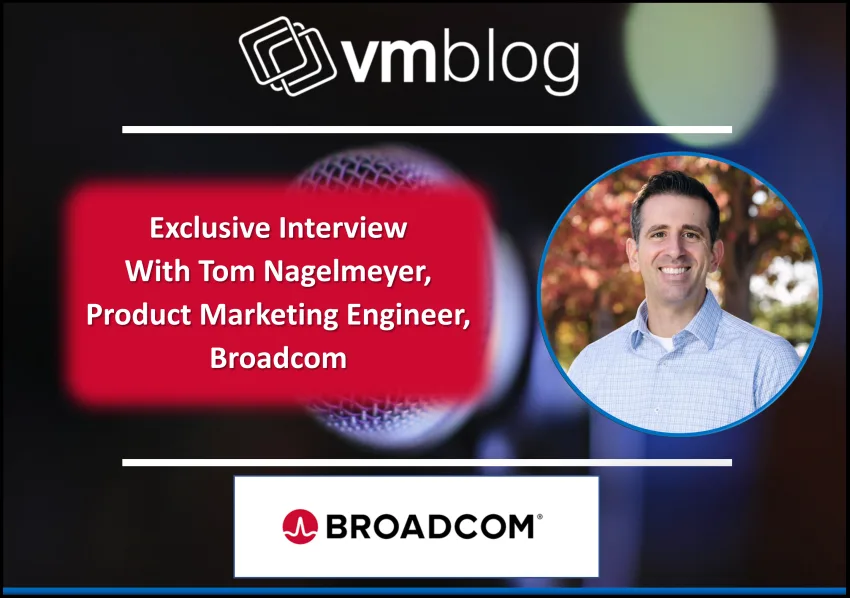
With VMware Cloud Foundation (VCF) 9.0, Broadcom is helping customers modernize their storage management across environments. VMblog sat down with Tom Nagelmeyer, Product Marketing Engineer at Broadcom, to talk about what’s new in the latest release, how customer needs are evolving, and why the conversation around storage is shifting from price to total value.
++
VMblog: What are the biggest storage-related updates in VMware Cloud Foundation 9.0, and why do they matter now?
Tom Nagelmeyer: Storage costs are a top concern for IT leaders, especially as data volumes grow more than 20% per year in many environments. VCF 9.0 introduces several updates that help customers manage those costs while also improving performance and resiliency.
One of the most important is global deduplication in VMware vSAN, which helps reduce storage capacity requirements across environments. We’ve also added vSAN-to-vSAN replication, which brings native asynchronous site-to-site replication to VCF. That provides customers with an additional level of resilience for their data. For customers already running vSAN outside of VCF, we’ve made it much easier to bring those clusters into the fold with a new, simplified import process.
VMblog: You also introduced storage traffic separation. What problem does that solve for customers?
Nagelmeyer: In environments where compute and storage are disaggregated, network congestion can be a real issue. With traffic separation, customers can isolate storage traffic from all other traffic. That means better performance, more predictable outcomes, and an opportunity to leverage existing investments to keep infrastructure investment costs in check. It’s a small change that unlocks significant value.
VMblog: How are cloud operating models changing what customers expect from on-prem storage?
Nagelmeyer: There’s a growing expectation that on-prem storage should operate more like cloud: it should be scalable, pay-as-you-grow, and easy to manage. Customers also want consistency. They don’t want one tool for on-premises, another for the cloud, and a third for the edge.
vSAN is designed to meet those expectations. It’s software-defined, it works across environments, and with VCF 9.0, we’ve made it even easier to manage. The goal is to give customers the flexibility of the cloud without sacrificing the control they get from their own infrastructure.
VMblog: AI and container workloads are becoming more common. How is VMware adapting its storage strategy to support them?
Nagelmeyer: AI, especially generative AI, has some demanding storage requirements-high throughput, low latency, and access to large, dynamic datasets. We’re making investments to support those workloads. We’re expanding our support for different types of storage media, increasing the scalability of vSAN’s native file services, and expanding vSAN’s native storage interfaces. We’re also investing in multi-tenancy and self-service capabilities, enabling developers to build, test, and train models more easily in a private cloud environment.
VMblog: What else is new in VCF 9.0 to help simplify storage operations?
Nagelmeyer: One thing I’m really excited about is how we’ve made the Storage Operational Overview Dashboard even more useful by giving customers a consolidated view of their vSAN, VMFS, and NFS storage all in one place. It gives administrators a single view across all their storage (vSAN, VMFS, NFS) and makes it much easier to monitor health, capacity, and performance. We’ve also automated more of the lifecycle management process, so customers can spend less time managing updates and more time focusing on the workloads that matter.
VMblog: You’ve said that price doesn’t equal cost when it comes to storage. What do you mean by that?
Nagelmeyer: When people talk about cost, they usually mean cost per terabyte. And while that’s important, it’s just one piece of the puzzle. You also need to consider support costs. A proprietary array with Fibre Channel can be significantly more expensive to support than a server-based system. Then there are operational costs, such as the time and personnel required to manage the system. In most studies I’ve seen, it takes 70 to 80 percent less time to manage vSAN than a traditional array.
There’s also opportunity cost. Arrays capacity is often significantly underutilized. That’s money just sitting there. With a scale-out model like vSAN, you can scale incrementally and avoid paying for capacity you’re not using. And finally, there’s procurement. It’s a lot easier to get approval for a $30,000 server than a $500,000 array. So TCO really includes a lot more than just raw storage pricing.
VMblog: Do you have any real-world examples that show this approach in action?
Nagelmeyer: Absolutely. One of my favorite examples is CID. They transitioned from traditional arrays to vSAN, achieving a fivefold improvement in performance and a 30 percent reduction in total cost of ownership. And because vSAN is modular, they can scale or replace nodes one at a time rather than replacing the whole system. That’s what we sometimes call the “ship of Theseus” approach.
Another great example is Audi. They adopted a vSAN storage cluster in a stretch cluster topology to support workloads in their factories. We exceeded their latency and availability requirements-and did it at a lower cost than other solutions. That’s a mission-critical deployment. If the storage goes down, their production line stops. So, for them, resiliency wasn’t just a feature; it was a business requirement.
VMblog: What’s next for VMware storage innovation?
Nagelmeyer: We’re focused on enabling new use cases, especially around AI. That includes support for more types of storage media to meet different density, endurance, and cost needs. We’re also expanding our storage interfaces to support large-scale AI model training and inference.
Beyond performance, we’re continuing to invest in cyber resilience. That includes things like vSAN-to-vSAN replication and a new feature we’re excited about called Intelligent Threat Detection. It combines AI and machine learning to proactively identify potential threats across restore points. It’s part of our integration with VMware Live Recovery and will help customers minimize the blast radius of ransomware or other attacks.
Ultimately, our goal is to make storage smarter, more flexible, and more secure, so customers are ready for whatever comes next.
##