As artificial intelligence pushes further out of the data center and onto factory floors, the storage powering that shift has to survive conditions most enterprise hardware was never built for. At Automate 2026, running June 22–25 at McCormick Place in Chicago, Swissbit will use its booth (#1074) to show how industrial-grade storage holds up under extreme temperatures, vibration, and unexpected power loss—the everyday realities of automated manufacturing environments. The timing carries extra weight this year: Swissbit is celebrating its 25th anniversary, and the company is marking the occasion with previews of two new PCIe SSD platforms aimed squarely at the data-intensive demands of modern industrial and edge computing.
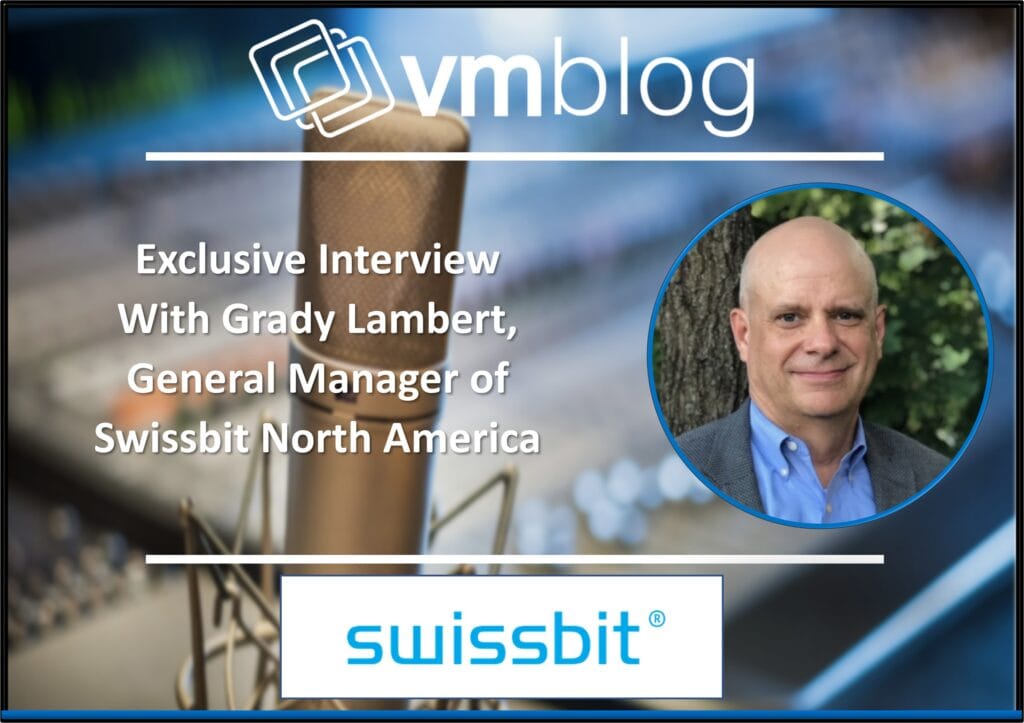
To dig into what’s behind the milestone, VMblog sat down with Grady Lambert, General Manager of Swissbit North America, who has spent over a decade with the company managing its SSD product range. Lambert walks us through the new N7000 and A2000 Series—covering everything from form factors and capacities to the architectural choices that set them apart—and explains why Swissbit’s vertically integrated manufacturing in Berlin gives customers in long-lifecycle industries a meaningful edge in supply chain resilience. Read on for the full conversation.
VMblog: Swissbit will be exhibiting at the Automate 2026 conference. Can you share the details of your presence, including where attendees can find you, and what your main focus is for the event?
Grady Lambert: We are very excited to showcase our latest technologies at Automate 2026 from June 22–25 at McCormick Place in Chicago. Attendees can visit us at booth #1074. As artificial intelligence continuously transitions from centralized data centers directly onto factory floors and distributed edge environments, industrial-grade storage has become a critical foundation for reliable automation infrastructure. Our focus is demonstrating how Swissbit storage ensures data integrity, consistent system performance, and long-term availability under harsh conditions like extreme temperatures, vibration, and unexpected power losses.
VMblog: Swissbit is celebrating its 25th anniversary this year. What new storage solutions are you previewing to mark this milestone and address modern edge demands?
Grady Lambert: To meet the evolving, data-intensive workloads of modern industrial and edge computing systems, we are previewing two core PCIe SSD series during our 25th anniversary year: the N7000 Series and the A2000 Series. The N7000 Series is a 4-channel PCIe SSD platform engineered to balance cost efficiency, reliability, and performance for next-generation boot drives. For higher-performance and low-latency deployments, such as server environments and edge AI, we are introducing the A2000 Series, which is an 8-channel PCIe Gen4/NVMe platform.
VMblog: Can you dive deeper into the technical specifications and use cases for the new N7000 and A2000 PCIe SSD Series?
Grady Lambert: Absolutely. The N7000 Series is designed primarily for lightweight workloads and reliable boot drives, featuring a DRAM-less controller design with Host Memory Buffer (HMB) for high responsiveness and integrated Power Loss Notification to safeguard data integrity during sudden power interruptions. It’s available in M.2 2280 and M.2 2242 form factors with capacities ranging from 80GB up to 4TB. On the other hand, the A2000 Series addresses the high-performance segment and is designed for demanding enterprise storage, networking infrastructure, advanced industrial systems, and edge AI applications. It uses an eight-NAND-channel, DRAM-based controller architecture together with a TLC direct firmware design, which helps deliver sustained performance, low latency, and low write amplification. At launch, the A2000 will be available in the M.2 2280 form factor with capacities from 480 GB to 4 TB, both with and without heatsink. Additional form factors, including E1.S and U.2, are planned for later this year, with capacities of up to 8 TB.
VMblog: Beyond these new PCIe SSD previews, what other industrial memory solutions is Swissbit highlighting for long-term system designs?
Grady Lambert: Alongside our PCIe previews, we are heavily emphasizing long-term design availability for industrial and embedded configurations. We are showcasing solder-down options, including e.MMC and PCIe BGA products, while also providing updates regarding our next-generation SATA platform. These solutions are designed specifically for long-lifecycle systems that require a strictly controlled bill of materials, dependable storage, and strategic availability planning for extended deployment timelines.
VMblog: Supply chain resilience is top of mind for many automated manufacturing industries. What is the key differentiator behind Swissbit’s manufacturing and backend processes that guarantees this security?
Grady Lambert: The key differentiator is the degree of control we have over our own manufacturing and back-end processes. Swissbit operates one of Europe’s few remaining high-volume production facilities for industrial storage in Berlin, Germany, and has been manufacturing there since 2002. In 2019, we expanded this capability with a new 10,000 m² facility including an integrated clean room, enabling advanced 3D semiconductor packaging and processing from 300 mm wafers.
For customers in automated manufacturing and other long-lifecycle industries, this vertical integration is a major advantage. A concrete example is our in-house NAND packaging capability for the new PCIe series. While many storage suppliers rely on external OSAT partners—outsourced semiconductor assembly and test providers—Swissbit covers key back-end assembly and test steps internally. This gives us greater transparency across raw materials, the bill of materials, production quality, and availability planning. As a result, we can reduce dependencies, strengthen supply-chain resilience, support faster lead times, and ensure long-term product availability through measures such as wafer banking.
##
About Grady Lambert
Grady Lambert is the General Manager of Swissbit North America, overseeing regional product development, sales, and marketing. Since joining Swissbit in 2014, he has held key R&D and business development roles in Westford, Massachusetts, managing their successful SSD product range. Previously, Lambert held technical leadership positions at SMART Modular and Centennial Technologies.