At VMware Explore Las Vegas, Broadcom made headlines by focusing heavily on private cloud infrastructure, a shift that resonated with many industry leaders and customers. In a cloud landscape often dominated by public cloud discussions, Broadcom’s strategy stands out for its emphasis on private environments, particularly through VMware Cloud Foundation (VCF). This approach directly addresses rising concerns over public cloud costs, migration challenges, and the increasing need for a consistent, secure cloud experience across both private and hybrid environments.
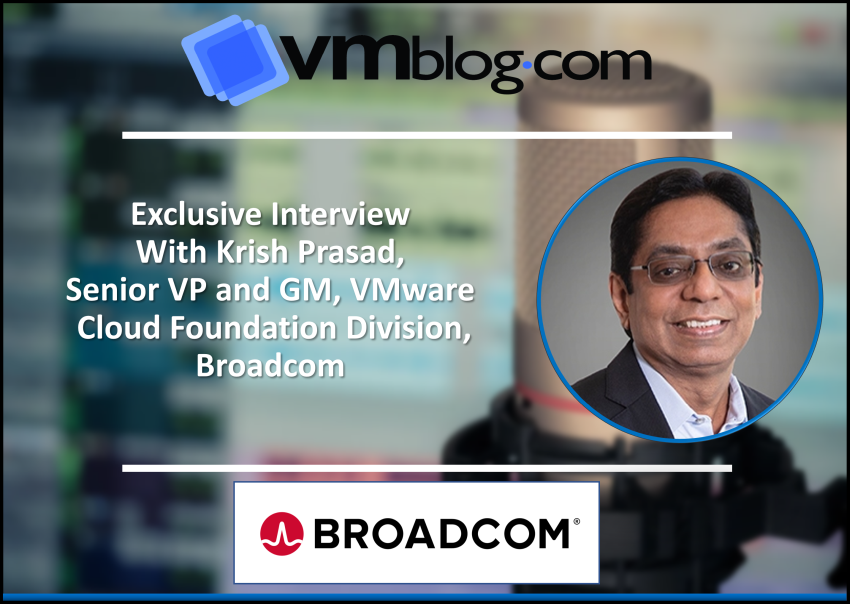
In this exclusive Q&A, VMblog sits down with Krish Prasad, Senior Vice President and General Manager of the Cloud Infrastructure Business Group at Broadcom, to explore the company’s rationale behind prioritizing private cloud as a core element of its strategy. Prasad provides insight into how Broadcom is reshaping the cloud ecosystem by modernizing private cloud environments, streamlining deployment, and addressing key enterprise challenges such as cost, complexity, and compliance. From the innovations within VCF 9 to their newly launched Private Cloud Modernization Program, Prasad explains how Broadcom is positioning itself as a leader in the next phase of cloud evolution.
Let’s dive in!
VMblog: At VMware Explore Las Vegas, there was a strong focus on private cloud infrastructure. What led Broadcom to prioritize private cloud as core to its cloud strategy?
Krish Prasad: Our decision to focus on private cloud infrastructure with VMware Cloud Foundation (VCF) was driven by evolving customer needs.
We felt it was critical to think about innovation for our customers not through the lens of incremental updates that deliver basic feature parity in the market, but rather with the goal of providing a more strategic solution designed to help enterprises succeed well into the future.
In working with partners and analysts across the industry, we consistently heard from customers that they were shifting from native public cloud to private infrastructure due to rising costs and migration challenges to the public cloud. They also emphasized the need for a consistent cloud experience across their “private” infrastructure -whether on-premises, at the edge, or using infrastructure from hyperscalers and service providers.
VMware Cloud Foundation addresses this by offering a unified, resilient, and secure private cloud platform that provides a similar experience to the public cloud, while operating on customers’ private infrastructure. By modernizing private cloud environments, VMware enables customers to tackle challenges around cost, complexity, and compliance, while accelerating their digital transformation.
VMblog: During your Explore session, you spoke about the “Three Transformations for the Smarter Way to Cloud.” Could you elaborate on the key transformations Broadcom implemented to deliver this new cloud platform?
Prasad: Yes, this was a three-pronged approach to transformation. First, we evolved ourselves internally by consolidating our technologies into a unified division, moving away from a siloed business unit structure. This allowed us to fully leverage Broadcom’s R&D investment and accelerate innovation, enabling us to deliver a more streamlined private cloud solution with VCF.
Then we focused on transforming the experience for our key stakeholders, including cloud administrators, developers and platform engineers, with the announcement of VCF 9. By evolving our flagship product to meet their specific needs, we’ll improve workflows and accelerate innovation.
Finally, we helped our customers transform and modernize their infrastructure. In tandem with VCF 9, we launched the Private Cloud Modernization Program to guide customers through their private cloud transformation. With VCF 9, customers will be able to run a wide range of workloads, from virtual machines and container-based applications to AI/ML tasks, within a unified cloud experience.
These changes have helped position us to deliver the best private cloud platform to accelerate innovation for our customers. While at the same time, working to solve IT’s growing challenges around cost, complexity, and compliance.
VMblog: How will VCF 9 make it faster and easier to deploy modern infrastructure?
Prasad: VCF 9 represents the next generation of VMware Cloud Foundation, designed to provide a more seamless and agile cloud experience. It will make it faster and easier to deploy modern infrastructure, deliver a cloud experience that provides frictionless consumption of resources, and enable uninterrupted operations, cyber resilience, and compliance.
To help customers modernize their infrastructure, VMware Cloud Foundation 9 will deliver capabilities that enable their infrastructure to operate as a single unified and automated system, help them keep pace with modern app requirements, and bring the advanced capabilities they already have from Broadcom into their private cloud platform.
First, VCF 9 will feature a self-service cloud portal for provisioning services and reduces more than a dozen management consoles to just one each for operations and automation. New integrated workflows will simplify the transition between operations and automation tasks, and enhanced insights and analytics will enable even more proactive management.
Next, the VCF platform will add the ability for customers to import VMware vSphere, VMware NSX, r and complex storage topologies into existing VCF environments, and use and integrate older versions of existing infrastructure.
Finally, a new memory tiering capability will significantly enhance data-intensive applications, such as AI, databases and real-time analytics, by reducing latency and accelerating data throughput. It will also make the storage of AI applications more cost-efficient and scalable.
VMblog: What are VMware Cloud Foundation Advanced Services, and how do they extend the platform’s capabilities?
Prasad: VMware Cloud Foundation Advanced Services is a catalog of ready-to-deploy solutions designed to meet specific needs and use cases. This lineup includes the following two key services:
- VMware Live Recovery, which provides a solution for rapid recovery from unplanned downtime, ensuring resilience and protection at all layers of the cloud platform.
- Private AI Foundation with NVIDIA, which offers a suite of tools to enhance secure and efficient AI deployments, including curated Model Store and Guided Deployment tools.
VMblog: What is Broadcom doing to help guide and support customers through their private cloud transformations?
Prasad: We know that there are many paths and steps to implementing a private cloud. That’s why we’re investing extensively to help guide and support customers through the process.
With our Cloud Maturity Model Assessment, VCF customers can use a comprehensive tool that defines current cloud maturity and derives desired cloud use cases. Our team then helps map customers’ desired business outcomes to specific use cases and deliver a prescriptive deployment plan to achieve the business outcomes.
Jumpstart Workshops help customers review their private cloud goals against their current cloud maturity level, evaluate their current architecture against their private cloud goals, and provide a tailored adoption plan to achieve the customers’ private cloud objectives.
Additionally, Broadcom’s new VMware Cloud Foundation certification exam allows IT teams to acquire in-demand skills aligned with current technology trends, make the transition to private cloud, reduce cloud costs, optimize resource usage, and maximize their VMware Cloud Foundation investment.
We’re also excited to be offering VCF customers unlimited complimentary access to the comprehensive VMware Cloud Foundation digital training library as well as instructor-led training to upskill and reskill teams via continuous learning.
Ultimately, we want to meet companies where they are in their unique journey to provide a phased approach to adopting and consuming VCF.
VMblog: How does VMware plan to continue innovating in the cloud space?
Prasad: As I mentioned, we recognize that our customers are at different stages of cloud maturity, and we want to meet them where they are in their journey. The transformations I discussed aren’t just about responding to change-they’re about anticipating it and positioning VMware to lead the industry. The three transformations represent a strategic shift toward a smarter, more agile cloud future.
We’re excited about what’s ahead and look forward to building the future of cloud together with our customers and partners.
##