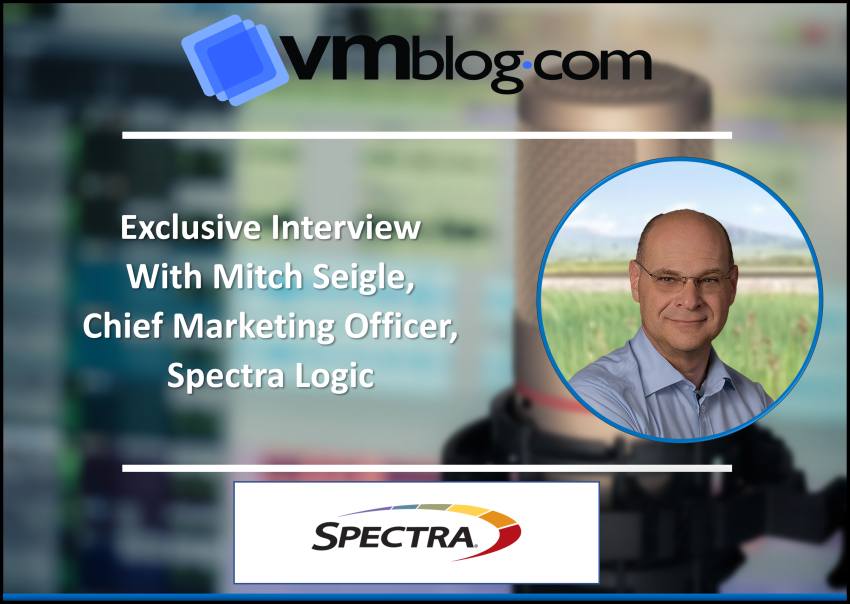
In an exclusive VMblog interview, Mitch Seigle, Chief Marketing Officer at Spectra Logic, unveils the company’s groundbreaking innovations in tape library technology. Spectra Logic has introduced two new solutions – LumOS software and the Spectra Cube library – designed to make tape storage more resilient, efficient, and cloud-friendly.
LumOS, Spectra Logic’s next-generation library management software, promises to extend the longevity of tape libraries almost indefinitely. Built on an extensible architecture, LumOS enhances reliability, ease of management, and performance, with operations up to 20 times faster than before. This software allows customers to retrofit existing TFinity libraries, ensuring their continued value for decades to come.
The Spectra Cube library, powered by LumOS, is a game-changer in the tape storage market. Engineered for seamless integration with cloud environments, Cube offers unparalleled ease of deployment, remote management, and serviceability. With its Ethernet connectivity and compatibility with S3 and S3 Glacier APIs, Cube enables organizations to leverage the benefits of tape storage, including cyber resilience, energy efficiency, and high-density storage, within their cloud infrastructures.
In this insightful Q&A session, Seigle dives into the capabilities of LumOS and Cube, addressing topics such as cloud integration, data sovereignty, ransomware protection, and the resurgence of tape storage in the face of ever-growing data volumes and emerging technologies like AI.
##
VMblog: Congratulations to Spectra Logic on your new product launches. Tell us about the first, your new LumOS software for tape libraries.
Mitch Seigle: Thank you, it’s a pretty exciting time for us.
LumOS library management software is our next-generation operating system for managing Spectra tape libraries. It’s a completely new library management platform, built on an extensible architecture that enables us to enhance and extend the longevity of our libraries almost indefinitely. This means that a Spectra library purchased today will be a reliable, useful IT asset for decades.
Unlike other storage infrastructure which typically becomes obsolete in a few short years, the primary mission of a library is the long-term preservation of data. To accomplish this, libraries must be engineered for longevity – a core competence for Spectra. We’re very proud of the fact that a Spectra library is often the oldest IT asset in use within a data center.
In addition to longevity, LumOS makes our libraries more reliable, easier to manage, and up to 20 times faster than before when performing typical library operations, such as monitoring, reporting, retrieving logs or managing partitions. It has an intuitive interface and a full REST API, so users can execute tasks from the front panel touchscreen or remotely via a web browser, as well as automate any task the library is capable of performing.
VMblog: How does the introduction of LumOS affect existing tape libraries? Is there a way for customers to retrofit?
Seigle: LumOS affects existing libraries in an incredibly positive way. We offer field upgrades for any existing TFinity library. This involves adding a new library control module and a display unit to support the LumOS software. Once an older library is upgraded, it is the virtual equivalent of a brand new TFinity Plus library. All the benefits of LumOS are then available to it, including its new features and support for future technology upgrades as they are introduced.
This gets back to my earlier point about longevity. With LumOS, a TFinity library installed 15 years ago can be upgraded to current standards and continue to deliver full value well into the next decade and beyond.
VMblog: In addition, Spectra Logic has also released a new tape library called Cube. Can you tell us about Cube and where it fits in Spectra’s line up of offerings?
Seigle: Our Spectra Cube library is an all-new design, powered by our LumOS software and centered on the idea of making tape technology much easier to consume in today’s cloud-centric world. Of course, it shares many field-proven components with its big brother, TFinity Plus, such as its robotics and the use of Spectra TeraPack magazines, which together allow it to deliver the fastest tape exchange rate of any library in its class.
But the real magic comes from its ability to easily integrate tape into cloud environments, whether they’re on-prem clouds, hybrid clouds, or as a foundational platform for delivery of storage services in the MSP or CSP world. For any deployment model, making things simple was a core design tenet for us.
The Spectra Cube library delivers on this in several ways:
First, by being easy to deploy – from unboxing to backups in typically less than four hours. If you use Spectra Certified Media with it, which we highly recommend, just insert your pre-loaded TeraPacks through the front access port and you’re good to go.
Second, it can be securely managed from anywhere using its touchscreen or a web browser – and it can be serviced by admin staff without tools or special training. If you can turn a thumbscrew, you can easily replace a component in a few minutes, without taking the library offline or powering it down. Of course, we’re more than happy to do any servicing for you, but in the cloud world things can be pretty dynamic so we make it easy to self-service, including adding capacity or upgrading performance on the fly.
Finally, the Spectra Cube library integrates seamlessly with our BlackPearl object storage platform to provide the ability to read and write to tape using S3 or S3 Glacier APIs. This makes it easy to add a tier of object-based tape to a cloud and get the intrinsic benefits of tape in terms of cyber resilience, energy efficiency and storage density. We’ve also enabled Ethernet connectivity for the data path so there’s no need to maintain a legacy fibre channel SAN just to support tape.
All of these Spectra Cube attributes translate into big TCO savings compared to flash, disk or public cloud storage options when storing data at scale over a long time horizon.
VMblog: Cube is designed for clouds? Isn’t the tape paradigm about options instead of the cloud?
Seigle: When we say that Spectra Cube is designed for clouds, we’re talking about all forms of clouds, not just the public cloud – which is the typical context when people talk about “the cloud.” On-premises clouds and hybrid clouds are bona fide clouds too, and modern tape libraries such as the Spectra Cube library fit very nicely into that paradigm.
With respect to public clouds, it’s equally at home serving as the storage infrastructure behind MSP or CSP delivery of storage services. In addition to cloud deployment models, the library can support many traditional applications that write files or objects to tape. So, these are just a few examples of use cases that are a great fit for the Spectra Cube.
VMblog: I understand you provide a lifetime guarantee on tape media. How is that possible?
Seigle: Yes, we do guarantee our Spectra Certified Media for life. We can offer this guarantee because of the patented process we use to pre-clean the media before it ever touches a tape head, followed by a full write/read pass over the entire length of the tape. The net result is we don’t ship tapes that don’t pass our stringent requirements, which means our certified media failure rates in the field are very low. And if a tape should ever fail, we make it fast and easy to get a replacement.
In addition, by certifying tape media before first use, we’re able to establish a baseline set of metrics for each tape that we then track throughout its lifetime to monitor its health, which allows us to identify when it’s time to replace a tape before a failure occurs. This is an important part of our pledge to preserve data – which starts by making sure any potential media issues are minimized so that data protection is maximized.
VMblog: We’re really seeing a resurgence in the interest and acquisition of tape. Can you tell us why?
Seigle: There’s a confluence of several trends behind the renewed interest we’re seeing:
The first is the existential threat that organizations are facing from ransomware. Tape offers a clear defense against this threat through air-gapping, which is the ability to isolate data stored on tape, making it inaccessible and impermeable to attacks conducted over the internet.
Next, there is the relentless growth of data being stored in the cloud. We hear from many customers about the painfully growing cost of storing backup or archive data in the cloud. Exacerbating this are significant charges when later accessing that data or moving it to another cloud provider. Modern tape with seamless cloud integration can reduce or eliminate ongoing cloud storage costs and avoid egress fees altogether, making it an attractive alternative.
Data sovereignty is another reason tape is growing in popularity. The cloud has created uncertainty about sovereignty, potentially exposing data owners to unwanted regulation or taxation based on where their data resides, not where it is created or used. Storing data on-premises is one method for assuring you are in control of your data’s residency and therefore its sovereignty.
Lastly, the rise of AI is already resulting in regulation, which may ultimately lead to massive amounts of data that must be preserved for compliance and discovery purposes. The jury is still out on exactly how or when this may happen, but it is not hard to imagine that it will happen. Tape continues to be the most economical means of storing and managing such large volumes of data, so the relevance of tape will only grow going forward.
##