As enterprises race to deploy AI workloads and navigate increasingly complex multi-cloud environments, their network infrastructure has become a critical bottleneck�and a glaring blind spot. Unlike other mission-critical systems that rely on rigorous testing and validation before changes go live, networking has long operated on a “hope-and-rollback” approach, where configuration changes hit production first and problems are discovered only after outages occur. In an era where network reliability directly impacts business outcomes, this reactive model is no longer sustainable.
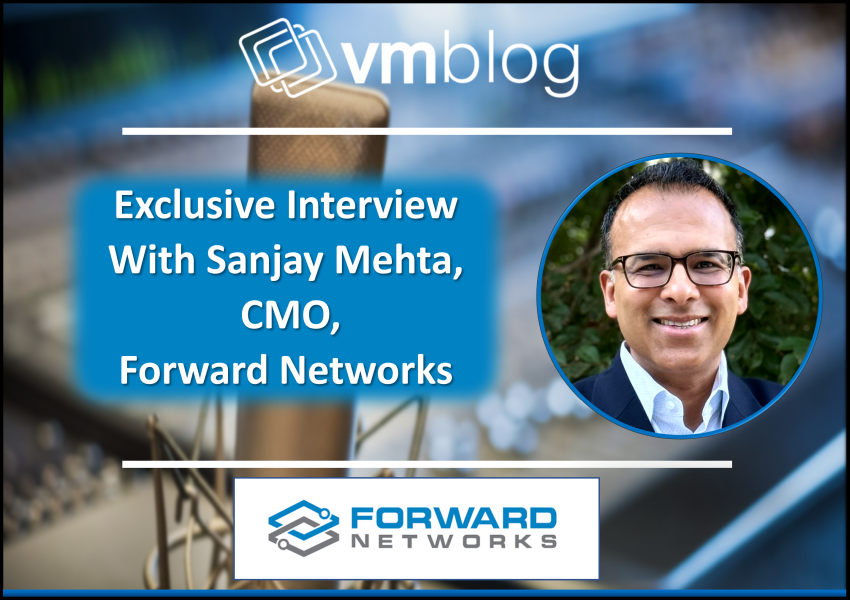
Sanjay Mehta, the newly appointed Chief Marketing Officer at Forward Networks, has spent his career at the intersection of infrastructure and security, holding leadership positions at Splunk, ThousandEyes, and Cisco. Now he’s championing a technology that promises to bring the same mathematical precision used in healthcare clinical trials and aviation simulations to enterprise networking: the network digital twin. In this exclusive VMblog interview, Mehta explains why AI workloads are creating unprecedented pressure on network infrastructure, how legacy monitoring tools fall short in today’s heterogeneous environments, and why Forward Networks customers are reporting an average of $14.2 million in annual ROI by validating changes before they reach production. As agentic operations and AI-driven automation reshape IT, the digital twin may represent the foundation that makes it all possible.
++
VMblog: What drew you to Forward Networks at this particular moment in your career, and what excites you most about leading its global marketing strategy?
Sanjay Mehta: I’ve spent my career at the leading edge of critical operations-at Splunk, ThousandEyes, and Cisco-always at the intersection of infrastructure and security. These are the lifeblood of every organization, and each wave of technology has brought seismic shifts: from mobile and the internet, to cloud, and now AI. I’ve always been drawn to companies that help organizations perfect how they run their infrastructure and operations as the stakes rise.
When David Erickson, Forward’s CEO and co-founder, introduced me to the company, the vision immediately resonated. Forward was founded by four Stanford PhDs with a transformative idea: the network digital twin. Every other high-stakes field validates change before it goes live-clinical trials in healthcare, test harnesses in software, simulations in aviation and automotive. Networking has been the outlier, where configuration changes hit production first, backed only by manual reviews and a hope-and-rollback mindset. In 2025, that’s simply indefensible.
Forward solves this. The digital twin brings mathematical precision and confidence to networking, giving enterprises the ability to model, validate, and secure before production. That’s the opportunity I see-helping organizations run their networks with the same rigor and discipline as other critical systems, but with a new level of speed and confidence.
VMblog: Why is the time right for network digital twin technology?
Mehta: The impact is clear. Forward Networks customers report an average of $14.2M in annual ROI through faster issue resolution and fewer outages. This is a must-have for CIOs who need their organizations to be secure, resilient, and efficient in a world where network reliability is mission-critical.
A mathematically precise model of the network changes the game. It exposes noncompliance and misconfigurations before they cause problems, and it automates routine tasks that were once too complex or manual. CIOs gain confidence that their networks are compliant, free of hidden vulnerabilities, and optimized for connectivity. The network digital twin is continuously verifying configuration, state, and behavior against the desired outcome-driving performance, reliability, and security.
VMblog: Can you tell us more about why networks are under pressure from AI, agentic operations, and digital transformation? From your perspective, how are these forces reshaping enterprise infrastructure challenges?
Mehta: AI is both a catalyst for change and a source of new pressure on networks. On the demand side, AI training and inference require massive distributed compute. That creates entirely new traffic patterns: enterprises are used to managing North-South traffic, but AI workloads drive enormous East-West traffic across data centers, between GPU clusters, and out to multi-cloud environments. This shift puts unprecedented strain on networks for bandwidth, latency, and reliability-at the very moment when environments are more distributed and complex than ever.
On the supply side, AI also offers an opportunity. It enables IT and NetOps leaders to glean insights buried in data and automate decisions that were previously manual. Gartner calls this shift agentic operations-autonomous, policy-driven systems with humans “on the loop,” not “in every loop.” But for AI to be effective in operations, it needs an accurate and trusted source of network truth.
That’s where Forward Networks comes in. Its network digital twin provides the mathematical certainty enterprises need to navigate this moment. It ensures infrastructure is configured, secure, and ready to support AI-driven demands. And it gives organizations the reliable data foundation required to implement agentic operations at scale-turning AI from a source of stress into a driver of resilience and efficiency.
VMblog: Legacy tools are described as inadequate for today’s operations. Can you explain why a digital twin is different, and why it’s needed now?
Mehta: Legacy tools were built to solve the problems of their time, often by hardware vendors or cloud providers focused on their own platforms. They served a purpose, but the result is a fragmented set of single-issue, vendor-specific tools that don’t reflect today’s heterogeneous, multi-cloud networks. Teams still struggle with long troubleshooting cycles, disconnected data, and reactive war rooms-modern approaches have helped, but they haven’t eliminated the risk of untested changes hitting production.
Forward Networks started by rethinking the problem at a fundamental level. The network digital twin is a searchable, single source of truth-engineers can query it like a Google search. Data from across vendors and clouds is automatically normalized and presented intuitively, so teams don’t need to be experts in every platform to gain deep, accurate insights. Instead of stitching together disparate tools and formats, they can instantly verify and visualize network behavior in a way that makes sense to anyone, from junior engineers to senior architects.
That’s the breakthrough: a digital twin is the modern approach for critical operations-bringing precision, predictability, and confidence to the heart of the enterprise.
VMblog: You helped build and scale ThousandEyes before its acquisition by Cisco. What lessons from that experience will you bring to Forward Networks’ next phase of growth?
Mehta: I’ve always been drawn to category creation-new disciplines that emerge as environments become more complex, distributed, and urgent. What drives me is seeing technology enable organizations to deliver on their mission, whether that’s serving patients, citizens, consumers, or businesses. When operations teams are empowered, entire industries move forward.
Building and scaling a team starts with that belief: that our mission is to help customers succeed. It’s about creating an organization oriented around customer impact, not just technology. Having lived through multiple market cycles, I’ve learned it’s never about clinging to the past-it’s about applying experience to make the right decisions for the moment. I’m excited to bring that perspective to Forward Networks as we help organizations everywhere gain operational advantage with a network digital twin.
##