Industry executives and experts share their predictions for 2025. Read them in this 17th annual VMblog.com series exclusive.
By Eran Kirzner, Co-Founder and CEO, Lightbits Labs
As cloud computing advances, cloud architecture is gaining significant momentum in data centers many organizations are shifting workloads back to on-premises1, modernizing their data center, or creating new specialized cloud services businesses2. With cloud IT infrastructure spending expected to reach $134 billion by 20263, storage will play a crucial role in supporting new technologies. Here are four major trends shaping cloud storage in 2025.
1. Accelerated growth in cloud storage services and on-premises cloud-architectures
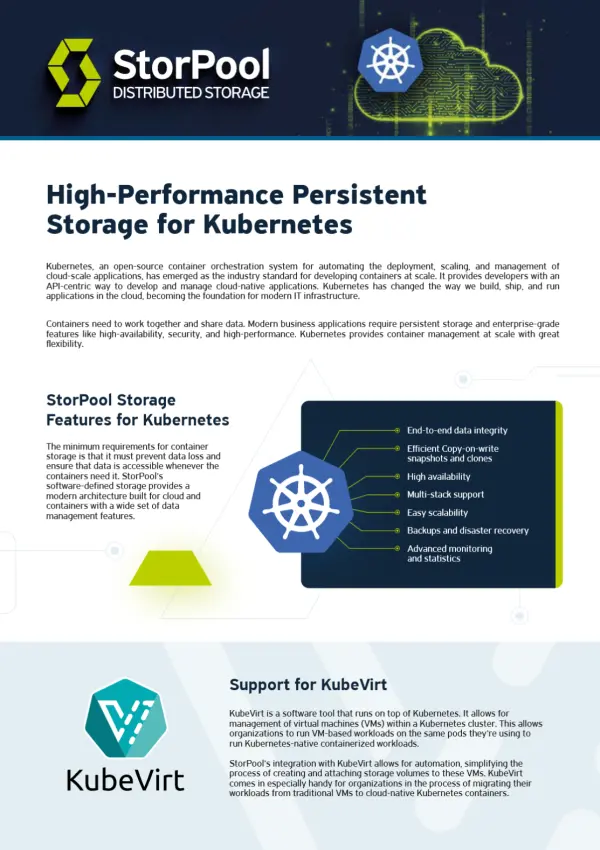
Companies are increasingly adopting cloud-like architectures on-premises to gain the efficiency, scalability, and automation benefits of public cloud. Technologies like software-defined storage and open-source tools (e.g., Kubernetes, OpenShift, OpenStack) are key enablers of this shift. As companies continue to evaluate alternatives to VMware with a need to deal with data center costs, coupled with increasing power consumption and environmental concerns, are pushing organizations to explore these more modern solutions. These solutions allow organizations to balance growing performance-sensitive application needs with cost containment and sustainability. Industries like financial services, CSPs, MSPs, biotech, pharma, and AI-driven fields, which require high performance and low latency, are leading this trend.
Concurrently, the global cloud storage market is projected to experience significant growth, reaching $234.9B and 18.8% CAGR by 20284. This growth is driven by increasing data generation from digitalization and a growing demand for data accessibility. Tier-2 CSPs and MSPs will gain market share by offering regional, specialized services to meet regulatory requirements.
As these parallel trends unfold, the future of storage will be shaped by the dual demands for cloud services innovation and efficient, on-premises solutions that empower organizations to stay agile and competitive.
2. Adoption of ‘Shared Everything’ and NVMe-Everywhere
I predict NVMe-oF will continue to gain momentum as a Tier-1 storage protocol. I talk with more organizations today seeking to replace iSCSI and FiberChannel to support their performance-hungry cloud-native applications. Organizations are moving towards “shared everything” architectures, where each node in a cluster can access all available resources, including storage and processors. This shift supports the dynamic allocation of resources based on workload needs, making storage systems more flexible and powerful. NVMe-based architectures will be the backbone of high-performance cloud storage in 2025.
3. Block storage becomes the foundation for database workloads in the AI/ML data pipelines
Block storage is emerging as a building block enabling AI/ML data pipelines, especially in applications like retrieval-augmented generation (RAG). In RAG models, data gets “vectorized” into a database, where each vector will have some specific meaning that can be searched semantically and contextually. The vector data can, in most cases, reside in a server, VM, or container pod’s memory, but this creates problems. One problem is that memory is volatile. The other problem is that, as vector databases grow in scale (with new datasets like videos, calling centers recording, images, etc.) they cannot fit into memory anymore and you need fast (low latency) storage to support this new architecture.
Software-defined block storage that is attuned to the performance and scalability requirements of AI, such as my company’s solution, will not slow down your GenAI application once you start embedding more data at scale. As RAG applications increase in use, organizations will increasingly rely on block storage to optimize AI workflows, accelerate model training, and boost database performance.
I speak to a lot of organizations using block storage as a cache in their AI/ML pipelines, especially for real-time analytics, where it can enhance performance without compromising data availability and scalability. Using block storage as a caching layer can reduce the need to store all data in high-performance, expensive memory solutions, striking a better balance between performance and cost.
4. The Growing Role of Storage in Cybersecurity
Research has found that 48% of organizations have experienced cyber extortion, making it more common than ransomware in 2024.5 The role of storage in cybersecurity cannot be underestimated. The role of storage as an enabler of capacity and performance will expand to include enabling organizations to safeguard sensitive information.
As data privacy regulations grow more complex, demand for secure-by-design storage solutions will increase. This will drive demand for more comprehensive data protection solutions. Storage systems must evolve to include advanced security measures, such as encryption in transit and at rest across distributed networks, and zero-trust architectures baked directly into the storage layer will become more prevalent in 2025. Cloud providers and storage vendors will emphasize secure data management as a key capability to build trust and confidence that their customer’s data is safe.
The Rise of Cloud Architecture
The year ahead will bring a renewed focus on storage architecture strategies that will put the spotlight on both cloud and on-premises solutions that are secure by design. Given how integral the relationship between data availability and high-speed storage performance has become to meet growing organizational demands, infrastructure management will take on new levels of importance in the coming months as cloud storage becomes a key enabler for innovation. Clearly, the cloud storage landscape will be shaped by the need for scalable, secure, and high-performance solutions that enable organizations to innovate and stay competitive.
##
ABOUT THE AUTHOR

Eran Kirzner is the co-founder and CEO of Lightbits Labs. Prior to Lightbits, Eran worked for PMC-Sierra, Wintegra and Freescale in various storage, compute and data communications roles. He holds patents in communication, QOS, processors architecture, flash, media-management and storage systems. He holds bachelor’s and master’s degrees in computer and electrical engineering from the Universitat Ben Gurion Ba-Negev and Tel Aviv University, respectively.
##
1 AWS claims customers are packing bags and heading back on-prem, The Register, September 17, 2024.
2 Nebul Delivers a Powerful AI Cloud Data Platform That’s Sovereign to the EU, Lightbits Labs
3 Annual spending on cloud IT infrastructure worldwide from 2023 to 2026, Statista, May 2024.
4 Cloud Storage market by Storage Type – Global Forecast to 2028, Markets and Markets, October 2024.
5 State of Security 2024, Splunk, October 2024