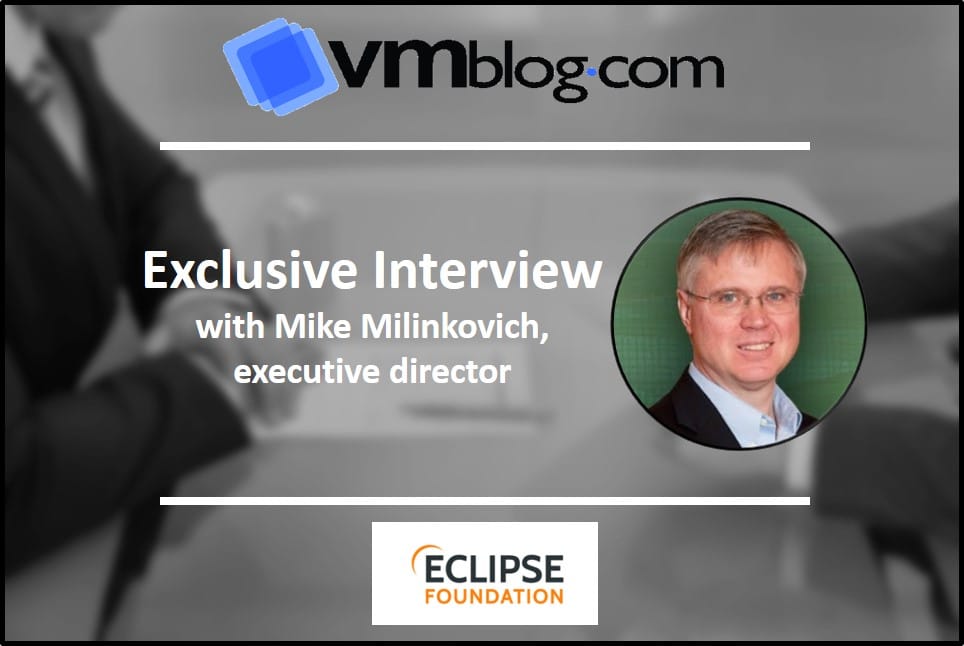
This is my first interview with Mike Milinkovich, the head of the Eclipse Foundation, home to more than 350 open source projects, including the Eclipse IDE for Java. When Oracle handed over stewardship of the future of Java EE to the Eclipse Foundation last year, many of our readers were curious about the cloud implications. Java EE was seen by many as not the best choice for cloud native architectures. That may change now.
Today there are many ways to move Java workloads into the cloud, including AWS, but the Eclipse Foundation is committed to a cloud native future for Java EE under the new brand name of Jakarta EE. I asked Mike to tell more about their plans and a recent survey his organization completed gathering the opinions of more than 1,800 Java developers on their hopes for Java going forward.
VMblog: So tell me what you learned from your survey?
Mike Milinkovich: We’re happy to kick off Jakarta EE by getting input from the Java community. That’s a new approach for Java EE and we hope an important signal to developers that we want them involved now and value their opinions. They are peers with the large vendors also participating in the new project.
What we learned is that developers most want better support for microservices and native integration with Kubernetes. The third biggest ask was to pick up the pace of innovation. These will be priorities for our working group. They align with what we saw as our mission in the first place with Jakarta EE.
VMblog: Any surprises in your survey findings?
Milinkovich: It turns out that developers were already doing a lot with Java building what we would call cloud native applications. We want to make their work easier with Jakarta EE. Nearly half of the developers surveyed are already building microservices with another 21 percent planning to join in the next year. Only 20 percent are running Java applications in the cloud today, however. At the same time, nearly 60 percent already think Java EE is suitable for cloud deployments and a third are already working with Kubernetes. The Java community hasn’t been standing still when it comes to microservices, clearly. One clear example is Eclipse MicroProfile, an open source baseline platform definition led by IBM, Red Hat and Oracle that optimizes Java EE for a microservices architecture by slimming it down. Already 15 percent of the developers surveyed are using MicroProfile even though the project was only announced last year.
VMblog: Why all this effort around Java when so many newer languages are arguably already cloud native?
Milinkovich: Sometimes it’s easy to take for granted a technology like Java EE that most enterprises IT organizations rely on to run their most critical applications. In the survey half of the respondents estimated that up to 80 percent of their enterprise workloads are applications written in Java. Clearly there is significant room for improvement when it comes to attracting organizations to embrace the latest and greatest Java innovations. That’s why we’re excited about Jakarta EE. There are an estimated 14 million Java developers today. Our survey found that the primary reasons organizations continue to rely on Java EE are stability (22%), specifications (21%) and, not to be overlooked, the actual availability of Java developers (19%). Jakarta EE is about defining the future of Java in the enterprise, especially when it comes to building cloud native applications.
##